


Page 360 - Clinical Application of Mechanical Ventilation
P. 360
326    Chapter 11


                      EFFECTS OF FLOW, CIRCUIT, AND LUNG
                      CHARACTERISTICS ON PRESSURE-TIME WAVEFORMS


                                            Flow and Transairway Pressure


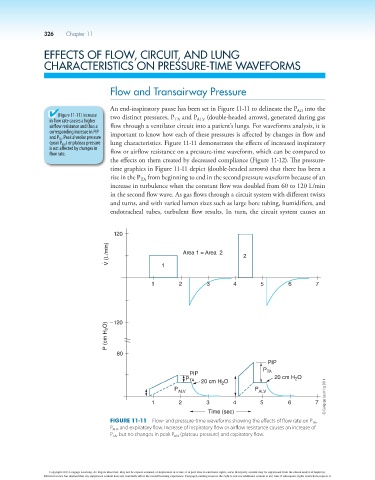
                                            An end-inspiratory pause has been set in Figure 11-11 to delineate the P  into the
                                                                                                         AO
                          (Figure 11-11) Increase   two distinct pressures, P  and P   (double-headed arrows), generated during gas
                        in flow rate causes a higher             TA     ALV
                        airflow resistance and thus a   flow through a ventilator circuit into a patient’s lungs. For waveforms analysis, it is
                        corresponding increase in PIP   important to know how each of these pressures is affected by changes in flow and
                        and P TA . Peak alveolar pressure
                        (peak P ALV ) or plateau pressure   lung characteristics. Figure 11-11 demonstrates the effects of increased inspiratory
                        is not affected by changes in   flow or airflow resistance on a pressure-time waveform, which can be compared to
                        flow rate.
                                            the effects on them created by decreased compliance (Figure 11-12). The pressure-
                                            time graphics in Figure 11-11 depict (double-headed arrows) that there has been a
                                            rise in the P  from beginning to end in the second pressure waveform because of an
                                                      TA
                                            increase in turbulence when the constant flow was doubled from 60 to 120 L/min
                                            in the second flow wave. As gas flows through a circuit system with different twists
                                            and turns, and with varied lumen sizes such as large bore tubing, humidifiers, and
                                            endotracheal tubes, turbulent flow results. In turn, the circuit system causes an


                                             120

                                           V (L/min)        1      Area 1 = Area  2    2


                                                         1        2        3        4        5        6        7


                                          P (cm H 2 O)  2120


                                              80
                                                                                               PIP
                                                                                             P
                                                                     PIP                       TA
                                                                    P TA  20 cm H O              20 cm H O
                                                                                                        2
                                                                                2
                                                                 P                         P
                                                                  ALV                       ALV
                                                         1        2        3        4        5        6        7  © Cengage Learning 2014
                                                                            Time (sec)
                                            Figure 11-11  Flow- and pressure-time waveforms showing the effects of flow rate on P TA ,
                                            P ALV , and expiratory flow. Increase of inspiratory flow or airflow resistance causes an increase of
                                            P TA , but no changes in peak P ALV  (plateau pressure) and expiratory flow.


                        Copyright 2013 Cengage Learning. All Rights Reserved. May not be copied, scanned, or duplicated, in whole or in part. Due to electronic rights, some third party content may be suppressed from the eBook and/or eChapter(s).
                      Editorial review has deemed that any suppressed content does not materially affect the overall learning experience. Cengage Learning reserves the right to remove additional content at any time if subsequent rights restrictions require it.

