


Page 378 - Clinical Application of Mechanical Ventilation
P. 378
344    Chapter 11


                                            V (L/min)  120  A                      B


                                                         2        4        6        8       10       12       14
                                             260
                                            P (cm H 2 O)  40                  a                              b


                                                                                                                  © Cengage Learning 2014


                                                         2        4        6        8       10       12       14
                                                                            Time (sec)
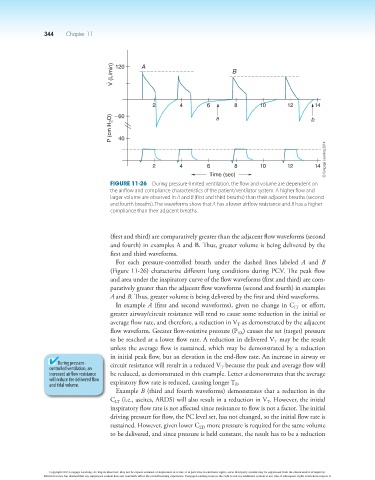
                                            Figure 11-26  During pressure-limited ventilation, the flow and volume are dependent on
                                            the airflow and compliance characteristics of the patient/ventilator system. A higher flow and
                                            larger volume are observed in A and B (first and third breaths) than their adjacent breaths (second
                                            and fourth breaths). The waveforms show that A has a lower airflow resistance and B has a higher
                                            compliance than their adjacent breaths.


                                            (first and third) are comparatively greater than the adjacent flow waveforms (second
                                            and fourth) in examples A and B. Thus, greater volume is being delivered by the
                                            first and third waveforms.
                                             For  each  pressure-controlled  breath  under  the  dashed  lines  labeled  A  and  B
                                            (Figure 11-26) characterize different lung conditions during PCV. The peak flow
                                            and area under the inspiratory curve of the flow waveforms (first and third) are com-
                                            paratively greater than the adjacent flow waveforms (second and fourth) in examples
                                            A and B. Thus, greater volume is being delivered by the first and third waveforms.
                                             In example A (first and second waveforms), given no change in C  or effort,
                                                                                                        LT
                                            greater airway/circuit resistance will tend to cause some reduction in the initial or
                                            average flow rate, and therefore, a reduction in V  as demonstrated by the adjacent
                                                                                     T
                                            flow waveform. Greater flow-resistive pressure (P ) causes the set (target) pressure
                                                                                     TA
                                            to be reached at a lower flow rate. A reduction in delivered V  may be the result
                                                                                                 T
                                            unless the average flow is sustained, which may be demonstrated by a reduction
                                            in initial peak flow, but an elevation in the end-flow rate. An increase in airway or
                          During pressure-  circuit resistance will result in a reduced V  because the peak and average flow will
                        controlled ventilation, an                              T
                        increased airflow resistance   be reduced, as demonstrated in this example. Letter a demonstrates that the average
                        will reduce the delivered flow   expiratory flow rate is reduced, causing longer T .
                        and tidal volume.                                           E
                                             Example B (third and fourth waveforms) demonstrates that a reduction in the
                                            C  (i.e., ascites, ARDS) will also result in a reduction in V . However, the initial
                                                                                               T
                                             LT
                                            inspiratory flow rate is not affected since resistance to flow is not a factor. The initial
                                            driving pressure for flow, the PC level set, has not changed, so the initial flow rate is
                                            sustained. However, given lower C , more pressure is required for the same volume
                                                                         LT
                                            to be delivered, and since pressure is held constant, the result has to be a reduction


                        Copyright 2013 Cengage Learning. All Rights Reserved. May not be copied, scanned, or duplicated, in whole or in part. Due to electronic rights, some third party content may be suppressed from the eBook and/or eChapter(s).
                      Editorial review has deemed that any suppressed content does not materially affect the overall learning experience. Cengage Learning reserves the right to remove additional content at any time if subsequent rights restrictions require it.

