


Page 395 - Clinical Application of Mechanical Ventilation
P. 395
Ventilator Waveform Analysis  361


                                             PIP (from 30 to 40 cm H O) is proportionate to the increase in P ALV  (from 25 to
                                                                    2
                            (Figure 11-39) A decrease   35 cm H O) that is caused by the reduction in C . The P  gradient throughout
                          in C LT  causes the pressure-  2                              LT      TA
                          volume loop to shift toward the   inspiration (and between PIP and peak P ALV ) is held constant. P  is affected by
                                                                                                      TA
                          pressure axis.
                                             changes in resistance, not by the changes in C .
                                                                                     LT
                                               It is essential to note that on some ventilators (e.g., Servo 300), pressure and
                                             volume may be assigned to the y- and x-axis, respectively. A reduction in C  would
                                                                                                            LT
                                             shift the PVL up and to the left (i.e., toward the pressure axis).
                            (Figure 11-39) A decrease
                          in C LT  will not affect the P TA
                          because the PIP- P ALV  gradient
                          (P TA ) remains unchanged.  Effect of Airflow Resistance on PVL
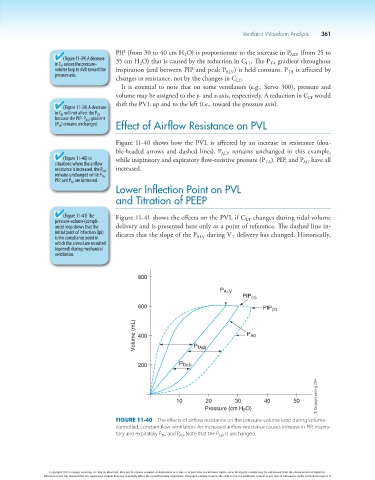
                                             Figure 11-40 shows how the PVL is affected by an increase in resistance (dou-
                                             ble-headed  arrows  and  dashed  lines).  P ALV   remains  unchanged  in  this  example,
                            (Figure 11-40) In   while inspiratory and expiratory flow-resistive pressure (P ), PIP, and P  have all
                          situations where the airflow                                        TA           AO
                          resistance is increased, the P ALV    increased.
                          remains unchanged while P TA ,
                          PIP, and P AO  are increased.
                                             Lower Inflection Point on PVL

                                             and Titration of PEEP


                            (Figure 11-41) The   Figure 11-41 shows the effects on the PVL if C  changes during tidal volume
                          pressure-volume (compli-                                      LT
                          ance) loop shows that the   delivery and is presented here only as a point of reference. The dashed line in-
                          initial point of inflection (Ipi)   dicates that the slope of the P   during V  delivery has changed. Historically,
                          is the compliance point in                    ALV        T
                          which the alveoli are recruited
                          (opened) during mechanical
                          ventilation.


                                                     800
                                                                               P ALV
                                                                                       PIP (1)
                                                     600                                     PIP (2)

                                                    Volume (mL)  400   P TA(2)          P A0


                                                     200          P TA(1)

                                                                                                               © Cengage Learning 2014


                                                                 10        20       30        40       50
                                                                          Pressure (cm H O)
                                                                                       2
                                             Figure 11-40  The effects of airflow resistance on the pressure-volume loop during volume-
                                             controlled, constant flow ventilation. An increased airflow resistance causes increase in PIP, inspira-
                                             tory and expiratory P TA , and P AO . Note that the P ALV  is unchanged.


                        Copyright 2013 Cengage Learning. All Rights Reserved. May not be copied, scanned, or duplicated, in whole or in part. Due to electronic rights, some third party content may be suppressed from the eBook and/or eChapter(s).
                      Editorial review has deemed that any suppressed content does not materially affect the overall learning experience. Cengage Learning reserves the right to remove additional content at any time if subsequent rights restrictions require it.

