


Page 397 - Clinical Application of Mechanical Ventilation
P. 397
Ventilator Waveform Analysis  363


                                                     800


                                                                                      1        2
                                                     600

                                                   Volume (mL)  400                          Point of Upper Inflection


                                                     200                             P ALV
                                                                                                                © Cengage Learning 2014


                                                                10      20       30      40      50      60
                                                                          Pressure (cm H O)
                                                                                      2
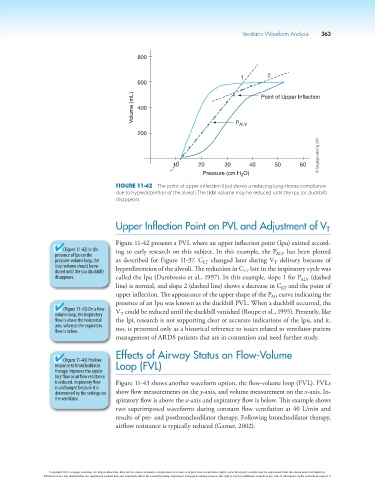
                                             Figure 11-42  The point of upper inflection (Ipu) shows a reducing lung-thorax compliance
                                             due to hyperdistention of the alveoli. The tidal volume may be reduced until the Ipu (or duckbill)
                                             disappears.


                                             Upper Inflection Point on PVL and Adjustment of V                    T


                                             Figure 11-42 presents a PVL where an upper inflection point (Ipu) existed accord-
                            (Figure 11-42) In the   ing to early research on this subject. In this example, the P   has been plotted
                          presence of Ipu on the                                                  ALV
                          pressure-volume loop, the   as described for Figure 11-37. C  changed later during V  delivery because of
                                                                          LT
                                                                                                 T
                          tidal volume should be re-  hyperdistention of the alveoli. The reduction in C  late in the inspiratory cycle was
                          duced until the Ipu (duckbill)                               LT
                          disappears.        called the Ipu (Dambrosio et al., 1997). In this example, slope 1 for P ALV  (dashed
                                             line) is normal, and slope 2 (dashed line) shows a decrease in C  and the point of
                                                                                                   LT
                                             upper inflection. The appearance of the upper shape of the P  curve indicating the
                                                                                                AO
                                             presence of an Ipu was known as the duckbill PVL. When a duckbill occurred, the
                            (Figure 11-43) On a flow-  V  could be reduced until the duckbill vanished (Roupe et al., 1995). Presently, like
                          volume loop, the inspiratory   T
                          flow is above the horizontal   the Ipi, research is not supporting clear or accurate indications of the Ipu, and it,
                          axis, whereas the expiratory   too, is presented only as a historical reference to issues related to ventilator-patient
                          flow is below.
                                             management of ARDS patients that are in contention and need further study.
                                             Effects of Airway Status on Flow-Volume
                            (Figure 11-43) Positive
                          response to bronchodilator   Loop (FVL)
                          therapy improves the expira-
                          tory flow as airflow resistance
                          is reduced. Inspiratory flow   Figure 11-43 shows another waveform option, the flow-volume loop (FVL). FVLs
                          is unchanged because it is
                          determined by the settings on   show flow measurements on the y-axis, and volume measurement on the x-axis. In-
                          the ventilator.    spiratory flow is above the x-axis and expiratory flow is below. This example shows
                                             two superimposed waveforms during constant flow ventilation at 40 L/min and
                                             results of pre- and postbronchodilator therapy. Following bronchodilator therapy,
                                             airflow resistance is typically reduced (Garner, 2002).


                        Copyright 2013 Cengage Learning. All Rights Reserved. May not be copied, scanned, or duplicated, in whole or in part. Due to electronic rights, some third party content may be suppressed from the eBook and/or eChapter(s).
                      Editorial review has deemed that any suppressed content does not materially affect the overall learning experience. Cengage Learning reserves the right to remove additional content at any time if subsequent rights restrictions require it.

