


Page 393 - Clinical Application of Mechanical Ventilation
P. 393
Ventilator Waveform Analysis  359


                                                0.8
                                              V (L)


                                                           2        4         6        8        10       12
                                              V (L/m)  60


                                                           2        4         6        8       10        12
                                              P (cm H 2 O)  40


                                                                                                                    © Cengage Learning 2014


                                                           2        4        6        8        10        12
                                                                             Time (sec)
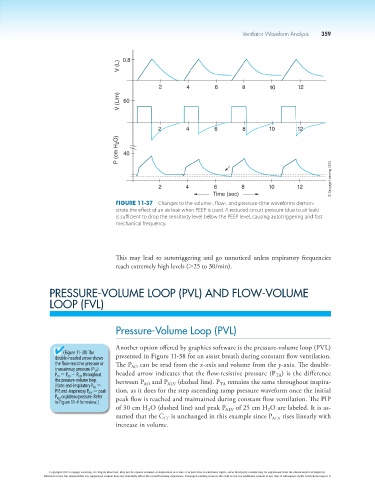
                                             Figure 11-37  Changes to the volume-, flow-, and pressure-time waveforms demon-
                                             strate the effect of an air leak when PEEP is used. A reduced circuit pressure (due to air leak)
                                             is sufficient to drop the sensitivity level below the PEEP level, causing autotriggering and fast
                                             mechanical frequency.


                                             This may lead to autotriggering and go unnoticed unless respiratory frequencies
                                             reach extremely high levels (.25 to 30/min).


                        PRESSURE-VOLUME LOOP (PVL) AND FLOW-VOLUME

                        LOOP (FVL)


                                             Pressure-Volume Loop (PVL)


                                             Another option offered by graphics software is the pressure-volume loop (PVL)
                            (Figure 11-38) The
                          double-headed arrow shows   presented in Figure 11-38 for an assist breath during constant flow ventilation.
                          the flow-resistive pressure or   The P  can be read from the x-axis and volume from the y-axis. The double-
                          transairway pressure (P TA ).   AO
                          P TA  5 P AO  2 P ALV  throughout   headed arrow indicates that the flow-resistive pressure (P ) is the difference
                                                                                                  TA
                          the pressure-volume loop.   between P  and P   (dashed line). P  remains the same throughout inspira-
                          [Note: end-inspiratory P AO  5   AO  ALV             TA
                          PIP, end-inspiratory P ALV  5 peak   tion, as it does for the step ascending ramp pressure waveform once the initial
                          P ALV  or plateau pressure. Refer   peak flow is reached and maintained during constant flow ventilation. The PIP
                          to Figure 11-4 for review.]
                                             of 30 cm H O (dashed line) and peak P ALV  of 25 cm H O are labeled. It is as-
                                                                                               2
                                                        2
                                             sumed that the C  is unchanged in this example since P ALV  rises linearly with
                                                             LT
                                             increase in volume.


                        Copyright 2013 Cengage Learning. All Rights Reserved. May not be copied, scanned, or duplicated, in whole or in part. Due to electronic rights, some third party content may be suppressed from the eBook and/or eChapter(s).
                      Editorial review has deemed that any suppressed content does not materially affect the overall learning experience. Cengage Learning reserves the right to remove additional content at any time if subsequent rights restrictions require it.

