


Page 247 - Cardiac Nursing
P. 247
6/2
                                  009
                                6/2
                              0/0
                              0/0
                                      0:4
                                      0:4
                                     1
                                  009
                                     1
                             3
                        44.
                          q
                        44.
                      1-2
                      1-2
                           xd
                             3
                           xd
                          q
                          q
                                        6 A
                                                   p
                                                   p
                                                  A
                                                23
                                                  A
                                                     ara
                                                     ara
                                                    t
                                                   p
                                                    t
                                                23
                                            Pa
                                            Pa
                                          M
                                        6 A
                                          M
                                               e 2
                                               e 2
                                              g
                                              g
                                              g
                   p
         LWB K34 0-c 10_ p pp211-244.qxd  30/06/2009  10:46 AM  Page 223 Aptara
                    21
                    21
         LWB
               0-c
                 10_
         LWBK340-c10_
            K34
                                                               C HAPTER 1 0 / History Taking and Physical Examination  223
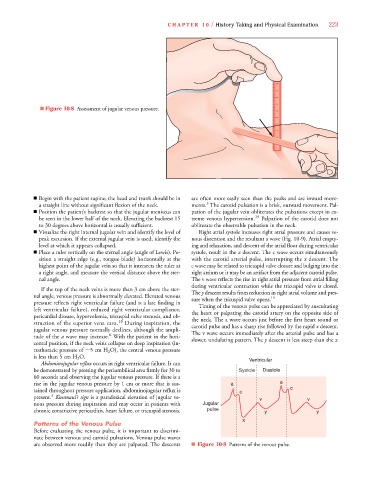
                     ■ Figure 10-8 Assessment of jugular venous pressure.
                   ■ Begin with the patient supine; the head and trunk should be in  are often more easily seen than the peaks and are inward move-
                                                                            3
                     a straight line without significant flexion of the neck.  ments. The carotid pulsation is a brisk, outward movement. Pal-
                   ■ Position the patient’s backrest so that the jugular meniscus can  pation of the jugular vein obliterates the pulsations except in ex-
                     be seen in the lower half of the neck. Elevating the backrest 15  treme venous hypertension. 19  Palpation of the carotid does not
                     to 30 degrees above horizontal is usually sufficient.  obliterate the observable pulsation in the neck.
                   ■ Visualize the right internal jugular vein and identify the level of  Right atrial systole increases right atrial pressure and causes ve-
                     peak excursion. If the external jugular vein is used, identify the  nous distention and the resultant a wave (Fig. 10-9). Atrial empty-
                     level at which it appears collapsed.              ing and relaxation, and descent of the atrial floor during ventricular
                   ■ Place a ruler vertically on the sternal angle (angle of Lewis). Po-  systole, result in the x descent. The c wave occurs simultaneously
                     sition a straight edge (e.g., tongue blade) horizontally at the  with the carotid arterial pulse, interrupting the x descent. The
                     highest point of the jugular vein so that it intersects the ruler at  c wave may be related to tricuspid valve closure and bulging into the
                     a right angle, and measure the vertical distance above the ster-  right atrium or it may be an artifact from the adjacent carotid pulse.
                     nal angle.                                        The v wave reflects the rise in right atrial pressure from atrial filling
                                                                       during ventricular contraction while the tricuspid valve is closed.
                     If the top of the neck veins is more than 3 cm above the ster-  The y descent results from reduction in right atrial volume and pres-
                   nal angle, venous pressure is abnormally elevated. Elevated venous  sure when the tricuspid valve opens. 19
                   pressure reflects right ventricular failure (and is a late finding in  Timing of the venous pulse can be appreciated by auscultating
                   left ventricular failure), reduced right ventricular compliance,  the heart or palpating the carotid artery on the opposite side of
                   pericardial disease, hypervolemia, tricuspid valve stenosis, and ob-  the neck. The a wave occurs just before the first heart sound or
                   struction of the superior vena cava. 18  During inspiration, the  carotid pulse and has a sharp rise followed by the rapid x descent.
                   jugular venous pressure normally declines, although the ampli-  The v wave occurs immediately after the arterial pulse and has a
                                            6
                   tude of the a wave may increase. With the patient in the hori-  slower, undulating pattern. The y descent is less steep than the x
                   zontal position, if the neck veins collapse on deep inspiration (in-
                   trathoracic pressure of  5 cm H 2 O), the central venous pressure
                   is less than 5 cm H 2 O.                                              Ventricular
                     Abdominojugular reflux occurs in right ventricular failure. It can
                   be demonstrated by pressing the periumbilical area firmly for 30 to  Systole  Diastole
                   60 seconds and observing the jugular venous pressure. If there is a
                   rise in the jugular venous pressure by 1 cm or more that is sus-  a              a
                   tained throughout pressure application, abdominojugular reflux is   c                c
                         3
                   present. Kussmaul’s sign is a paradoxical elevation of jugular ve-        v               v
                   nous pressure during inspiration and may occur in patients with  Jugular
                   chronic constrictive pericarditis, heart failure, or tricuspid stenosis.  pulse  y           y
                                                                                       x
                   Patterns of the Venous Pulse
                   Before evaluating the venous pulse, it is important to discrimi-
                   nate between venous and carotid pulsations. Venous pulse waves
                   are observed more readily than they are palpated. The descents  ■ Figure 10-9 Patterns of the venous pulse.

