


Page 249 - Cardiac Nursing
P. 249
6/2
                                  009
                                6/2
                              0/0
                              0/0
                                      0:4
                                      0:4
                                     1
                                  009
                                     1
                             3
                        44.
                          q
                        44.
                      1-2
                      1-2
                           xd
                             3
                           xd
                          q
                          q
                                        6 A
                                                   p
                                                   p
                                                  A
                                                25
                                                  A
                                                     ara
                                                     ara
                                                    t
                                                   p
                                                    t
                                                25
                                            Pa
                                            Pa
                                          M
                                        6 A
                                          M
                                               e 2
                                               e 2
                                              g
                                              g
                                              g
         LWBK340-c10_
                   p
         LWB
                 10_
         LWB K34 0-c 10_ pp211-244.qxd  30/06/2009  10:46 AM  Page 225 Aptara
                   p
            K34
               0-c
                    21
                    21
                                                               C HAPTER 1 0 / History Taking and Physical Examination  225
                                          300
                                               290
                                          280
                                               270                      Lying              Sitting              Standing
                                          260
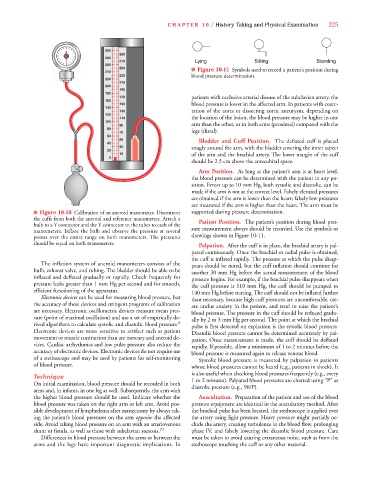
                                               250                     ■ Figure 10-11 Symbols used to record a patient’s position during
                                          240
                                               230                     blood pressure determination.
                                          220
                                               210
                                          200
                                               190
                                          180
                                               170                     patients with occlusive arterial disease of the subclavian artery, the
                                          160
                                               150                     blood pressure is lower in the affected arm. In patients with coarc-
                                          140
                                               130                     tation of the aorta or dissecting aortic aneurysm, depending on
                                          120
                                               110                     the location of the lesion, the blood pressure may be higher in one
                                          100
                                               90                      arm than the other, or in both arms (proximal) compared with the
                                           80                          legs (distal).
                                               70
                                           60
                                               50
                                           40                            Bladder and Cuff Position. The deflated cuff is placed
                                               30                      snugly around the arm, with the bladder covering the inner aspect
                                           20
                                               10                      of the arm and the brachial artery. The lower margin of the cuff
                                            0
                                                                       should be 2.5 cm above the antecubital space.
                                                                         Arm Position. As long as the patient’s arm is at heart level,
                                                                       the blood pressure can be determined with the patient in any po-
                                                                       sition. Errors up to 10 mm Hg, both systolic and diastolic, can be
                                                                       made if the arm is not at the correct level. Falsely elevated pressures
                                                                       are obtained if the arm is lower than the heart; falsely low pressures
                                                                       are measured if the arm is higher than the heart. The arm must be
                   ■ Figure 10-10 Calibration of an aneroid manometer. Disconnect  supported during pressure determination.
                   the cuffs from both the aneroid and reference manometers. Attach a  Patient Position. The patient’s position during blood pres-
                   bulb to a Y connector and the Y connector to the tubes to each of the
                   manometers. Inflate the bulb and observe the pressure at several  sure measurement always should be recorded. Use the symbols or
                   points over the entire range on both manometers. The pressures  drawings shown in Figure 10-11.
                   should be equal on both manometers.                   Palpation. After the cuff is in place, the brachial artery is pal-
                                                                       pated continuously. Once the brachial or radial pulse is obtained,
                                                                       the cuff is inflated rapidly. The pressure at which the pulse disap-
                     The inflation system of aneroid manometers consists of the  pears should be noted, but the cuff inflation should continue for
                   bulb, exhaust valve, and tubing. The bladder should be able to be  another 30 mm Hg before the actual measurement of the blood
                   inflated and deflated gradually or rapidly. Check frequently for  pressure begins. For example, if the brachial pulse disappears when
                   pressure leaks greater than 1 mm Hg per second and for smooth,  the cuff pressure is 110 mm Hg, the cuff should be pumped to
                   efficient functioning of the apparatus.              140 mm Hg before starting. The cuff should not be inflated further
                     Electronic devices can be used for measuring blood pressure, but  than necessary, because high cuff pressures are uncomfortable, cre-
                   the accuracy of these devices and stringent programs of calibration  ate undue anxiety in the patient, and tend to raise the patient’s
                   are necessary. Electronic oscillometric devices measure mean pres-  blood pressure. The pressure in the cuff should be reduced gradu-
                   sure (point of maximal oscillation) and use a set of empirically de-  ally by 2 to 3 mm Hg per second. The point at which the brachial
                   rived algorithms to calculate systolic and diastolic blood pressure. 6  pulse is first detected on expiration is the systolic blood pressure.
                   Electronic devices are more sensitive to artifact such as patient  Diastolic blood pressure cannot be determined accurately by pal-
                   movement or muscle contraction than are mercury and aneroid de-  pation. Once measurement is made, the cuff should be deflated
                   vices. Cardiac arrhythmias and low pulse pressure also reduce the  rapidly. If possible, allow a minimum of 1 to 2 minutes before the
                   accuracy of electronic devices. Electronic devices do not require use  blood pressure is measured again to release venous blood.
                   of a stethoscope and may be used by patients for self-monitoring  Systolic blood pressure is measured by palpation in patients
                   of blood pressure.                                  whose blood pressures cannot be heard (e.g., patients in shock). It
                                                                       is also useful when checking blood pressures frequently (e.g., every
                   Technique                                           1 to 2 minutes). Palpated blood pressures are charted using “P” as
                   On initial examination, blood pressure should be recorded in both  diastolic pressure (e.g., 90/P).
                   arms and, in infants, in one leg as well. Subsequently, the arm with
                   the higher blood pressure should be used. Indicate whether the  Auscultation. Preparation of the patient and use of the blood
                   blood pressure was taken on the right arm or left arm. Avoid pos-  pressure equipment are identical in the auscultatory method. After
                   sible development of lymphedema after mastectomy by always tak-  the brachial pulse has been located, the stethoscope is applied over
                   ing the patient’s blood pressures on the arm opposite the affected  the artery using light pressure. Heavy pressure might partially oc-
                   side. Avoid taking blood pressure on an arm with an arteriovenous  clude the artery, creating turbulence in the blood flow, prolonging
                   shunt or fistula, as well as those with subclavian stenosis. 24  phase IV, and falsely lowering the diastolic blood pressure. Care
                     Differences in blood pressure between the arms or between the  must be taken to avoid causing extraneous noise, such as from the
                   arms and the legs have important diagnostic implications. In  stethoscope touching the cuff or any other material.

