


Page 248 - Cardiac Nursing
P. 248
LWBK340-c10_p211-244.qxd  30/06/2009  10:46 AM  Page 224 Aptara


                  224    PA R T  III / Assessment of Heart Disease

                  descent. Consistently large a waves are seen in tricuspid stenosis,
                  pulmonary hypertension, and right ventricular failure. Cannon a  Table 10-3 ■ ACCEPTABLE BLADDER DIMENSIONS
                  waves are seen in patients with atrioventricular dissociation as the  (IN CM) FOR ARMS OF DIFFERENT SIZES *
                                                             3
                  right atrium contracts against the closed tricuspid valve. The a  Bladder  Bladder  Arm Circumference
                  wave is absent in atrial fibrillation because of the absence of coor-  Cuff  Width (cm)  Length (cm)  Range at Midpoint (cm)
                  dinated atrial contraction. Elevated v waves and rapid y descents
                  suggest tricuspid regurgitation or increased intravascular volume.  Newborn  3  6         6
                  Blunting of the y descent suggests impaired atrial emptying in  Infant  5  15            6–15 †  †
                  early ventricular diastole, such as occurs in tricuspid stenosis, peri-  Child  10 8  21  16–21
                                                                                                           22–26
                                                                                             24
                                                                      Small adult
                  cardial disease, or cardiac tamponade.              Adult       13         30            27–34
                                                                      Large adult  16        38            35–44
                                                                      Adult thigh  20        42            45–52
                  Blood Pressure
                                                                      * There is some overlapping of the recommended range for arm circumferences to limit
                  Systemic arterial blood pressure can be measured indirectly or di-
                                                                       the number of cuffs; it is recommended that the larger cuff be used when available.
                  rectly. Indirect measurement of blood pressure is most common  † To approximate the bladder width:arm circumference ratio of 0.40 more closely in in-
                  and is described in this section. Direct measurement of blood  fants and children, additional cuffs are available.
                                                                      From Perloff, D., Grim, C., Flack, J., et al. (2001). Human blood pressure determination
                  pressure, an invasive technique requiring placement of an arterial
                                                                       by sphygmomanometry. Dallas, TX: American Heart Association.
                  catheter, may be necessary in certain conditions, such as clinical
                  shock. Direct measurement of blood pressure is discussed in
                  Chapter 21.                                         accuracy of measurement, should be approximately twice that of
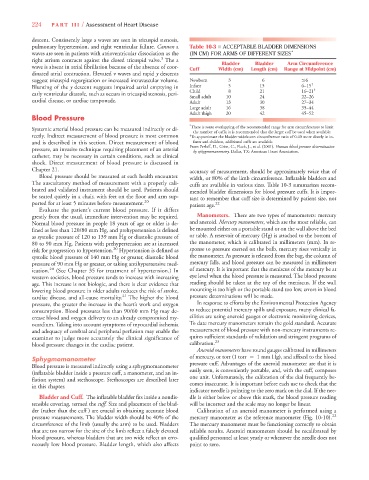
                     Blood pressure should be measured at each health encounter.  width, or 80% of the limb circumference. Inflatable bladders and
                  The auscultatory method of measurement with a properly cali-  cuffs are available in various sizes. Table 10-3 summarizes recom-
                  brated and validated instrument should be used. Patients should  mended bladder dimensions for blood pressure cuffs. It is impor-
                  be seated quietly in a chair, with feet on the floor and arm sup-  tant to remember that cuff size is determined by patient size, not
                  ported for at least 5 minutes before measurement. 20  patient age. 22
                     Evaluate the patient’s current  blood pressure. If it  differs
                  greatly from the usual, immediate intervention may be required.  Manometers. There are two types of manometers: mercury
                  Normal blood pressure in people 18 years of age or older is de-  and aneroid. Mercury manometers, which are the most reliable, can
                  fined as less than 120/80 mm Hg, and prehypertension is defined  be mounted either on a portable stand or on the wall above the bed
                  as systolic pressure of 120 to 139 mm Hg or diastolic pressure of  or table. A reservoir of mercury (Hg) is attached to the bottom of
                  80 to 90 mm Hg. Patients with prehypertension are at increased  the manometer, which is calibrated in millimeters (mm). In re-
                  risk for progression to hypertension. 20  Hypertension is defined as  sponse to pressure exerted on the bulb, mercury rises vertically in
                  systolic blood pressure of 140 mm Hg or greater, diastolic blood  the manometer. As pressure is released from the bag, the column of
                  pressure of 90 mm Hg or greater, or taking antihypertensive med-  mercury falls, and blood pressure can be measured in millimeters
                  ication. 20  (See Chapter 35 for treatment of hypertension.) In  of mercury. It is important that the meniscus of the mercury be at
                  western societies, blood pressure tends to increase with increasing  eye level when the blood pressure is measured. The blood pressure
                  age. This increase is not biologic, and there is clear evidence that  reading should be taken at the top of the meniscus. If the wall
                  lowering blood pressure in older adults reduces the risk of stroke,  mounting is too high or the portable stand too low, errors in blood
                  cardiac disease, and all-cause mortality. 21  The higher the blood  pressure determinations will be made.
                  pressure, the greater the increase in the heart’s work and oxygen  In response to efforts by the Environmental Protection Agency
                  consumption. Blood pressures less than 90/60 mm Hg may de-  to reduce potential mercury spills and exposure, many clinical fa-
                  crease blood and oxygen delivery to an already compromised my-  cilities are using aneroid gauges or electronic monitoring devices,
                  ocardium. Taking into account symptoms of myocardial ischemia  To date mercury manometers remain the gold standard. Accurate
                  and adequacy of cerebral and peripheral perfusion may enable the  measurement of blood pressure with non-mercury instruments re-
                  examiner to judge more accurately the clinical significance of  quires sufficient standards of validation and stringent programs of
                  blood pressure changes in the cardiac patient.      calibration. 23
                                                                        Aneroid manometers have round gauges calibrated in millimeters
                  Sphygmomanometer                                    of mercury, or torr (1 torr    1 mm Hg), and affixed to the blood
                                                                      pressure cuff. Advantages of the aneroid manometer are that it is
                  Blood pressure is measured indirectly using a sphygmomanometer
                                                                      easily seen, is conveniently portable, and, with the cuff, composes
                  (inflatable bladder inside a pressure cuff, a manometer, and an in-
                                                                      one unit. Unfortunately, the calibration of the dial frequently be-
                  flation system) and stethoscope. Stethoscopes are described later
                                                                      comes inaccurate. It is important before each use to check that the
                  in this chapter.
                                                                      indicator needle is pointing to the zero mark on the dial. If the nee-
                     Bladder and Cuff. The inflatable bladder fits inside a nondis-  dle is either below or above this mark, the blood pressure reading
                  tensible covering, termed the cuff. Size and placement of the blad-  will be incorrect and the scale may no longer be linear.
                  der (rather than the cuff ) are crucial in obtaining accurate blood  Calibration of an aneroid manometer is performed using a
                  pressure measurements. The bladder width should be 40% of the  mercury manometer as the reference manometer (Fig. 10-10). 22
                  circumference of the limb (usually the arm) to be used. Bladders  The mercury manometer must be functioning correctly to obtain
                  that are too narrow for the size of the limb reflect a falsely elevated  reliable results. Aneroid manometers should be recalibrated by
                  blood pressure, whereas bladders that are too wide reflect an erro-  qualified personnel at least yearly or whenever the needle does not
                  neously low blood pressure. Bladder length, which also affects  point to zero.

