


Page 310 - Cardiac Nursing
P. 310
2 A
                                          M
                                      0:4
                                        2 A
                                            Pa
                                            Pa
                                          M
                                          M
                                      0:4
                                6/2
                                6/2
                              0/0
                              0/0
                                     1
                                     1
                                  009
                                  009
                                                   p
                                                    t
                                                   p
                                                   p
                                                     ara
                                                     ara
                                                    t
                                                     ara
                                                  A
                                              g
                                               e 2
                                              g
                                              g
                                                86
                                                  A
                                               e 2
                                                86
                   p
                    27
                 13_
                   p
                      7-2
                        90.
                    27
                      7-2
         LWB
            K34
         LWBK340-c13_ pp277-290.qxd  30/06/2009  10:42 AM  Page 286 Aptara
         LWB
               0-c
                 13_
            K34
               0-c
                              3
                           xd
                             3
                             3
                           xd
                          q
                        90.
                          q
                          q
                  286    P A R T  III / Assessment of Heart Disease
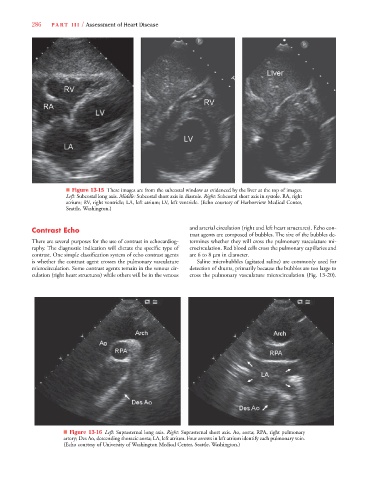
                              ■ Figure 13-15 These images are from the subcostal window as evidenced by the liver at the top of images.
                              Left: Subcostal long axis. Middle: Subcostal short axis in diastole. Right: Subcostal short axis in systole. RA, right
                              atrium; RV, right ventricle; LA, left atrium; LV, left ventricle. (Echo courtesy of Harborview Medical Center,
                              Seattle, Washington.)
                  Contrast Echo                                       and arterial circulation (right and left heart structures). Echo con-
                                                                      trast agents are composed of bubbles. The size of the bubbles de-
                  There are several purposes for the use of contrast in echocardiog-  termines whether they will cross the pulmonary vasculature mi-
                  raphy. The diagnostic indication will dictate the specific type of  crocirculation. Red blood cells cross the pulmonary capillaries and
                  contrast. One simple classification system of echo contrast agents  are 6 to 8 μm in diameter.
                  is whether the contrast agent crosses the pulmonary vasculature  Saline microbubbles (agitated saline) are commonly used for
                  microcirculation. Some contrast agents remain in the venous cir-  detection of shunts, primarily because the bubbles are too large to
                  culation (right heart structures) while others will be in the venous  cross the pulmonary vasculature microcirculation (Fig. 13-20).


                             ■ Figure 13-16 Left: Suprasternal long axis. Right: Suprasternal short axis. Ao, aorta; RPA, right pulmonary
                             artery; Des Ao, descending thoracic aorta; LA, left atrium. Four arrows in left atrium identify each pulmonary vein.
                             (Echo courtesy of University of Washington Medical Center, Seattle, Washington.)

