


Page 309 - Cardiac Nursing
P. 309
0:4
                                      0:4
                                     1
                                     1
                                        2 A
                                          M
                                          M
                                        2 A
                                          M
                             3
                              0/0
                              3
                             3
                              0/0
                                  009
                                  009
                                6/2
                                6/2
                                            Pa
                                                   p
                                                   p
                                                  A
                                                   p
                                                    t
                                                     ara
                                                     ara
                                                    t
                                                     ara
                                              g
                                              g
                                            Pa
                                              g
                                               e 2
                                                85
                                                  A
                                               e 2
                                                85
                           xd
         LWB K34 0-c 13_ p p pp277-290.qxd  30/06/2009  10:42 AM  Page 285 Aptara
         LWB
                    27
                    27
               0-c
                 13_
         LWBK340-c13_
            K34
                          q
                        90.
                          q
                           xd
                          q
                      7-2
                      7-2
                        90.
                                                                                 C HAPTER 1 3 / Echocardiography   285
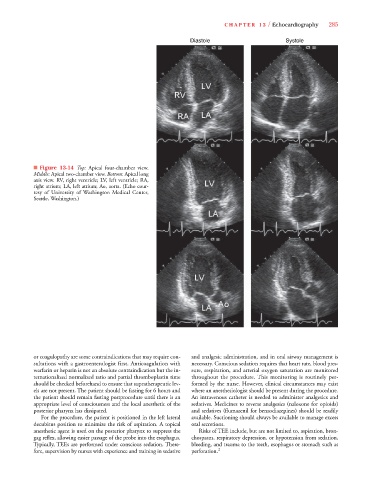
                                                                      Diastole                       Systole
                   ■ Figure 13-14 Top: Apical four-chamber view.
                   Middle: Apical two-chamber view. Bottom: Apical long
                   axis view. RV, right ventricle; LV, left ventricle; RA,
                   right atrium; LA, left atrium; Ao, aorta. (Echo cour-
                   tesy of University of  Washington Medical Center,
                   Seattle, Washington.)


                   or coagulopathy are some contraindications that may require con-  and analgesic administration, and in oral airway management is
                   sultations with a gastroenterologist first. Anticoagulation with  necessary. Conscious sedation requires that heart rate, blood pres-
                   warfarin or heparin is not an absolute contraindication but the in-  sure, respiration, and arterial oxygen saturation are monitored
                   ternationalized normalized ratio and partial thromboplastin time  throughout the procedure. This monitoring is routinely per-
                   should be checked beforehand to ensure that supratherapeutic lev-  formed by the nurse. However, clinical circumstances may exist
                   els are not present. The patient should be fasting for 6 hours and  where an anesthesiologist should be present during the procedure.
                   the patient should remain fasting postprocedure until there is an  An intravenous catheter is needed to administer analgesics and
                   appropriate level of consciousness and the local anesthetic of the  sedatives. Medicines to reverse analgesics (naloxone for opioids)
                   posterior pharynx has dissipated.                   and sedatives (flumazenil for benzodiazepines) should be readily
                     For the procedure, the patient is positioned in the left lateral  available. Suctioning should always be available to manage excess
                   decubitus position to minimize the risk of aspiration. A topical  oral secretions.
                   anesthetic agent is used on the posterior pharynx to suppress the  Risks of TEE include, but are not limited to, aspiration, bron-
                   gag reflex, allowing easier passage of the probe into the esophagus.  chospasm, respiratory depression, or hypotension from sedation,
                   Typically, TEEs are performed under conscious sedation. There-  bleeding, and trauma to the teeth, esophagus or stomach such as
                   fore, supervision by nurses with experience and training in sedative  perforation. 2

