


Page 306 - Cardiac Nursing
P. 306
g
                                                    t
                                                    t
                                            Pa
                                6/2
                                6/2
                                                     ara
                                               e 2
                              0/0
                              0/0
                                               e 2
                                                82
                                              g
                                              g
                                      0:4
                                      0:4
                                     1
                                        2 A
                                          M
                                          M
                                        2 A
                                                     ara
                                  009
                                  009
                                                     ara
                                     1
                                          M
                                            Pa
                             3
                                                  A
                                                   p
                                                   p
                                                  A
                   p
                   p
                                                82
         LWBK340-c13_
         LWB
         LWB K34 0-c 13_ pp277-290.qxd  30/06/2009  10:42 AM  Page 282 Aptara
            K34
                                                   p
                 13_
               0-c
                           xd
                          q
                          q
                             3
                              3
                           xd
                          q
                      7-2
                    27
                    27
                      7-2
                        90.
                        90.
                  282    P A R T  III / Assessment of Heart Disease
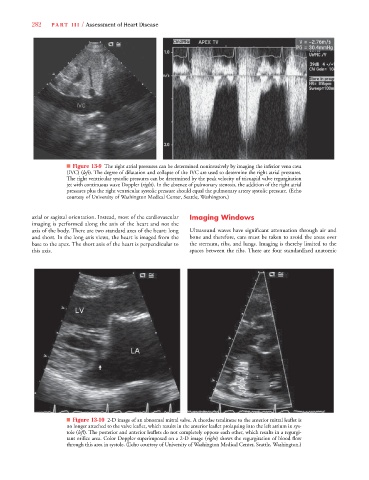
                              ■ Figure 13-9 The right atrial pressures can be determined noninvasively by imaging the inferior vena cava
                              (IVC) (left). The degree of dilatation and collapse of the IVC are used to determine the right atrial pressures.
                                     t
                                     t
                              The right ventricular systolic pressures can be determined by the peak velocity of tricuspid valve regurgitation
                              jet with continuous wave Doppler (right). In the absence of pulmonary stenosis, the addition of the right atrial
                                                         t
                                                         t
                              pressures plus the right ventricular systolic pressure should equal the pulmonary artery systolic pressure. (Echo
                              courtesy of University of Washington Medical Center, Seattle, Washington.)
                  axial or sagittal orientation. Instead, most of the cardiovascular  Imaging Windows
                  imaging is performed along the axis of the heart and not the
                  axis of the body. There are two standard axes of the heart: long  Ultrasound waves have significant attenuation through air and
                  and short. In the long axis views, the heart is imaged from the  bone and therefore, care must be taken to avoid the areas over
                  base to the apex. The short axis of the heart is perpendicular to  the sternum, ribs, and lungs. Imaging is thereby limited to the
                  this axis.                                          spaces between the ribs. There are four standardized anatomic


                              ■ Figure 13-10 2-D image of an abnormal mitral valve. A chordae tendineae to the anterior mitral leaflet is
                              no longer attached to the valve leaflet, which results in the anterior leaflet prolapsing into the left atrium in sys-
                              tole (left). The posterior and anterior leaflets do not completely oppose each other, which results in a regurgi-
                                   t
                                   t
                                                                              t
                                                                              t
                              tant orifice area. Color Doppler superimposed on a 2-D image (right) shows the regurgitation of blood flow
                              through this area in systole. (Echo courtesy of University of Washington Medical Center, Seattle, Washington.)

