


Page 308 - Cardiac Nursing
P. 308
0:4
                                      0:4
                                     1
                                     1
                                        2 A
                                          M
                                          M
                                        2 A
                                          M
                                  009
                             3
                             3
                           xd
                              3
                              0/0
                                6/2
                                  009
                              0/0
                                6/2
                                                   p
                                                   p
                                                  A
                                                   p
                                                    t
                                                     ara
                                                     ara
                                                    t
                                                     ara
                                                  A
                                              g
                                              g
                                            Pa
                                            Pa
                                              g
                                                84
                                                84
                                               e 2
                                               e 2
                           xd
                 13_
                 13_
               0-c
                   p
                   p
         LWB
            K34
         LWB
            K34
         LWBK340-c13_ pp277-290.qxd  30/06/2009  10:42 AM  Page 284 Aptara
                    27
                        90.
                          q
                        90.
                          q
                          q
                      7-2
               0-c
                    27
                      7-2
                  284    P A R T  III / Assessment of Heart Disease
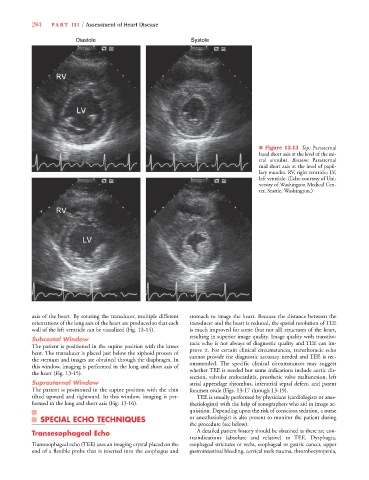
                                 Diastole                             Systole
                                                                                             ■ Figure 13-13 Top: Parasternal
                                                                                             basal short axis at the level of the mi-
                                                                                             tral annulus.  Bottom: Parasternal
                                                                                             mid short axis at the level of papil-
                                                                                             lary muscles. RV, right ventricle; LV,
                                                                                             left ventricle. (Echo courtesy of Uni-
                                                                                             versity of Washington Medical Cen-
                                                                                             ter, Seattle, Washington.)
                  axis of the heart. By rotating the transducer, multiple different  stomach to image the heart. Because the distance between the
                  orientations of the long axis of the heart are produced so that each  transducer and the heart is reduced, the spatial resolution of TEE
                  wall of the left ventricle can be visualized (Fig. 13-14).  is much improved for some (but not all) structures of the heart,
                                                                      resulting in superior image quality. Image quality with transtho-
                  Subcostal Window
                  The patient is positioned in the supine position with the knees  racic echo is not always of diagnostic quality and TEE can im-
                  bent. The transducer is placed just below the xiphoid process of  prove it. For certain clinical circumstances, transthoracic echo
                  the sternum and images are obtained through the diaphragm. In  cannot provide the diagnostic accuracy needed and TEE is rec-
                  this window, imaging is performed in the long and short axis of  ommended.  The specific clinical circumstances may suggest
                  the heart (Fig. 13-15).                             whether TEE is needed but some indications include aortic dis-
                                                                      section, valvular endocarditis, prosthetic valve malfunction, left
                  Suprasternal Window                                 atrial appendage thrombus, interatrial septal defect, and patent
                  The patient is positioned in the supine position with the chin  foramen ovale (Figs. 13-17 through 13-19).
                  tilted upward and rightward. In this window, imaging is per-  TEE is usually performed by physicians (cardiologists or anes-
                  formed in the long and short axis (Fig. 13-16).     thesiologists) with the help of sonographers who aid in image ac-
                                                                      quisition. Depending upon the risk of conscious sedation, a nurse
                     SPECIAL ECHO TECHNIQUES                          or anesthesiologist is also present to monitor the patient during
                                                                      the procedure (see below).
                  Transesophageal Echo                                  A detailed patient history should be obtained as there are con-
                                                                      traindications (absolute and relative) to  TEE. Dysphagia,
                  Transesophageal echo (TEE) uses an imaging crystal placed on the  esophageal strictures or webs, esophageal or gastric cancer, upper
                  end of a flexible probe that is inserted into the esophagus and  gastrointestinal bleeding, cervical neck trauma, thrombocytopenia,

