Page 331 - Cardiac Nursing
P. 331

xd
                           xd
                          q
                          q
                              /29
                              /29
                             6
                             6
                                            e 3
                      0-3
                                              07
                                              07
                        32.
                          q
                      0-3
                        32.
                                     0 P
                                     0 P
                                   0:3
                                           g
                                        M
                                          Pa
                                          Pa
                                        M
                                            e 3
                                           g
                                /09
                                /09
                                           g
                                   0:3
                                   1
                                   1
                    30
         LWBK340-c15_
                                                    In
                                                    In
                                                   a
                                                   a
                                                      c.
                 15_
         LWB
                                                      c.
            K34
               0-c
                                                A
                                                 p
                                                A
                    30
         LWB K34 0-c 15_ p p pp300-332.qxd  6/29/09  10:30 PM  Page 307 Aptara Inc.
                                                 p
                                                  t
                                                  ara
                                                  ara
                                                 p
                                                  t
                                                                                C HAPTER 1 5 / Electrocardiography  307
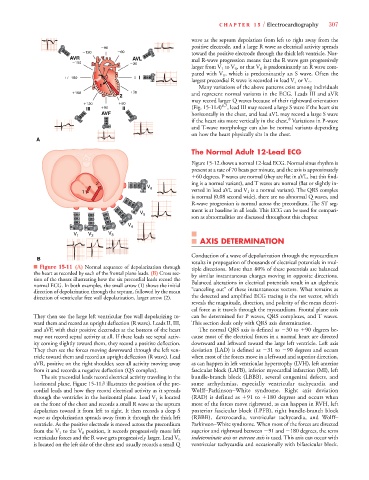
                                                                       wave as the septum depolarizes from left to right away from the
                                          90                           positive electrode, and a large R wave as electrical activity spreads
                                    120        60                      toward the positive electrode through the thick left ventricle. Nor-
                               AVR                 AVL                 mal R-wave progression means that the R wave gets progressively
                                 150               30
                                                                                            V V
                                                                       larger from V 1 to V 6 , or that V 6 is predominantly an R wave com-
                                                                                   V V
                                                                       pared with V 1 , which is predominantly an S wave. Often the
                             
  180                 0 I
                                                                       largest precordial R wave is recorded in lead V 4 or V 5 .
                                                                                                       V
                                         1 1 1 1 1 1 1 1 1 1 1 1 1 1 1 1 1 1 1 1 1 1 1 1 1 1 1 1 1 1 1 1 1 1 1 1 1 1 1 1 1 1 1  Many variations of the above patterns exist among individuals
                                
150              
30                  and represent normal variants in the ECG. Leads III and aVR
                                               2
                                                                       may record larger Q waves because of their rightward orientation
                                   
120        
60                               6,7
                                    III  
90    II                     (Fig. 15-11A) , lead III may record a large S wave if the heart sits
                                         AVF                           horizontally in the chest, and lead aVL may record a large S wave
                                                                                                      8
                                                                       if the heart sits more vertically in the chest. Variations in P-wave
                                                                       and T-wave morphology can also be normal variants depending
                                                                       on how the heart physically sits in the chest.
                    A
                                                                       The Normal Adult 12-Lead ECG
                                                                       Figure 15-12 shows a normal 12-lead ECG. Normal sinus rhythm is
                                                                       present at a rate of 70 beats per minute, and the axis is approximately
                                                                       
60 degrees. P waves are normal (they are flat in aVL, but this find-
                                       2 2                             ing is a normal variant), and T waves are normal (flat or slightly in-
                                                        V 6
                                   1                                   verted in lead aVL and V 1 is a normal variant). The QRS complex
                                                                       is normal (0.08 second wide), there are no abnormal Q waves, and
                                                                       R-wave progression is normal across the precordium. The ST seg-
                                                                       ment is at baseline in all leads. This ECG can be used for compari-
                                                      V
                                                       5
                                                                       son as abnormalities are discussed throughout this chapter.
                                                  V
                                                   4
                                V 1  V 2   V 3
                                                                         AXIS DETERMINATION
                                                                       Conduction of a wave of depolarization through the myocardium
                    B
                                                                       results in propagation of thousands of electrical potentials in mul-
                   ■ Figure 15-11 (A) Normal sequence of depolarization through  tiple directions. More than 80% of these potentials are balanced
                   the heart as recorded by each of the frontal plane leads. (B) Cross sec-  by similar instantaneous charges moving in opposite directions.
                   tion of the thorax illustrating how the six precordial leads record the
                   normal ECG. In both examples, the small arrow (1) shows the initial  Balanced alterations in electrical potentials result in an algebraic
                   direction of depolarization through the septum, followed by the mean  “canceling out” of these instantaneous vectors. What remains as
                   direction of ventricular free wall depolarization, larger arrow (2).  the detected and amplified ECG tracing is the net vector, which
                                                                       reveals the magnitude, direction, and polarity of the mean electri-
                                                                       cal force as it travels through the myocardium. Frontal plane axis
                   They then see the large left ventricular free wall depolarizing to-  can be determined for P waves, QRS complexes, and T waves.
                   ward them and record an upright deflection (R wave). Leads II, III,  This section deals only with QRS axis determination.
                   and aVF, with their positive electrodes at the bottom of the heart  The normal QRS axis is defined as  30 to 
90 degrees be-
                   may not record septal activity at all. If these leads see septal activ-  cause most of the electrical forces in a normal heart are directed
                   ity coming slightly toward them, they record a positive deflection.  downward and leftward toward the large left ventricle. Left axis
                   They then see the forces moving downward through the left ven-  deviation (LAD) is defined as  31 to  90 degrees and occurs
                   tricle toward them and record an upright deflection (R wave). Lead  when most of the forces move in a leftward and superior direction,
                   aVR, positive on the right shoulder, sees all activity moving away  as can happen in left ventricular hypertrophy (LVH), left anterior
                   from it and records a negative deflection (QS complex).  fascicular block (LAFB), inferior myocardial infarction (MI), left
                     The six precordial leads record electrical activity traveling in the  bundle-branch block (LBBB), several congenital defects, and
                   horizontal plane. Figure 15-11B illustrates the position of the pre-  some arrhythmias, especially ventricular tachycardia and
                   cordial leads and how they record electrical activity as it spreads  Wolff–Parkinson–White syndrome. Right axis deviation
                   through the ventricles in the horizontal plane. Lead V 1 is located  (RAD) is defined as 
91 to 
180 degrees and occurs when
                   on the front of the chest and records a small R wave as the septum  most of the forces move rightward, as can happen in RVH, left
                   depolarizes toward it from left to right. It then records a deep S  posterior fascicular block (LPFB), right bundle-branch block
                   wave as depolarization spreads away from it through the thick left  (RBBB),  dextrocardia, ventricular tachycardia, and Wolff–
                   ventricle. As the positive electrode is moved across the precordium  Parkinson–White syndrome. When most of the forces are directed
                                  V V
                   from the V 1 to the V 6 position, it records progressively more left  superior and rightward between  91 and  180 degrees, the term
                                                                 V     indeterminate axis or extreme axis is used. This axis can occur with
                   ventricular forces and the R wave gets progressively larger. Lead V 6
                   is located on the left side of the chest and usually records a small Q  ventricular tachycardia and occasionally with bifascicular block.
   326   327   328   329   330   331   332   333   334   335   336