


Page 393 - Cardiac Nursing
P. 393
M
                                          Pa
                                        M
                                     6 A
                                     6 A
                                           g
                                           g
                                           g
                                          Pa
                                          Pa
                                /09
                                /09
                                /09
                              /30
                              /30
                                   2:1
                                   2:1
                                   1
                                    1
                                   1
                                                  ara
                                                   a
                                                  ara
                                                  t
                                                  t
                                                      c.
                                                      c.
                                                     In
                                                   a
                                                     In
                                              69
                                              69
                                              69
                                            e 3
                                            e 3
                                                 p
                                                 p
                                                 p
                                                A
                                                A
                             6
               0-c
                        87.
            K34
                          q
                          q
                        87.
                    33
                 16_
                    33
                      3-3
                      3-3
                          q
         LWB
         LWB K34 0-c 16_ p p pp333-387.qxd  6/30/09  12:16 AM  Page 369 Aptara Inc.
                             6
                           xd
                           xd
         LWBK340-c16_
                                                             C HAPTER 1 6 / Arrhythmias and Conduction Disturbances  369
                                                                                       AV node
                                                                                                  Fast pathway
                                                                       Slow pathway
                                                          A
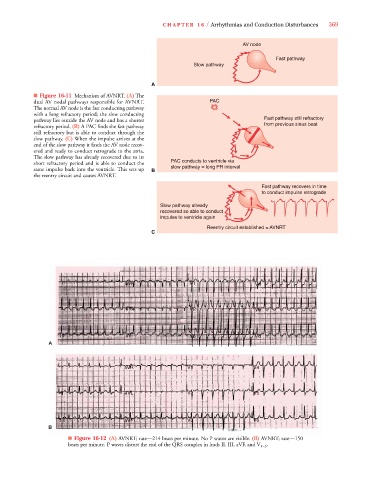
                   ■ Figure 16-11 Mechanism of AVNRT. (A) The
                   dual AV nodal pathways responsible for AVNRT.             PAC
                   The normal AV node is the fast conducting pathway
                   with a long refractory period; the slow conducting
                   pathway lies outside the AV node and has a shorter                         Fast pathway still refractory
                   refractory period. (B) A PAC finds the fast pathway                         from previous sinus beat
                   still refractory but is able to conduct through the
                   slow pathway. (C) When the impulse arrives at the
                   end of the slow pathway it finds the AV node recov-
                   ered and ready to conduct retrograde to the atria.
                   The slow pathway has already recovered due to its
                   short refractory period and is able to conduct the  PAC conducts to ventricle via
                   same impulse back into the ventricle. This sets up  B  slow pathway = long PR interval
                   the reentry circuit and causes AVNRT.
                                                                                              Fast pathway recovers in time
                                                                                              to conduct impulse retrograde
                                                            Slow pathway already
                                                            recovered so able to conduct
                                                            impulse to ventricle again
                                                                            Reentry circuit established = AVNRT
                                                          C
                            I                    aVR                  V1                   V4
                            II                   aVL                  V2                   V5
                            III                  aVF                  V3                   V6
                        A A
                            I                    aVR                 V1                    V4
                            II                   aVL                 V2                    V5
                            III                  aVF                 V3                    V6
                        B B
                              ■ Figure 16-12 (A) AVNRT; rate—214 beats per minute. No P waves are visible. (B) AVNRT; rate—150
                              beats per minute. P waves distort the end of the QRS complex in leads II, III, aVF, and V 1–3 .

