


Page 388 - Cardiac Nursing
P. 388
2:1
                                     6 A
                                   2:1
                                   1
                                   1
                                     6 A
                                          Pa
                                          Pa
                                          Pa
                                        M
                                        M
                                    1
                           xd
                             6
                           xd
                          q
                          q
                             6
                                /09
                                /09
                                /09
                              /30
                              /30
                                                  ara
                                                  ara
                                                  t
                                                 p
                                                  t
                                                   a
                                                      c.
                                                      c.
                                                     In
                                                   a
                                                     In
                                                 p
                                            e 3
                                            e 3
                                           g
                                           g
                                           g
                                              64
                                                A
                                                 p
                                                A
                                              64
                                              64
         LWB K34 0-c 16_ p p pp333-387.qxd  6/30/09  12:16 AM  Page 364 Aptara Inc.
         LWB
                    33
                    33
               0-c
                 16_
         LWBK340-c16_
            K34
                        87.
                      3-3
                      3-3
                          q
                        87.
                  364    P A R T  III / Assessment of Heart Disease
                             A
                             B
                   C
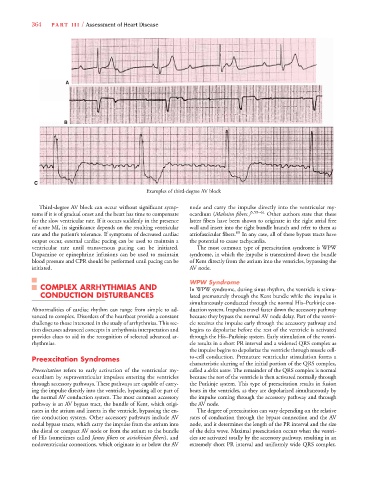
                                                        Examples of third-degree AV block
                     Third-degree AV block can occur without significant symp-  node and carry the impulse directly into the ventricular my-
                  toms if it is of gradual onset and the heart has time to compensate  ocardium (Mahaim fibers.) 5,59–61  Other authors state that these
                  for the slow ventricular rate. If it occurs suddenly in the presence  latter fibers have been shown to originate in the right atrial free
                  of acute MI, its significance depends on the resulting ventricular  wall and insert into the right bundle branch and refer to them as
                  rate and the patient’s tolerance. If symptoms of decreased cardiac  atriofascicular fibers. 60  In any case, all of these bypass tracts have
                  output occur, external cardiac pacing can be used to maintain a  the potential to cause tachycardia.
                  ventricular rate until transvenous pacing can be initiated.  The most common type of preexcitation syndrome is WPW
                  Dopamine or epinephrine infusions can be used to maintain  syndrome, in which the impulse is transmitted down the bundle
                  blood pressure and CPR should be performed until pacing can be  of Kent directly from the atrium into the ventricles, bypassing the
                  initiated.                                          AV node.
                                                                      WPW Syndrome
                     COMPLEX ARRHYTHMIAS AND                          In WPW syndrome, during sinus rhythm, the ventricle is stimu-
                     CONDUCTION DISTURBANCES                          lated prematurely through the Kent bundle while the impulse is
                                                                      simultaneously conducted through the normal His–Purkinje con-
                  Abnormalities of cardiac rhythm can range from simple to ad-  duction system. Impulses travel faster down the accessory pathway
                  vanced to complex. Disorders of the heartbeat provide a constant  because they bypass the normal AV node delay. Part of the ventri-
                  challenge to those interested in the study of arrhythmias. This sec-  cle receives the impulse early through the accessory pathway and
                  tion discusses advanced concepts in arrhythmia interpretation and  begins to depolarize before the rest of the ventricle is activated
                  provides clues to aid in the recognition of selected advanced ar-  through the His–Purkinje system. Early stimulation of the ventri-
                  rhythmias.                                          cle results in a short PR interval and a widened QRS complex as
                                                                      the impulse begins to depolarize the ventricle through muscle cell-
                  Preexcitation Syndromes                             to-cell conduction. Premature ventricular stimulation forms a
                                                                      characteristic slurring of the initial portion of the QRS complex,
                  Preexcitation refers to early activation of the ventricular my-  called a delta wave. The remainder of the QRS complex is normal
                  ocardium by supraventricular impulses entering the ventricles  because the rest of the ventricle is then activated normally through
                  through accessory pathways. These pathways are capable of carry-  the Purkinje system. This type of preexcitation results in fusion
                  ing the impulse directly into the ventricle, bypassing all or part of  beats in the ventricles, as they are depolarized simultaneously by
                  the normal AV conduction system. The most common accessory  the impulse coming through the accessory pathway and through
                  pathway is an AV bypass tract, the bundle of Kent, which origi-  the AV node.
                  nates in the atrium and inserts in the ventricle, bypassing the en-  The degree of preexcitation can vary depending on the relative
                  tire conduction system. Other accessory pathways include AV  rates of conduction through the bypass connection and the AV
                  nodal bypass tracts, which carry the impulse from the atrium into  node, and it determines the length of the PR interval and the size
                  the distal or compact AV node or from the atrium to the bundle  of the delta wave. Maximal preexcitation occurs when the ventri-
                  of His (sometimes called James fibers or atriohisian fibers), and  cles are activated totally by the accessory pathway, resulting in an
                  nodoventricular connections, which originate in or below the AV  extremely short PR interval and uniformly wide QRS complex.

