


Page 391 - Cardiac Nursing
P. 391
1
                                   1
                                   2:1
                                /09
                                /09
                                    1
                                        M
                                        M
                                          Pa
                                   2:1
                                     6 A
                                     6 A
                          q
                          q
                           xd
                        87.
                        87.
                          q
                              /30
                              /30
                                /09
                           xd
                             6
                             6
                                          Pa
                                                  t
                                                  ara
                                                  ara
                                                 p
                                                 p
                                                  t
                                                     In
                                                      c.
                                                      c.
                                                   a
                                                   a
                                                     In
                                           g
                                            e 3
                                            e 3
                                          Pa
                                           g
                                           g
                                                A
                                                A
                                                 p
                                              67
                                              67
                                              67
                      3-3
                   p
         LWB K34 0-c 16_ pp333-387.qxd  6/30/09  12:16 AM  Page 367 Aptara Inc.
                    33
                   p
         LWBK340-c16_
               0-c
                 16_
         LWB
            K34
                    33
                      3-3
                                                             C HAPTER 1 6 / Arrhythmias and Conduction Disturbances  367
                   Rate: Ventricular rates up to 300 beats per minute  waves can simulate left bundle-branch block (LBBB), anterior
                   Rhythm: Irregular. Often appears as groups of very short R-R in-  MI, anterior fascicular block, and left ventricular hypertro-
                     tervals alternating with groups of longer R-R intervals. The  phy. 22,62,65,66
                     longest R-R intervals are often more than twice the shortest R-
                     R intervals.                                      Variants of Preexcitation Syndromes
                   P waves: None, because atria are fibrillating        In addition to the Kent bundle described above, which is respon-
                   PR interval: None                                   sible for WPW syndrome, other anatomical connections exist that
                   QRS complex: Wide, bizarre due to abnormal depolarization of  can bypass the normal AV node delay or create connections be-
                     ventricles through accessory pathway              tween different parts of the conduction system and the ventricles
                   Conduction: Disorganized and chaotic through atria. Atrial im-  and cause variations of the preexcitation pattern. Fibers originat-
                     pulses conduct into ventricles through accessory pathway, re-  ing in the atria and inserting into the His bundle (atriohisian
                     sulting in muscle cell-to-cell conduction through ventricles.  fibers) have been demonstrated anatomically and can result in a
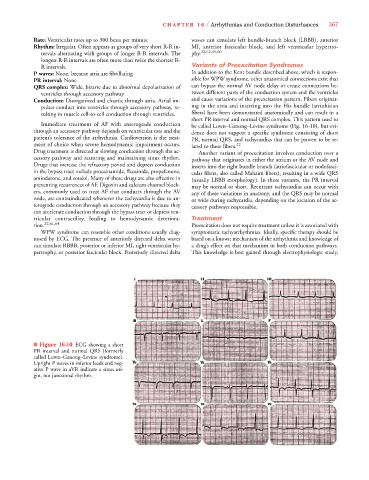
                                                                       short PR interval and normal QRS complex. This pattern used to
                     Immediate treatment of AF with anterograde conduction  be called Lown–Ganong–Levine syndrome (Fig. 16-10), but evi-
                   through an accessory pathway depends on ventricular rate and the  dence does not support a specific syndrome consisting of short
                   patient’s tolerance of the arrhythmia. Cardioversion is the treat-  PR, normal QRS, and tachycardias that can be proven to be re-
                   ment of choice when severe hemodynamic impairment occurs.  lated to these fibers. 22
                   Drug treatment is directed at slowing conduction through the ac-  Another variant of preexcitation involves conduction over a
                   cessory pathway and restoring and maintaining sinus rhythm.  pathway that originates in either the atrium or the AV node and
                   Drugs that increase the refractory period and depress conduction  inserts into the right bundle branch (atriofascicular or nodofasci-
                   in the bypass tract include procainamide, flecainide, propafenone,  cular fibers, also called Mahaim fibers), resulting in a wide QRS
                   amiodarone, and sotalol. Many of these drugs are also effective in  (usually LBBB morphology). In these variants, the PR interval
                   preventing recurrences of AF. Digoxin and calcium channel block-  may be normal or short. Reentrant tachycardias can occur with
                   ers, commonly used to treat AF that conducts through the AV  any of these variations in anatomy, and the QRS may be normal
                   node, are contraindicated whenever the tachycardia is due to an-  or wide during tachycardia, depending on the location of the ac-
                   terograde conduction through an accessory pathway because they  cessory pathways responsible.
                   can accelerate conduction through the bypass tract or depress ven-
                   tricular contractility,  leading to  hemodynamic  deteriora-  Treatment
                   tion. 22,61,64                                      Preexcitation does not require treatment unless it is associated with
                     WPW syndrome can resemble other conditions usually diag-  symptomatic tachyarrhythmias. Ideally, specific therapy should be
                   nosed by ECG. The presence of anteriorly directed delta waves  based on a known mechanism of the arrhythmia and knowledge of
                   can simulate RBBB, posterior or inferior MI, right ventricular hy-  a drug’s effect on that mechanism in both conduction pathways.
                   pertrophy, or posterior fascicular block. Posteriorly directed delta  This knowledge is best gained through electrophysiologic study,
                   ■ Figure 16-10 ECG showing a short
                   PR interval and normal QRS (formerly
                   called Lown–Ganong–Levine syndrome).
                   Upright P waves in inferior leads and neg-
                   ative P wave in aVR indicate a sinus ori-
                   gin, not junctional rhythm.

