


Page 397 - Cardiac Nursing
P. 397
6 A
                                     6 A
                                   2:1
                                   1
                                   2:1
                                        M
                                          Pa
                                           g
                                          Pa
                                        M
                                          Pa
                             6
                              /30
                             6
                           xd
                           xd
                              /30
                                    1
                                   1
                                /09
                                /09
                                /09
                                                  ara
                                                  ara
                                                  t
                                                 p
                                                  t
                                                   a
                                                      c.
                                                      c.
                                                     In
                                                   a
                                                     In
                                            e 3
                                              73
                                            e 3
                                           g
                                           g
                                              73
                                                 p
                                                 p
                                                A
                                              73
                                                A
                          q
                    33
                    33
                   p
                      3-3
                      3-3
         LWB
                   p
               0-c
            K34
            K34
                 16_
                 16_
               0-c
                        87.
         LWBK340-c16_ pp333-387.qxd  6/30/09  12:16 AM  Page 373 Aptara Inc.
         LWB
                        87.
                          q
                          q
                                                             C HAPTER 1 6 / Arrhythmias and Conduction Disturbances  373
                           MCL 1
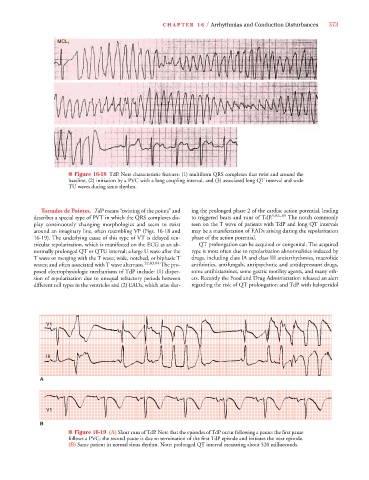
                              ■ Figure 16-18 TdP. Note characteristic features: (1) multiform QRS complexes that twist and around the
                              baseline, (2) initiation by a PVC with a long coupling interval, and (3) associated long QT interval and wide
                              TU waves during sinus rhythm.
                     Torsades de Pointes.  TdP means “twisting of the points” and  ing the prolonged phase 2 of the cardiac action potential, leading
                   describes a special type of PVT in which the QRS complexes dis-  to triggered beats and runs of TdP. 5,83–85  The notch commonly
                   play continuously changing morphologies and seem to twist  seen on the T wave of patients with TdP and long QT intervals
                   around an imaginary line, often resembling VF (Figs. 16-18 and  may be a manifestation of EADs arising during the repolarization
                   16-19). The underlying cause of this type of VT is delayed ven-  phase of the action potential.
                   tricular repolarization, which is manifested on the ECG as an ab-  QT prolongation can be acquired or congenital. The acquired
                   normally prolonged QT or QTU interval; a large U wave after the  type is most often due to repolarization abnormalities induced by
                   T wave or merging with the T wave; wide, notched, or biphasic T  drugs, including class IA and class III antiarrhythmics, macrolide
                   waves; and often associated with T wave alternans. 22,83,84  The pro-  antibiotics, antifungals, antipsychotic and antidepressant drugs,
                   posed electrophysiologic mechanisms of TdP include: (1) disper-  some antihistamines, some gastric motility agents, and many oth-
                   sion of repolarization due to unequal refractory periods between  ers. Recently the Food and Drug Administration released an alert
                   different cell types in the ventricles and (2) EADs, which arise dur-  regarding the risk of QT prolongation and TdP with haloperidol
                       V V1
                       V1
                       V1
                       III III
                     A
                       V1
                       V V V1
                       V V V V V V V1
                       V1
                       V1
                       V1
                       V V V1
                     B
                              ■ Figure 16-19 (A) Short runs of TdP. Note that the episodes of TdP occur following a pause: the first pause
                              follows a PVC; the second pause is due to termination of the first TdP episode and initiates the next episode.
                              (B) Same patient in normal sinus rhythm. Note: prolonged QT interval measuring about 520 milliseconds.

