


Page 396 - Cardiac Nursing
P. 396
6 A
                                     6 A
                                   2:1
                                   1
                                   2:1
                                        M
                                          Pa
                                           g
                                          Pa
                                        M
                                          Pa
                             6
                              /30
                             6
                           xd
                           xd
                              /30
                                    1
                                   1
                                /09
                                /09
                                /09
                                                  ara
                                                  ara
                                                  t
                                                 p
                                                  t
                                                   a
                                                      c.
                                                      c.
                                                     In
                                                   a
                                                     In
                                            e 3
                                              72
                                            e 3
                                           g
                                           g
                                              72
                                                 p
                                                 p
                                                A
                                              72
                                                A
                 16_
            K34
         LWB
                      3-3
            K34
                   p
                 16_
                   p
                    33
                    33
                        87.
                        87.
                          q
                          q
                          q
                      3-3
               0-c
               0-c
         LWBK340-c16_ pp333-387.qxd  6/30/09  12:16 AM  Page 372 Aptara Inc.
         LWB
                  372    P A R T  III / Assessment of Heart Disease
                     I
                     II
                     III
                   aVR
                   aVL
                   aVF
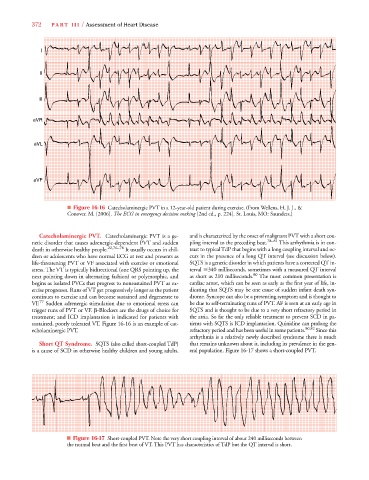
                              ■ Figure 16-16 Catecholaminergic PVT in a 12-year-old patient during exercise. (From Wellens, H. J. J., &
                              Conover. M. [2006]. The ECG in emergency decision making [2nd ed., p. 224]. St. Louis, MO: Saunders.)
                     Catecholaminergic PVT.  Catecholaminergic PVT is a ge-  and is characterized by the onset of malignant PVT with a short cou-
                  netic disorder that causes adrenergic-dependent PVT and sudden  pling interval to the preceding beat. 78–81  This arrhythmia is in con-
                  death in otherwise healthy people. 22,76–78  It usually occurs in chil-  trast to typical TdP that begins with a long coupling interval and oc-
                  dren or adolescents who have normal ECG at rest and presents as  curs in the presence of a long QT interval (see discussion below).
                  life-threatening PVT or VF associated with exercise or emotional  SQTS is a genetic disorder in which patients have a corrected QT in-
                  stress. The VT is typically bidirectional (one QRS pointing up, the  terval  340 milliseconds, sometimes with a measured QT interval
                  next pointing down in alternating fashion) or polymorphic, and  as short as 210 milliseconds. 80  The most common presentation is
                  begins as isolated PVCs that progress to nonsustained PVT as ex-  cardiac arrest, which can be seen as early as the first year of life, in-
                  ercise progresses. Runs of VT get progressively longer as the patient  dicating that SQTS may be one cause of sudden infant death syn-
                  continues to exercise and can become sustained and degenerate to  drome. Syncope can also be a presenting symptom and is thought to
                  VF. 77  Sudden adrenergic stimulation due to emotional stress can  be due to self-terminating runs of PVT. AF is seen at an early age in
                  trigger runs of PVT or VF.  -Blockers are the drugs of choice for  SQTS and is thought to be due to a very short refractory period in
                  treatment; and ICD implantation is indicated for patients with  the atria. So far the only reliable treatment to prevent SCD in pa-
                  sustained, poorly tolerated VT. Figure 16-16 is an example of cat-  tients with SQTS is ICD implantation. Quinidine can prolong the
                  echolaminergic PVT.                                 refractory period and has been useful in some patients. 80,82 Since this
                                                                      arrhythmia is a relatively newly described syndrome there is much
                     Short QT Syndrome. SQTS (also called short-coupled TdP)  that remains unknown about it, including its prevalence in the gen-
                  is a cause of SCD in otherwise healthy children and young adults,  eral population. Figure 16-17 shows a short-coupled PVT.
                              ■ Figure 16-17 Short-coupled PVT. Note the very short coupling interval of about 240 milliseconds between
                              the normal beat and the first beat of VT. This PVT has characteristics of TdP but the QT interval is short.

