


Page 399 - Cardiac Nursing
P. 399
2:1
                                   2:1
                                   1
                                    1
                                   1
                                     6 A
                                          Pa
                                          Pa
                                        M
                                     6 A
                                        M
                                /09
                           xd
                           xd
                          q
                          q
                          q
                             6
                                /09
                                /09
                              /30
                             6
                              /30
                                          Pa
                                                  ara
                                                  ara
                                                  t
                                                 p
                                                  t
                                                   a
                                                      c.
                                                      c.
                                                     In
                                                   a
                                                     In
                                                 p
                                            e 3
                                            e 3
                                           g
                                           g
                                           g
                                              75
                                                A
                                                 p
                                                A
                                              75
                                              75
                 16_
                    33
                    33
         LWB K34 0-c 16_ p p pp333-387.qxd  6/30/09  12:16 AM  Page 375 Aptara Inc.
         LWB
         LWBK340-c16_
               0-c
                        87.
                        87.
                      3-3
            K34
                      3-3
                                                             C HAPTER 1 6 / Arrhythmias and Conduction Disturbances  375
                        Beat 1          Beat 2       Beat 3
                                           LBB
                              Short Cycle  RBB
                                                            V V V1
                                                            V1
                                                            V1 1
                                           LBB
                                                                R R R R
                           Long Cycle
                                           RBB
                                                              r r r
                                                               s s s s
                                                                 V1
                                                                 V V V1
                                                                 V1
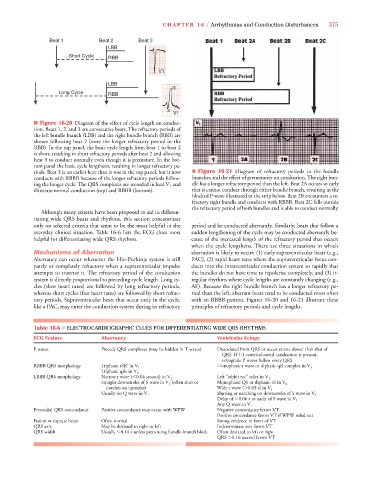
                   ■ Figure 16-20 Diagram of the effect of cycle length on conduc-
                   tion. Beats 1, 2, and 3 are consecutive beats. The refractory periods of
                   the left bundle branch (LBB) and the right bundle branch (RBB) are
                   shown following beat 2 (note the longer refractory period in the
                   RBB). In the top panel, the basic cycle length from beat 1 to beat 2
                   is short, resulting in short refractory periods after beat 2 and allowing
                   beat 3 to conduct normally even though it is premature. In the bot-
                   tom panel the basic cycle lengthens, resulting in longer refractory pe-
                   riods. Beat 3 is no earlier here than it was in the top panel, but it now  ■ Figure 16-21 Diagram of refractory periods in the bundle
                   conducts with RBBB because of the longer refractory periods follow-  branches and the effect of prematurity on conduction. The right bun-
                   ing the longer cycle. The QRS complexes are recorded in lead V 1 and  dle has a longer refractory period than the left. Beat 2A occurs so early
                   illustrate normal conduction (top) and RBBB (bottom).  that it cannot conduct through either bundle branch, resulting in the
                                                                       blocked P wave illustrated in the strip below. Beat 2B encounters a re-
                                                                       fractory right bundle and conducts with RBBB. Beat 2C falls outside
                                                                       the refractory period of both bundles and is able to conduct normally.
                     Although many criteria have been proposed to aid in differen-
                   tiating wide QRS beats and rhythms, this section concentrates
                   only on selected criteria that seem to be the most helpful in the  period and be conducted aberrantly. Similarly, beats that follow a
                   everyday clinical situation. Table 16-6 lists the ECG clues most  sudden lengthening of the cycle may be conducted aberrantly be-
                   helpful for differentiating wide QRS rhythms.       cause of the increased length of the refractory period that occurs
                                                                       when the cycle lengthens. There are three situations in which
                   Mechanisms of Aberration                            aberration is likely to occur: (1) early supraventricular beats (e.g.,
                   Aberrancy can occur whenever the His–Purkinje system is still  PAC), (2) rapid heart rates where the supraventricular focus con-
                   partly or completely refractory when a supraventricular impulse  ducts into the intraventricular conduction system so rapidly that
                   attempts to traverse it. The refractory period of the conduction  the bundles do not have time to repolarize completely, and (3) ir-
                   system is directly proportional to preceding cycle length. Long cy-  regular rhythms where cycle lengths are constantly changing (e.g.,
                   cles (slow heart rates) are followed by long refractory periods,  AF). Because the right bundle branch has a longer refractory pe-
                   whereas short cycles (fast heart rates) are followed by short refrac-  riod than the left, aberrant beats tend to be conducted most often
                   tory periods. Supraventricular beats that occur early in the cycle,  with an RBBB pattern. Figures 16-20 and 16-21 illustrate these
                   like a PAC, may enter the conduction system during its refractory  principles of refractory periods and cycle lengths.
                   Table 16-6 ■ ELECTROCARDIOGRAPHIC CLUES FOR DIFFERENTIATING WIDE QRS RHYTHMS
                   ECG Feature           Aberrancy                             Ventricular Ectopy
                   P waves               Precede QRS complexes (may be hidden in T waves)  Dissociated from QRS or occur at rate slower than that of
                                                                                 QRS. If 1:1 ventriculoatrial conduction is present,
                                                                                 retrograde P waves follow every QRS
                   RBBB QRS morphology   Triphasic rSR’ in V 1                 Monophasic r wave or diphasic qR complex in V 1
                                         Triphasic qRs in V 6
                   LBBB QRS morphology   Narrow r wave ( 0.04 second) in V 1   Left “rabbit ear” taller in V 1
                                         Straight downstroke of S wave in V 1 (often slurs or   Monophasic QS or diphasic rS in V 6
                                           notches on upstroke)                Wide r wave ( 0.03 s) in V 1
                                         Usually no Q wave in V 6              Slurring or notching on downstroke of S wave in V 1
                                                                               Delay of  0.06 s to nadir of S wave in V 1
                                                                               Any Q wave in V 6
                   Precordial QRS concordance  Positive concordance may occur with WPW  Negative concordance favors VT
                                                                               Positive concordance favors VT if WPW ruled out
                   Fusion or capture beats  Often normal                       Strong evidence in favor of VT
                   QRS axis              May be deviated to right or left      Indeterminate axis favors VT
                   QRS width             Usually  0.14 s unless preexisting bundle-branch block  Often deviated to left or right
                                                                               QRS  0.16 second favors VT

