


Page 402 - Cardiac Nursing
P. 402
e 3
                                            e 3
                              6
                             6
                              /30
                                           g
                             6
                           xd
                           xd
                          q
                                                A
                                              78
                                              78
                                                A
                              /30
                                     6 A
                                   2:1
                                   2:1
                                     6 A
                                          Pa
                                        M
                                        M
                                          Pa
                                           g
                                           g
                                /09
                                   1
                                   1
                                /09
                          q
                                                     In
                                                      c.
                                                      c.
                                                     In
                                                  ara
                                                   a
                                                   a
         LWBK340-c16_
         LWB
         LWB K34 0-c 16_ p p pp333-387.qxd  6/30/09  12:16 AM  Page 378 Aptara Inc.
            K34
                                                      c.
                 16_
               0-c
                      3-3
                      3-3
                    33
                        87.
                          q
                                                A
                        87.
                                                  t
                                                 p
                                                  ara
                                                  t
                    33
                                                 p
                                                 p
                  378    P A R T  III / Assessment of Heart Disease
                             I                   aVR                  V1                     V4
                             II                  aVL                  V2                     V5
                             III                 aVF                  V3                     V6
                           A
                            I                    aVR                   V1                    V4
                            II                   aVL                   V2                    V5
                           III                   aVF                   V3                    V6
                          B B
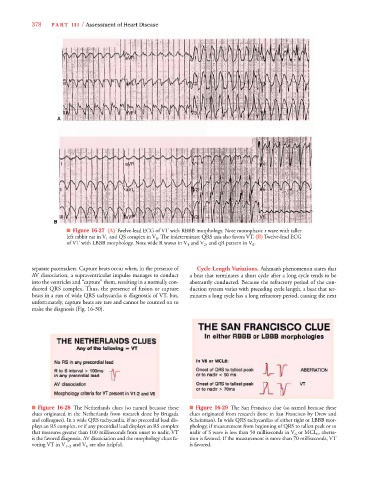
                              ■ Figure 16-27 (A) Twelve-lead ECG of VT with RBBB morphology. Note monophasic r wave with taller
                              left rabbit ear in V 1 and QS complex in V 6 . The indeterminate QRS axis also favors VT. (B) Twelve-lead ECG
                                                                         V
                              of VT with LBBB morphology. Note wide R waves in V 1 and V 2 , and qR pattern in V 6 .
                  separate pacemakers. Capture beats occur when, in the presence of  Cycle Length Variations. Ashman’s phenomenon states that
                  AV dissociation, a supraventricular impulse manages to conduct  a beat that terminates a short cycle after a long cycle tends to be
                  into the ventricles and “capture” them, resulting in a normally con-  aberrantly conducted. Because the refractory period of the con-
                  ducted QRS complex. Thus, the presence of fusion or capture  duction system varies with preceding cycle length, a beat that ter-
                  beats in a run of wide QRS tachycardia is diagnostic of VT, but,  minates a long cycle has a long refractory period, causing the next
                  unfortunately, capture beats are rare and cannot be counted on to
                  make the diagnosis (Fig. 16-30).


                  ■ Figure 16-28 The Netherlands clues (so named because these  ■ Figure 16-29 The San Francisco clue (so named because these
                  clues originated in the Netherlands from research done by Brugada  clues originated from research done in San Francisco by Drew and
                  and colleagues). In a wide QRS tachycardia, if no precordial lead dis-  Scheinman). In wide QRS tachycardias of either right or LBBB mor-
                  plays an RS complex, or if any precordial lead displays an RS complex  phology, if measurement from beginning of QRS to tallest peak or to
                  that measures greater than 100 milliseconds from onset to nadir, VT  nadir of S wave is less than 50 milliseconds in V 6 or MCL 6 , aberra-
                  is the favored diagnosis. AV dissociation and the morphology clues fa-  tion is favored. If the measurement is more than 70 milliseconds, VT
                  voring VT in V 1–2 and V 6 are also helpful.        is favored.

