


Page 493 - Cardiac Nursing
P. 493
9/0
                               0
                                  9/2
                                        8:2
                                    009
                       0-5
                    p46
                         10.
                           qxd
                         10.
                                                    69
                                                  e 4
                                                    69
                                                         ara
                                                       Apt
                                             M
                                           8 A
                                               P
                                                 g
                                               P
            K34
            K34
                 21_
               0-c
         LWBK340-c21_21_p460-510.qxd  09/09/2009  08:28 AM  Page 469 Aptara
         L L LWB K34 0-c 21_ p46 0-5 10. qxd  0 9/0 9/2 009  0 0 8:2 8 A M  P a a g e 4 69  Apt ara
         LWB
                                                                           C HAPTER 2 1 / Hemodynamic Monitoring   469
                      CVP MONITORING                                   or dorsal hand veins 120,121  or from a lower extremity insertion
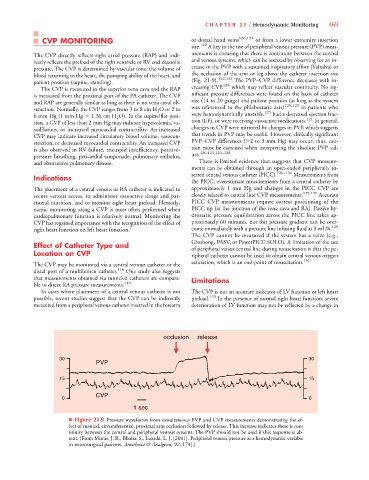
                                                                       site. 122  A key to the use of peripheral venous pressure (PVP) meas-
                   The CVP directly reflects right atrial pressure (RAP) and indi-  urements is ensuring that there is continuity between the central
                   rectly reflects the preload of the right ventricle or RV end-diastolic  and venous systems, which can be assessed by observing for an in-
                   pressure. The CVP is determinedby vascular tone, the volume of  crease in the PVP with a sustained inspiratory effort (Valsalva) or
                   blood returning to the heart, the pumping ability of the heart, and  the occlusion of the arm or leg above the catheter insertion site
                                                                               122,123
                   patient position (supine, standing).                (Fig. 21-9).  124  The PVP–CVP difference decreases with in-
                     The CVP is measured in the superior vena cava and the RAP  creasing CVP,  which may reflect vascular continuity. No sig-
                   is measuredfrom the proximal port of the PA catheter. The CVP  nificant pressure differences were found on the basis of catheter
                   and RAP are generally similar as long as there is no vena caval ob-  size (14 to 20 gauge) and patient position (as long as the system
                                                                                                     120,122
                   struction. Normally, the CVP ranges from 3 to 8 cm H 2 O or 2 to  was referenced to the phlebostatic axis)  in patients who
                                                                                               125
                   6 mm Hg(1 mm Hg   1.36 cm H 2 O). In the supine/flat posi-  were hemodynamically unstable,  had a decreased ejection frac-
                                                                                                            121
                   tion, a CVP ofless than 2 mm Hg may indicate hypovolemia, va-  tion (EF), or were receiving vasoactive medications.  In general,
                   sodilation, or increased myocardial contractility. An increased  changes in CVP were mirrored by changes in PVP, which suggests
                   CVP may indicate increased circulatoryblood volume, vasocon-  that trends in PVP may be useful. However, clinically significant
                   striction, or decreased myocardial contractility. An increased CVP  PVP–CVP differences ( 2 to 3 mm Hg) may occur; thus, cau-
                   is also observed in RV failure, tricuspid insufficiency, positive-  tion must be exercised when interpreting the absolute PVP val-
                                                                         120,121,123–128
                   pressure breathing, pericardial tamponade, pulmonary embolus,  ues.
                   and obstructive pulmonary disease.                    There is limited evidence that suggests that CVP measure-
                                                                       ments can be obtained through an open-ended peripherally in-
                                                                       serted central venous catheter (PICC). 129–131  Measurements from
                   Indications
                                                                       the PICC, overestimate measurements from a central catheter by
                   The placement of a central venous or RA catheter is indicated to  approximately 1 mm Hg and changes in the PICC CVP are
                   secure venous access, to administer vasoactive drugs and par-  closely related to central line CVP measurements. 129,131  Accurate
                   enteral nutrition, and to monitor right heart preload. Hemody-  PICC CVP measurements require correct positioning of the
                   namic monitoring using a CVP is most often performed when  PICC tip (at the junction of the vena cava and RA). Passive hy-
                   cardiopulmonary function is relatively normal. Monitoring the  drostatic pressure equilibration across the PICC line takes ap-
                   CVP has regained importance with the recognition of the effect of  proximately 60 minutes, but this pressure gradient can be over-
                   right heart function on left heart function. 7      come immediately with a pressure line infusing fluid at 3 mL/h. 129
                                                                       The CVP cannot be measured if the system has a valve (e.g.,
                                                                       Groshong, PASV, or PowerPICC SOLO). A limitation of the use
                   Effect of Catheter Type and                         of peripheral versus central line during resuscitation is that the pe-
                   Location on CVP                                     ripheral catheter cannot be used to obtain central venous oxygen
                                                                       saturation, which is an end-point of resuscitation. 132
                   The CVP may be monitored via a central venous catheter or the
                   distal port of a multilumen catheter. 118  One study also suggests
                   that measurements obtained via tunneled catheters are compara-  Limitations
                   ble to direct RA pressure measurements. 119
                     In cases where placement of a central venous catheter is not  The CVP is not an accurate indicator of LV function or left heart
                   possible, recent studies suggest that the CVP can be indirectly  preload. 133  In the presence of normal right heart function, severe
                   measured from a peripheral venous catheter inserted in the forearm  deterioration of LV function may not be reflected by a change in
                                                             occlusion   release
                           30                                                                                30
                                       PVP

                           15                                                                                15

                                       CVP
                            0                                                                                0
                                                    1 sec

                              ■ Figure 21-9 Pressure waveforms from simultaneous PVP and CVP measurements demonstrating the ef-
                              fect of manual, circumferential, proximal arm occlusion followed by release. This increase indicates there is con-
                              tinuity between the central and peripheral venous systems. The PVP should not be used if this response is ab-
                              sent. (From Munis, J. R., Bhatia, S., Lozada, L. J. [2001]. Peripheral venous pressure as a hemodynamic variable
                              in neurosurgical patients. Anesthesia & Analgesia, 92, 174[.)

