


Page 495 - Cardiac Nursing
P. 495
8:2
                                    009
                                  9/2
                                           8 A
                                               P
                                               P
                                             M
                         10.
                       0-5
                    p46
                         10.
                                9/0
                               0
                           qxd
                                                 g
            K34
               0-c
                 21_
            K34
         LWB K34 0-c 21_ p46 0-5 10. qxd  0 9/0 9/2 009  0 0 8:2 8 A M  P a a g e 4 71  Apt ara
         L L LWB
         LWBK340-c21_21_p460-510.qxd  09/09/2009  08:28 AM  Page 471 Aptara
                                                    71
                                                    71
                                                  e 4
                                                       Apt
                                                         ara
                                                                           C HAPTER 2 1 / Hemodynamic Monitoring   471
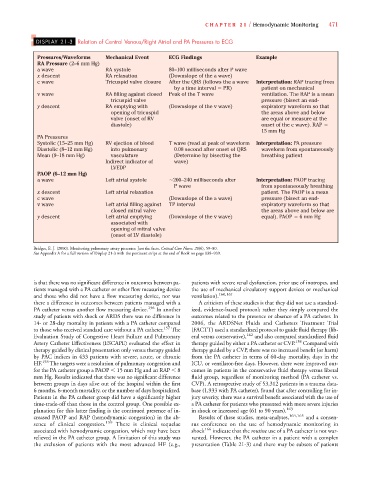
                    DISPLAY 21-3 Relation of Central Venous/Right Atrial and PA Pressures to ECG
                    Pressures/Waveforms    Mechanical Event    ECG Findings                 Example
                    RA Pressure (2–6 mm Hg)
                    a wave                 RA systole          80–100 milliseconds after P wave
                    x descent              RA relaxation       (Downslope of the a wave)
                    c wave                 Tricuspid valve closure  After the QRS (follows the a wave   Interpretation: RAP tracing from
                                                                 by a time interval   PR)    patient on mechanical
                    v wave                 RA filling against closed   Peak of the T wave     ventilation. The RAP is a mean
                                            tricuspid valve                                  pressure (bisect an end-
                    y descent              RA emptying with    (Downslope of the v wave)     expiratory waveform so that
                                            opening of tricuspid                             the areas above and below
                                            valve (onset of RV                               are equal or measure at the
                                            diastole)                                        onset of the c wave). RAP
                                                                                             15 mm Hg
                    PA Pressures
                    Systolic (15–25 mm Hg)  RV ejection of blood   T wave (read at peak of waveform  Interpretation: PA pressure
                    Diastolic (8–12 mm Hg)  into pulmonary       0.08 second after onset of QRS   waveform from spontaneously
                    Mean (9–18 mm Hg)       vasculature          (Determine by bisecting the   breathing patient
                                           Indirect indicator of   wave)
                                            LVEDP
                    PAOP (6–12 mm Hg)
                    a wave                 Left atrial systole   200–240 milliseconds after   Interpretation: PAOP tracing
                                                                 P wave                      from spontaneously breathing
                    x descent              Left atrial relaxation                            patient. The PAOP is a mean
                    c wave                                     (Downslope of the a wave)     pressure (bisect an end-
                    v wave                 Left atrial filling against   TP interval          expiratory waveform so that
                                            closed mitral valve                              the areas above and below are
                    y descent              Left atrial emptying   (Downslope of the v wave)  equal). PAOP   6 mm Hg
                                            associated with
                                            opening of mitral valve
                                            (onset of LV diastole)
                   Bridges, E. J. (2000). Monitoring pulmonary artery pressures: Just the facts. Critical Care Nurse, 20(6), 59–80.
                   See Appendix A for a full version of Display 21-3 with the pertinent strips at the end of Book on page 938–939.
                   is that there was no significant difference in outcomes between pa-  patients with severe renal dysfunction, prior use of inotropes, and
                   tients managed with a PA catheter or other flow measuring device  the use of mechanical circulatory support devices or mechanical
                   and those who did not have a flow measuring device, nor was  ventilation). 160,161
                   there a difference in outcomes between patients managed with a  A criticism of these studies is that they did not use a standard-
                   PA catheter versus another flow measuring device. 156  In another  ized, evidence-based protocol; rather they simply compared the
                   study of patients with shock or ARDS there was no difference in  outcomes related to the presence or absence of a PA catheter. In
                   14- or 28-day mortality in patients with a PA catheter compared  2006, the ARDSNet Fluids and Catheters  Treatment  Trial
                   to those who received standard care without a PA catheter. 157  The  (FACTT) used a standardized protocol to guide fluid therapy (lib-
                   Evaluation Study of Congestive Heart Failure and Pulmonary  eral versus conservative), 162  and also compared standardized fluid
                   Artery Catheter Effectiveness (ESCAPE) evaluated the effect in  therapy guided by either a PA catheter or CVP. 138  Compared with
                   therapy guided by clinical presentation only versus therapy guided  therapy guided by a CVP, there was no increased benefit (or harm)
                   by PAC indices in 433 patients with severe, acute, or chronic  from the PA catheter in terms of 60-day mortality, days in the
                   HF. 158 The targets were a resolution of pulmonary congestion and  ICU, or ventilator-free days. However, there were improved out-
                   for the PA catheter group a PAOP   15 mm Hg and an RAP   8  comes in patients in the conservative fluid therapy versus liberal
                   mm Hg. Results indicated that there was no significant difference  fluid group, regardless of monitoring method (PA catheter vs.
                   between groups in days alive out of the hospital within the first  CVP). A retrospective study of 53,312 patients in a trauma data-
                   6 months, 6-month mortality, or the number of days hospitalized.  base (1,933 with PA catheter), found that after controlling for in-
                   Patients in the PA catheter group did have a significantly higher  jury severity, there was a survival benefit associated with the use of
                   time-trade-off than those in the control group. One possible ex-  a PA catheter for patients who presented with more severe injuries
                   planation for this latter finding is the continued presence of in-  in shock or increased age (61 to 90 years). 163
                   creased PAOP and RAP (hemodynamic congestion) in the ab-  Results of these studies, meta-analyses, 164,165  and a consen-
                   sence of clinical congestion. 159  There is clinical sequelae  sus conference on the use of hemodynamic monitoring in
                   associated with hemodynamic congestion, which may have been  shock 166  indicate that the routine use of a PA catheter is not war-
                   relieved in the PA catheter group. A limitation of this study was  ranted. However, the PA catheter in a patient with a complex
                   the exclusion of patients with the most advanced HF (e.g.,  presentation (Table 21-3) and there may be subsets of patients

