


Page 496 - Cardiac Nursing
P. 496
9/0
                               0
                                  9/2
                                        8:2
                                    009
                       0-5
                    p46
                         10.
                           qxd
                         10.
                                                    72
                                                  e 4
                                                    72
                                                         ara
                                                       Apt
                                             M
                                           8 A
                                               P
                                                 g
                                               P
            K34
               0-c
                 21_
            K34
         LWB K34 0-c 21_ p46 0-5 10. qxd  0 9/0 9/2 009  0 0 8:2 8 A M  P a a g e 4 72  Apt ara
         L L LWB
         LWBK340-c21_21_p460-510.qxd  09/09/2009  08:28 AM  Page 472 Aptara
                  472    P A R T  III / Assessment of Heart Disease
                                                                      available (Fig. 21-11). The thermodilution catheter is 7.5 Fr in di-
                                                                      ameter and 110 cm long and is marked in 10-cm increments. The
                                                                      balloon is inflated with a maximum of 1.5 mL of air.
                                                                      Insertion of the PA Catheter
                                                                      The catheter is inserted percutaneously. Once the RA is reached,
                                                                      the balloon, located on the distal end of the catheter, is inflated
                   A
                                                                      and the catheter is “floated” through the RA and RV and out into
                                                                      the PA, where it occludes a branch of the PA. After the character-
                                                                      istic PAOP tracing has been obtained, the balloon is deflated, al-
                                                                      lowing the catheter to recoil slightly into the PA. The catheter is
                                                                      left in the balloon-down position to prevent pulmonary infarc-
                                                                      tion. The nursing responsibilities during insertion of the PA
                                                                      catheter are summarized in Display 21-5.
                                                                      PA Waveform Characteristics
                       30
                       20
                                                                      As the catheter passes through the heart, three pressure waveforms
                       10                                             can be visualized using a PA catheter: RA, PA, and PAOP (Fig.
                                                                         2
                                                                         2
                       0                                              21-12A).
                   B
                                                                      PA Pressure
                                                                      PA pressures provide an index of the pressure within the pul-
                                                                      monary vasculature and are affected by compliance of the LV, pul-
                                                                      monary vascular pressure, CO, and the state of the lung tissue. In
                                                                      individuals without preexisting cardiopulmonary disease, PA pres-
                                                                      sure increases slightly with age (older than 60 years, PA mean
                                                                        16   3 mm Hg; younger than 60 years, PA mean   12
                                                                      2 mm Hg). 172  Similarly, in individuals with hypertension without
                      60                              60              other cardiac disease there is also an age-related increase in PA
                                                                      pressures (aged less than 45 years, PA mean   17   5 mm Hg;
                      40                              40
                                                                      aged 45 to 64 years, PA mean   18   6 mm Hg, and aged greater
                      20                              20
                                                                      than or equal to 65 years, PA mean   21   8 mm Hg). 173
                       0                              0
                   C                                                    Three PA pressures are measured: systolic, diastolic, and mean.
                                                                      The PA systolic (PAS) pressure reflects the flow of blood into the PA
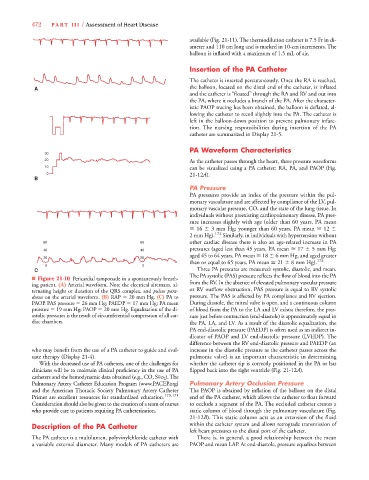
                  ■ Figure 21-10 Pericardial tamponade in a spontaneously breath-
                  ing patient. (A) Arterial waveform. Note the electrical alternans, al-  from the RV. In the absence of elevated pulmonary vascular pressure
                  ternating height or duration of the QRS complex, and pulsus para-  or RV outflow obstruction, PAS pressure is equal to RV systolic
                  doxus on the arterial waveform. (B) RAP   20 mm Hg. (C) PA to  pressure. The PAS is affected by PA compliance and RV ejection.
                  PAOP. PAS pressure   26 mm Hg; PAEDP   17 mm Hg; PA mean  During diastole, the mitral valve is open, and a continuous column
                  pressure   19 mm Hg; PAOP   20 mm Hg. Equalization of the di-  of blood from the PA to the LA and LV exists; therefore, the pres-
                  astolic pressures is the result of circumferential compression of all car-  sure just before contraction (end-diastole) is approximately equal in
                  diac chambers.                                      the PA, LA, and LV. As a result of the diastolic equalization, the
                                                                      PA end-diastolic pressure (PAEDP) is often used as an indirect in-
                                                                      dicator of PAOP and LV end-diastolic pressure (LVEDP). The
                                                                      difference between the RV end-diastolic pressure and PAEDP (an
                  who may benefit from the use of a PA catheter to guide and eval-  increase in the diastolic pressure as the catheter passes across the
                  uate therapy (Display 21-4).                        pulmonic valve) is an important characteristic in determining
                     With the decreased use of PA catheters, one of the challenges for  whether the catheter tip is correctly positioned in the PA or has
                  clinicians will be to maintain clinical proficiency in the use of PA  flipped back into the right ventricle (Fig. 21-12A).
                                                                                                        2
                                                                                                        2
                  catheters and the hemodynamic data obtained (e.g., CO,   ). The
                  Pulmonary Artery Catheter Education Program (www.PACEP.org)  Pulmonary Artery Occlusion Pressure
                  and the American Thoracic Society Pulmonary Artery Catheter  The PAOP is obtained by inflation of the balloon on the distal
                  Primer are excellent resources for standardized education. 170,171  end of the PA catheter, which allows the catheter to float forward
                  Consideration should also be given to the creation of a team of nurses  to occlude a segment of the PA. The occluded catheter creates a
                  who provide care to patients requiring PA catheterization.  static column of blood through the pulmonary vasculature (Fig.
                                                                      21-12B). This static column acts as an extension of the fluid
                  Description of the PA Catheter                      within the catheter system and allows retrograde transmission of
                                                                      left heart pressures to the distal port of the catheter.
                  The PA catheter is a multilumen, polyvinylchloride catheter with  There is, in general, a good relationship between the mean
                  a variable external diameter. Many models of PA catheters are  PAOP and mean LAP. At end-diastole, pressure equalizes between

