


Page 498 - Cardiac Nursing
P. 498
74
                                                    74
                                                  e 4
                                               P
                                                 g
                                           8 A
                    p46
                                                         ara
                       0-5
                                                       Apt
                                9/0
                               0
                                  9/2
                                        8:2
                                    009
                                             M
                                               P
                         10.
                           qxd
                         10.
            K34
                 21_
               0-c
            K34
         L L LWB
         LWB K34 0-c 21_ p46 0-5 10. qxd  0 9/0 9/2 009  0 0 8:2 8 A M  P a a g e 4 74  Apt ara
         LWBK340-c21_21_p460-510.qxd  09/09/2009  08:28 AM  Page 474 Aptara
                  474    P A R T  III / Assessment of Heart Disease
                         Thermistor connector         Balloon inflation       Proximal infusion
                                                      valve                   port @ 31 cm
                                                                                                              Thermistor
                   Distal lumen hub          Proximal injectate              Proximal injectate    Balloon
                                             lumen hub                       port @ 30 cm
                            Proximal infusion
                            lumen hub
                                                                                              Distal lumen
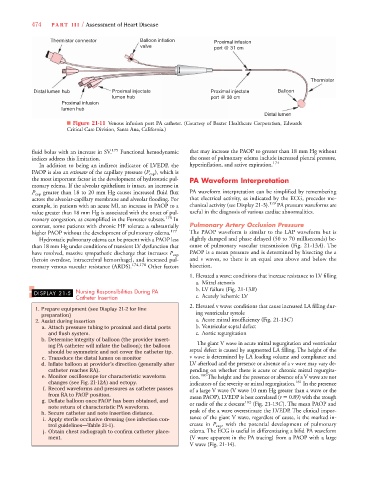
                              ■ Figure 21-11 Venous infusion port PA catheter. (Courtesy of Baxter Healthcare Corporation, Edwards
                              Critical Care Division, Santa Ana, California.)
                  fluid bolus with an increase in SV. 175  Functional hemodynamic  that may increase the PAOP to greater than 18 mm Hg without
                  indices address this limitation.                    the onset of pulmonary edema include increased pleural pressure,
                     In addition to being an indirect indicator of LVEDP, the  hyperinflation, and active expiration. 174
                                                        P P
                  PAOP is also an estimate of the capillary pressure (P cap ), which is
                  the most important factor in the development of hydrostatic pul-  PA Waveform Interpretation
                  monary edema. If the alveolar epithelium is intact, an increase in
                  P cap greater than 18 to 20 mm Hg causes increased fluid flux  PA waveform interpretation can be simplified by remembering
                  P
                  across the alveolar-capillary membrane and alveolar flooding. For  that electrical activity, as indicated by the ECG, precedes me-
                  example, in patients with an acute MI, an increase in PAOP to a  chanical activity (see Display 21-3). 179  PA pressure waveforms are
                  value greater than 18 mm Hg is associated with the onset of pul-  useful in the diagnosis of various cardiac abnormalities.
                  monary congestion, as exemplified in the Forrester subsets. 176  In
                  contrast, some patients with chronic HF tolerate a substantially  Pulmonary Artery Occlusion Pressure
                  higher PAOP without the development of pulmonary edema. 177  The PAOP waveform is similar to the LAP waveform but is
                     Hydrostatic pulmonary edema can be present with a PAOP less  slightly damped and phase delayed (50 to 70 milliseconds) be-
                  than 18 mm Hg under conditions of transient LV dysfunction that  cause of pulmonary vascular transmission (Fig. 21-13A). The
                                                               P P    PAOP is a mean pressure and is determined by bisecting the a
                  have resolved, massive sympathetic discharge that increases P cap
                  (heroin overdose, intracerebral hemorrhage), and increased pul-  and v waves, so there is an equal area above and below the
                  monary venous vascular resistance (ARDS). 174,178  Other factors  bisection.
                                                                      1. Elevated a wave: conditions that increase resistance to LV filling
                                                                        a. Mitral stenosis
                   DISPLAY 21-5  Nursing Responsibilities During PA     b. LV failure (Fig. 21-13B)
                                 Catheter Insertion                     c. Acutely ischemic LV
                                                                      2.Elevated v wave: conditions that cause increased LA filling dur-
                    1. Prepare equipment (see Display 21-2 for line
                     preparation)                                       ing ventricular systole
                    2. Assist during insertion                          a. Acute mitral insufficiency (Fig. 21-13C )
                      a. Attach pressure tubing to proximal and distal ports  b. Ventricular septal defect
                        and flush system.                                c. Aortic regurgitation
                      b. Determine integrity of balloon (the provider insert-
                        ing PA catheter will inflate the balloon); the balloon  The giant V wave in acute mitral regurgitation and ventricular
                        should be symmetric and not cover the catheter tip.  septal defect is caused by augmented LA filling. The height of the
                      c. Transduce the distal lumen on monitor        v wave is determined by LA loading volume and compliance and
                      d. Inflate balloon at provider’s direction (generally after  LV afterload and the presence or absence of a v wave may vary de-
                        catheter reaches RA).                         pending on whether there is acute or chronic mitral regurgita-
                      e. Monitor oscilloscope for characteristic waveform  tion. 180 The height and the presence or absence of a V wave are not
                                         2
                                         2
                        changes (see Fig. 21-12A) and ectopy.         indicators of the severity or mitral regurgitation. 181  In the presence
                      f. Record waveforms and pressures as catheter passes  of a large V wave (V wave 10 mm Hg greater than a wave or the
                        from RA to PAOP position.                     mean PAOP), LVEDP is best correlated (r   0.89) with the trough
                      g. Deflate balloon once PAOP has been obtained, and  or nadir of the x descent 182  (Fig. 21-13C). The mean PAOP and
                        note return of characteristic PA waveform.
                      h. Secure catheter and note insertion distance.  peak of the a wave overestimate the LVEDP. The clinical impor-
                      i. Apply sterile occlusive dressing (see infection con-  tance of the giant V wave, regardless of cause, is the marked in-
                                                                              P
                        trol guidelines—Table 21-1).                  crease  in P cap , with the  potential development of  pulmonary
                      j. Obtain chest radiograph to confirm catheter place-  edema. The ECG is useful in differentiating a bifid PA waveform
                        ment.                                         (V wave apparent in the PA tracing) from a PAOP with a large
                                                                      V wave (Fig. 21-14).

