


Page 497 - Cardiac Nursing
P. 497
9/0
                               0
                                  9/2
                                        8:2
                                    009
                       0-5
                    p46
                         10.
                           qxd
                         10.
                                                    73
                                                  e 4
                                                    73
                                                         ara
                                                       Apt
                                             M
                                           8 A
                                               P
                                                 g
                                               P
            K34
               0-c
                 21_
            K34
         LWB K34 0-c 21_ p46 0-5 10. qxd  0 9/0 9/2 009  0 0 8:2 8 A M  P a a g e 4 73  Apt ara
         L L LWB
         LWBK340-c21_21_p460-510.qxd  09/09/2009  08:28 AM  Page 473 Aptara
                                                                           C HAPTER 2 1 / Hemodynamic Monitoring   473
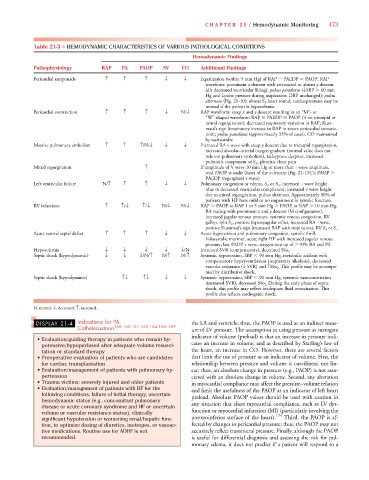
                   Table 21-3 ■ HEMODYNAMIC CHARACTERISTICS OF VARIOUS PATHOLOGICAL CONDITIONS
                                                                       Hemodynamic Findings
                   Pathophysiology       RAP    PA    PAOP   SV    CO     Additional Findings
                   Pericardial tamponade  ↑     ↑      ↑      ↓     ↓     Equalization (within 5 mm Hg) of RAP   PAEDP   PAOP; RAP
                                                                           waveform: prominent x descent with attenuated or absent y descent
                                                                           (d/t decreased ventricular filling); pulsus paradoxus (↓SBP   10 mm
                                                                           Hg and ↓pulse pressure during inspiration; DBP unchanged); pulsus
                                                                           alternans (Fig. 21-10); absent S 3 heart sound; cardiacpressures may be
                                                                           normal if the patient is hypovolemic
                   Pericardial constriction  ↑  ↑      ↑      ↓    N/↓    RAP waveform: steep x and y descent resulting in an “M”- or
                                                                           “W”-shaped waveform; RAP   PAEDP   PAOP (if no tricuspid or
                                                                           mitral regurgitation); decreased respiratory variation in RAP; Kuss-
                                                                           maul’s sign (inspiratory increase in RAP in severe pericardial constric-
                                                                           tion); pulsus paradoxus (approximately 33% of cases). CO maintained
                                                                           by tachycardia
                   Massive pulmonary embolism  ↑  ↑   ↑/N/↓   ↓     ↓     Increased RA v wave with steep y descent due to tricuspid regurgitation,
                                                                           increased alveolar–arterial oxygen gradient (normal value does not
                                                                           rule out pulmonary embolism), tachypnea, dyspnea, increased
                                                                           pulmonic component of S 2 , pleuritic chest pain
                   Mitral regurgitation                ↑                  If amplitude of V wave 10 mm Hg or more than a wave amplitude,
                                                                           read PAOP at nadir (base) of the x descent (Fig. 21-13C ); PAOP
                                                                           PAEDP (regurgitant v wave)
                   Left ventricular failure  N/↑  ↑    ↑      ↓     ↓     Pulmonary congestion or edema, S 3 or S 4 , increased a wave height
                                                                           (due to decreased ventricular compliance); increased v wave height
                                                                           due to mitral regurgitation, pulsus alternans. Approximately 50% of
                                                                           patients with HF have mild or no impairment in systolic function
                   RV infarction          ↑     ↑/↓    ↑/↓   N/↓   N/↓    RAP   PAOP or RAP 1 to 5 mm Hg   PAOP, or RAP   10 mm Hg,
                                                                           RA tracing with prominent x and y descent (M configuration),
                                                                           increased jugular venous pressure, systemic venous congestion, RV
                                                                           gallop, split S 2 , positive hepatojugular reflux, increased RA a wave,
                                                                           positive Kussmaul’s sign (increased RAP with inspiration), RV S 3  or S 4
                   Acute ventral septal defect  ↑  ↑   ↑      ↓     ↓     Acute hypotension and pulmonary congestion, systolic thrill,
                                                                           holosystolic murmur, acute right HF with increased jugular venous
                                                                           pressure, late PAOP v wave, oxygen step up of  10% RA and PA
                   Hypovolemia            ↓     ↓      ↓      ↓    ↓/N    Increased SVR (compensatory), decreased Svo 2
                   Septic shock (hyperdynamic)  ↓  ↓  ↓/N/↑  N/↑   N/↑    Systemic hypotension, SBP   90 mm Hg, metabolic acidosis with
                                                                           compensatory hyperventilation (respiratory alkalosis), decreased
                                                                                                   . This profile may be accompa-
                                                                           vascular resistance (↓ SVR) and ↑Svo 2
                                                                           nied by distributive shock.
                   Septic shock (hypodynamic)   ↑↓     ↑↓     ↓     ↓     Systemic hypotension, SBP   90 mm Hg, systemic vasoconstriction
                                                                                               .  During the early phase of septic
                                                                           (increased SVR), decreased Svo 2
                                                                           shock, this profile may reflect inadequate fluid resuscitation. This
                                                                           profile also reflects cardiogenic shock.
                   N, normal; ↓, decreased; ↑, increased.
                    DISPLAY 21-4  Indications for PA                   the LA and ventricle; thus, the PAOP is used as an indirect meas-
                                 Catheterization 158,160,161,163,164,166–169  ure of LV pressure. The assumption in using pressure as surrogate
                                                                       indicator of volume (preload) is that an increase in pressure indi-
                    • Evaluation/guiding therapy in patients who remain hy-
                      potensive/hypoperfused after adequate volume resusci-  cates an increase in volume, and as described by Starling’s law of
                      tation or standard therapy                       the heart, an increase in CO. However, there are several factors
                    • Preoperative evaluation of patients who are candidates  that limit the use of pressure as an indicator of volume. First, the
                      for cardiac transplantation                      relationship between pressure and volume is curvilinear, not lin-
                    • Evaluation/management of patients with pulmonary hy-  ear; thus, an absolute change in pressure (e.g., PAOP) is not asso-
                      pertension                                       ciated with an absolute change in volume. Second, any alteration
                    • Trauma victims: severely injured and older patients  in myocardial compliance may affect the pressure–volume relation
                    • Evaluation/management of patients with HF for the  and limit the usefulness of the PAOP as an indicator of left heart
                      following conditions: failure of initial therapy, uncertain  preload. Absolute PAOP values should be used with caution in
                      hemodynamic status (e.g., concomitant pulmonary
                      disease or acute coronary syndrome and HF or uncertain  any situation that alters myocardial compliance, such as LV dys-
                      volume or vascular resistance status), clinically  function or myocardial infarction (MI) (particularly involving the
                                                                                                  174
                      significant hypotension or worsening renal/hepatic func-  posteroinferior surface of the heart).  Third, the PAOP is af-
                      tion, to optimize dosing of diuretics, inotropes, or vasoac-  fected by changes in pericardial pressure; thus, the PAOP may not
                      tive medications. Routine use for ADHF is not    accurately reflect transmural pressure. Finally, although the PAOP
                      recommended.                                     is useful for differential diagnosis and assessing the risk for pul-
                                                                       monary edema, it does not predict if a patient will respond to a

