


Page 500 - Cardiac Nursing
P. 500
9/2
                                  9/2
                                9/0
                               0
                                9/0
                                        0
                                        8:2
                                        0
                                    009
                                    009
                       0-5
                         10.
                       0-5
                    p46
                    p46
                           qxd
                               0
                           qxd
                         10.
                         10.
                                        8:2
                                                    76
                                                    76
                                                  e 4
                                                 g
                                                  e 4
                                                         ara
                                                         ara
                                                       Apt
                                                    76
                                                       Apt
                                             M
                                               P
                                             M
                                           8 A
                                           8 A
                                                a
                                                 g
                                                a
                                               P
                                               P
            K34
            K34
         L L LWB
         LWB
            K34
                 21_
                 21_
               0-c
               0-c
         LWBK340-c21_21_p460-510.qxd  09/09/2009  08:28 AM  Page 476 Aptara
                  476    P A R T  III / Assessment of Heart Disease
                   30                                        30
                   20        "a"  "v"    "v"                 20
                              x c  "y"  "a"
                                                             10
                   10                                        10
                   0                                          0
                   A
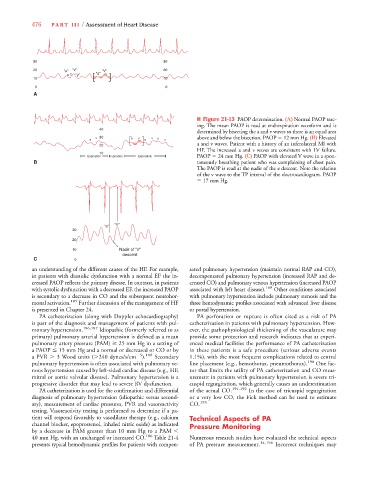
                                                                        ■ Figure 21-13 PAOP determination. (A) Normal PAOP trac-
                                                                        ing. The mean PAOP is read at end-expiration waveform and is
                                        40
                                                                        determined by bisecting the a and v waves so there is an equal area
                                       v  30       a  v   v  a          above and below the bisection. PAOP   12 mm Hg. (B) Elevated
                                     a                 a      v
                                        20                              a and v waves. Patient with a history of an inferolateral MI with
                                                                        HF. The increased a and v waves are consistent with LV failure.
                                        10
                                     Expiration  Inspiration  Expiration  PAOP   24 mm Hg. (C) PAOP with elevated V wave in a spon-
                   B                                                    taneously breathing patient who was complaining of chest pain.
                                                                        The PAOP is read at the nadir of the x descent. Note the relation
                                                                        of the v wave to the TP interval of the electrocardiogram. PAOP
                                                                          17 mm Hg.
                                             "V"
                                          "a"
                                30
                                20
                                10             Nadir of "x"
                                                descent
                   C            0
                  an understanding of the different causes of the HF. For example,  sated pulmonary hypertension (maintain normal RAP and CO),
                  in patients with diastolic dysfunction with a normal EF the in-  decompensated pulmonary hypertension (increased RAP and de-
                  creased PAOP reflects the primary disease. In contrast, in patients  creased CO) and pulmonary venous hypertension (increased PAOP
                  with systolic dysfunction with a decreased EF, the increased PAOP  associated with left heart disease). 189  Other conditions associated
                  is secondary to a decrease in CO and the subsequent neurohor-  with pulmonary hypertension include pulmonary stenosis and the
                  monal activation. 185  Further discussion of the management of HF  three hemodynamic profiles associated with advanced liver disease
                  is presented in Chapter 24.                         or portal hypertension.
                     PA catheterization (along with Doppler echocardiography)  PA  perforation or rupture is often cited as a risk of PA
                  is part of the diagnosis and management of patients with pul-  catheterization in patients with pulmonary hypertension. How-
                  monary hypertension. 186,187  Idiopathic (formerly referred to as  ever, the pathophysiological thickening of the vasculature may
                  primary) pulmonary arterial hypertension is defined as a mean  provide some protection and research indicates that at experi-
                  pulmonary artery pressure (PAM)   25 mm Hg in a setting of  enced medical facilities the performance of PA catheterization
                  a PAOP   15 mm Hg and a normal or decreased or CO or by  in these patients is a safe procedure (serious adverse events
                                                      ).
                  a PVR   3 Wood units ( 240 dynes/s/cm   5 188  Secondary  1.1%), with the most frequent complications related to central
                  pulmonary hypertension is often associated with pulmonary ve-  line placement (e.g., hemothorax, pneumothorax). 190  One fac-
                  nous hypertension caused by left-sided cardiac disease (e.g., HF,  tor that limits the utility of PA catheterization and CO meas-
                  mitral or aortic valvular disease). Pulmonary hypertension is a  urement in patients with pulmonary hypertension is severe tri-
                  progressive disorder that may lead to severe RV dysfunction.  cuspid regurgitation, which generally causes an underestimation
                     PA catheterization is used for the confirmation and differential  of the actual CO. 191,192  In the case of tricuspid regurgitation
                  diagnosis of pulmonary hypertension (idiopathic versus second-  or a very low CO, the Fick method can be used to estimate
                  ary), measurement of cardiac pressures, PVR and vasoreactivity  CO. 193
                  testing. Vasoreactivity testing is performed to determine if a pa-
                  tient will respond favorably to vasodilator therapy (e.g., calcium  Technical Aspects of PA
                  channel blocker, epoprostenol, inhaled nitric oxide) as indicated  Pressure Monitoring
                  by a decrease in PAM greater than 10 mm Hg to a PAM
                  40 mm Hg, with an unchanged or increased CO. 186  Table 21-4  Numerous research studies have evaluated the technical aspects
                  presents typical hemodynamic profiles for patients with compen-  of PA  pressure measurement. 14,194  Incorrect techniques may

