


Page 702 - Cardiac Nursing
P. 702
09
                           qxd
                                     49
                                           P
                                        AM
                       5-7
                    p65
                               7
                         04.
                                /1/
                                             g
            K34
               0-c
         LWB
         L L LWB K34 0-c 28_ p65 5-7 04. qxd  7 /1/ 09  9: 49  AM  P a a g e e  678  Ap tar a a
         LWBK340-c28_p655-704.qxd  7/1/09  9:9:49 AM  Page 678 Aptara
                                                  Ap
                                               678
                                                    tar
                 28_
                  678    PA R T  I V / Pathophysiology and Management Disease
                                A


                                B


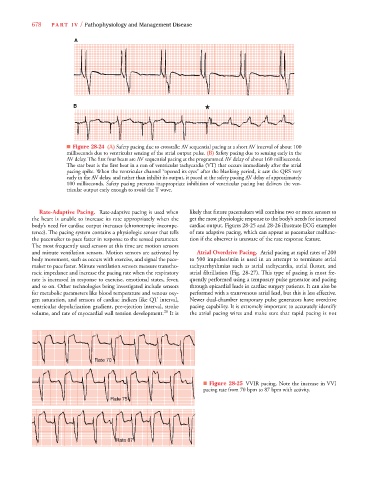
                              ■ Figure 28-24 (A) Safety pacing due to crosstalk: AV sequential pacing at a short AV interval of about 100
                              milliseconds due to ventricular sensing of the atrial output pulse. (B) Safety pacing due to sensing early in the
                              AV delay. The first four beats are AV sequential pacing at the programmed AV delay of about 160 milliseconds.
                              The star beat is the first beat in a run of ventricular tachycardia (VT) that occurs immediately after the atrial
                              pacing spike. When the ventricular channel “opened its eyes” after the blanking period, it saw the QRS very
                              early in the AV delay, and rather than inhibit its output, it paced at the safety pacing AV delay of approximately
                              100 milliseconds. Safety pacing prevents inappropriate inhibition of ventricular pacing but delivers the ven-
                              tricular output early enough to avoid the T wave.


                     Rate-Adaptive Pacing. Rate-adaptive pacing is used when  likely that future pacemakers will combine two or more sensors to
                  the heart is unable to increase its rate appropriately when the  get the most physiologic response to the body’s needs for increased
                  body’s need for cardiac output increases (chronotropic incompe-  cardiac output. Figures 28-25 and 28-26 illustrate ECG examples
                  tence). The pacing system contains a physiologic sensor that tells  of rate adaptive pacing, which can appear as pacemaker malfunc-
                  the pacemaker to pace faster in response to the sensed parameter.  tion if the observer is unaware of the rate response feature.
                  The most frequently used sensors at this time are motion sensors
                  and minute ventilation sensors. Motion sensors are activated by  Atrial Overdrive Pacing. Atrial pacing at rapid rates of 200
                  body movement, such as occurs with exercise, and signal the pace-  to 500 impulses/min is used in an attempt to terminate atrial
                  maker to pace faster. Minute ventilation sensors measure transtho-  tachyarrhythmias such as atrial tachycardia, atrial flutter, and
                  racic impedance and increase the pacing rate when the respiratory  atrial fibrillation (Fig. 28-27). This type of pacing is most fre-
                  rate is increased in response to exercise, emotional states, fever,  quently performed using a temporary pulse generator and pacing
                  and so on. Other technologies being investigated include sensors  through epicardial leads in cardiac surgery patients. It can also be
                  for metabolic parameters like blood temperature and venous oxy-  performed with a transvenous atrial lead, but this is less effective.
                  gen saturation, and sensors of cardiac indices like QT interval,  Newer dual-chamber temporary pulse generators have overdrive
                  ventricular depolarization gradient, pre-ejection interval, stroke  pacing capability. It is extremely important to accurately identify
                  volume, and rate of myocardial wall tension development. 28  It is  the atrial pacing wires and make sure that rapid pacing is not


                                           70
                                       Rate 70
                                       Rate 70
                                       Rate 7 70
                                       Rate
                                       Rate
                                                                          ■ Figure 28-25 VVIR pacing. Note the increase in VVI
                                                                          pacing rate from 70 bpm to 87 bpm with activity.
                                            R R R R R R Rate 75
                                             at at a a a
                                            Ra  e  e  e e te te  7 7 7 7 7 7 5 5 5
                                            Raate 75


                                               ate 87
                                               ate
                                               ate
                                              Ra
                                              R
                                              Ra
                                              Ra  e  8 8 8 7 7 7 7 7 7 7
                                               a
                                               a
                                               ate

