


Page 75 - Cardiac Nursing
P. 75
0/2
                                0/2
                              6/3
                              6/3
                                  009
                                     1
                                      5:3
                                  009
                                     1
                             0
                          q
                          q
                        68.
                        68.
                          q
                              0
                             0
                           xd
                           xd
                                      5:3
                                                p
                                                p
                                              1 A
                                              1 A
                                                p
                                                  r
                                                  r
                                                 ta
                                                 ta
                                            e 5
                                         Pa
                                         Pa
                                        3
                                        3
                                         Pa
                                           g
                                            e 5
                                           g
                                           g
                      2-0
            K34
               0-c
                 02_
         LWB K34 0-c 02_ p p pp042-068.qxd  06/30/2009  15:33  Page 51 Aptara a a
         LWBK340-c02_
         LWB
                    04
                    04
                      2-0
                                                   C HAPTER 2 / Systemic and Pulmonary Circulation and Oxygen Delivery  51
                                                                       subtypes. The   1 -adrenergic receptors, which are now characterized
                                                                       as subtypes   1A ,   1B , and   1D , are located in arteries, arterioles, and
                                                                       cutaneous and visceral veins. The   1A receptors are responsible for
                                                                       vessel contraction. The   1B receptors are thought to contribute to
                                                                       the maintenance ofbasal vascular tone and arterialblood pressure
                                                                       in conscious animals and are sensitive to exogenous agonists.
                                                                       Finally, the   1D receptors also play a role in vascular contraction,
                                                                       although they have a lesser effect than the   1B receptors. 107
                                                                         The   2 receptors, whichhave presynaptic and postsynaptic
                                                                       functions, are characterized as   2A/D ,   2B , and   2C . The   2A/D
                                                                       and   2B receptors are present in large arteries but are located with
                                                                       greater density on the terminal arterioles, which act as precapillary
                                                                       sphincters to control the number of open capillaries and total cap-
                                                                       illary bloodflow. The   2A/D receptors play the primary role in
                                                                       vasoconstriction. 108,109  The   2B receptors also play a role in vaso-
                                                                       constriction and may contribute to the onset ofhypertension. The
                                                                         2C receptors are responsible for venoconstriction. 107,110
                                                                         Whereas stimulation of the presynaptic   2 receptors inhibits
                                                                       norepinephrine, stimulation of the postsynaptic   2 receptors lo-
                                                                       cated on the vascular smooth muscle causes norepinephrine re-
                                                                       lease and subsequent vasoconstriction. However, the   2 -mediated
                                                                       vasoconstriction is attenuatedby the   2 presynaptic inhibition of
                                                                       norepinephrine release. In addition, in contrast to   1 receptor
                                                                       stimulation, the effect of norepinephrine on   2 in terminal arteri-
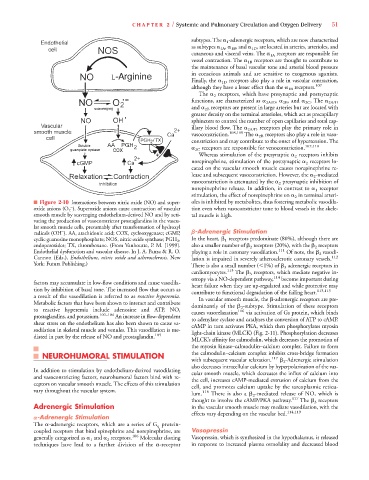
                   ■ Figure 2-10 Interactions between nitric oxide (NO) and super-  oles is inhibitedby metabolites, thus fostering metabolic vasodila-
                               –
                   oxide anions (O 2 ). Superoxide anions cause contraction of vascular  tion even when vasoconstrictor tone to blood vessels in the skele-
                   smooth muscle by scavenging endothelium-derived NO and by acti-  tal muscle is high.
                   vating the production of vasoconstrictor prostaglandins in the vascu-
                   lar smooth muscle cells, presumably after transformation of hydroxyl
                            –
                   radicals (OH ). AA, arachidonic acid; COX, cyclooxygenase; cGMP,   -Adrenergic Stimulation
                   cyclic guanosine monophosphate; NOS, nitric oxide synthase; PGH 2 ,  In the heart,   1 receptors predominate (80%), although there are
                   endoperoxides; TX, thromboxane. (From Vanhoutte, P. M. [1999].  also a smaller number of   2 receptors (20%), with the   2 receptors
                   Endothelial dysfunction and vascular disease. In J. A. Panza & R. O.  playing a role in coronary vasodilation. 111  Of note, the   2 vasodi-
                   Cannon (Eds.), Endothelium, nitric oxide and atherosclerosis. New  lation is impaired in severely atherosclerotic coronary vessels. 112
                   York: Futura Publishing.)                           There is also a small number ( 1%) of   3 adrenergic receptors in
                                                                       cardiomyocytes. 113  The   3 receptors, which mediate negative in-
                                                                       otropy via a NO-dependent pathway, 114  become important during
                   factors may accumulate in low-flow conditions and cause vasodila-  heart failure when they are up-regulated and while protective may
                   tion by inhibition of basal tone. The increased flow that occurs as  contribute to functionaldegradation of the failingheart. 113,115
                   a result of the vasodilation is referred to as reactive hyperemia.  In vascular smooth muscle, the  -adrenergic receptors are pre-
                   Metabolic factors that have been shown to interact and contribute  dominantly of the   2 -subtype. Stimulation of these receptors
                   to reactive hyperemia include adenosine and ATP, NO,  causes vasorelaxation 116  via activation of Gs protein, whichbinds
                   prostaglandins, and potassium. 102–104  An increase in flow-dependent  to adenylate cyclase and catalyzes the conversion of ATP to cAMP.
                   shear stress on the endothelium has also been shown to cause va-  cAMP in turn activates PKA, which then phosphorylates myosin
                   sodilation in skeletal muscle and venules. This vasodilation is me-  light-chain kinase (MLCK) (Fig. 2-11). Phosphorylation decreases
                   diated in part by the release of NO and prostaglandin. 105
                                                                       MLCK’s affinity for calmodulin, whichdecreases the promotion of
                                                                       the myosin kinase–calmodulin–calcium complex. Failure to form
                      NEUROHUMORAL STIMULATION                         the calmodulin–calcium complex inhibits cross-bridge formation
                                                                       with subsequent vascular relaxation. 117    2 -Adrenergic stimulation
                                                                       also decreases intracellular calcium by hyperpolarization of the vas-
                   In addition to stimulation by endothelium-derived vasodilating  cular smooth muscle, whichdecreases the influx of calcium into
                   and vasoconstricting factors, neurohumoral factors bind with re-  the cell, increases cAMP-mediated extrusion of calcium from the
                   ceptors on vascular smooth muscle. The effects of this stimulation  cell, andpromotes calcium uptake by the sarcoplasmic reticu-
                   vary throughout the vascular system.                   118
                                                                       lum.  There is also a   2 -mediated release of NO, which is
                                                                       thought to involve the cAMP/PKA pathway. 117  The   3 receptors
                   Adrenergic Stimulation                              in the vascular smooth muscle may mediate vasodilation, with the
                                                                       effects vary depending on the vascular bed. 114,119
                    -Adrenergic Stimulation
                   The  -adrenergic receptors, which are a series of G q protein-
                   coupled receptors that bind epinephrine and norepinephrine, are  Vasopressin
                   generally categorized as   1 and   2 receptors. 106  Molecular cloning  Vasopressin, which is synthesized in the hypothalamus, is released
                   techniques have lead to a further division of the   -receptor  in response to increased plasma osmolality and decreased blood

