


Page 212 - ACCCN's Critical Care Nursing
P. 212
Cardiovascular Assessment and Monitoring  189

             depressing  these  pacemaker  cells.  Cardiac  innervation      Capillary          Capillary
             includes sympathetic fibres from branches of T1–T5, and   Endothelial cells        network
                                                    10
             parasympathetic  input  via  the  vagus  nerve.   The  heart
             rate at any moment is a product of the respective inputs
             of sympathetic stimuli (which accelerate) and parasym-
             pathetic stimuli (which depress) on heart rate. Rises in
             heart rate can thus be achieved by an increase in sympa-
             thetic  tone  or  by  a  reduction  in  parasympathetic  tone
             (vagal inhibition). Conversely, slowing of the heart rate
             can be achieved by decreasing sympathetic or increasing
             parasympathetic activity. 4
             Hormonal, biochemical and pharmacological inputs also
             exert heart rate influences by their effect on autonomic                  Lumen
             neural  receptors  or  directly  on  pacemaker  cells.  In                 Valve
             mimicking  the  effects  of  direct  nervous  inputs,  these            Tunica intima:
             influences  may  be  described  as  sympathomimetic  or                 Endothelium
             parasympathomimetic.  Sympathomimetic  stimulation                   Subendothelial layer
             (e.g. through the use of isoprenaline) achieves the same             Internal elastic lamina
             cardiac endpoints as direct sympathetic activity, increas-  Artery                          Vein
             ing  the  heart  rate,  while  sympathetic  antagonism  (e.g.           Tunica media
             beta-blockade therapy) slows the heart through receptor               Tunica adventitia
             inhibition.  By  contrast,  parasympathomimetic  agonist                                         3
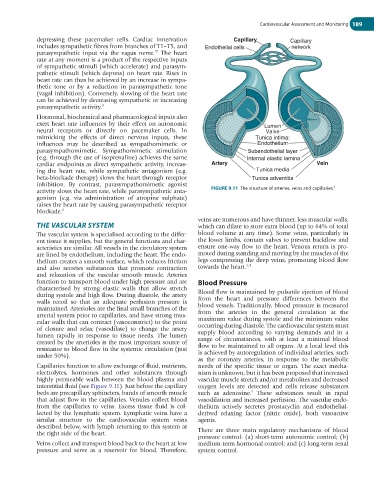
             activity slows the heart rate, while parasympathetic anta-  FIGURE 9.11  The structure of arteries, veins and capillaries.
             gonism  (e.g.  via  administration  of  atropine  sulphate)
             raises the heart rate by causing parasympathetic receptor
             blockade. 4
                                                                  veins are numerous and have thinner, less muscular walls,
             THE VASCULAR SYSTEM                                  which can dilate to store extra blood (up to 64% of total
             The vascular system is specialised according to the differ-  blood volume at any time). Some veins, particularly in
             ent tissue it supplies, but the general functions and char-  the lower limbs, contain valves to prevent backflow and
             acteristics are similar. All vessels in the circulatory system   ensure one-way flow to the heart. Venous return is pro-
             are lined by endothelium, including the heart. The endo-  moted during standing and moving by the muscles of the
             thelium creates a smooth surface, which reduces friction   legs compressing the deep veins, promoting blood flow
             and  also  secretes  substances  that  promote  contraction   towards the heart. 1,4
             and  relaxation  of  the  vascular  smooth  muscle.  Arteries
             function to transport blood under high pressure and are   Blood Pressure
             characterised  by  strong  elastic  walls  that  allow  stretch   Blood flow is maintained by pulsatile ejection of blood
             during systole and high flow. During diastole, the artery   from  the  heart  and  pressure  differences  between  the
             walls  recoil  so  that  an  adequate  perfusion  pressure  is   blood vessels. Traditionally, blood pressure is measured
             maintained. Arterioles are the final small branches of the   from  the  arteries  in  the  general  circulation  at  the
             arterial system prior to capillaries, and have strong mus-  maximum value during systole and the minimum value
             cular walls that can contract (vasoconstrict) to the point   occurring during diastole. The cardiovascular system must
             of  closure  and  relax  (vasodilate)  to  change  the  artery   supply  blood  according  to  varying  demands  and  in  a
             lumen  rapidly  in  response  to  tissue  needs.  The  lumen   range  of  circumstances,  with  at  least  a  minimal  blood
             created by the arterioles is the most important source of   flow to be maintained to all organs. At a local level this
             resistance to blood flow in the systemic circulation (just   is achieved by autoregulation of individual arteries, such
             under 50%).
                                                                  as  the  coronary  arteries,  in  response  to  the  metabolic
             Capillaries function to allow exchange of fluid, nutrients,   needs  of  the  specific  tissue  or  organ.  The  exact  mecha-
             electrolytes,  hormones  and  other  substances  through   nism is unknown, but it has been proposed that increased
             highly permeable walls between the blood plasma and   vascular muscle stretch and/or metabolites and decreased
             interstitial fluid (see Figure 9.11). Just before the capillary   oxygen  levels  are  detected  and  cells  release  substances
             beds are precapillary sphincters, bands of smooth muscle   such  as  adenosine.   These  substances  result  in  rapid
                                                                                   4
             that adjust flow in the capillaries. Venules collect blood   vasodilation and increased perfusion. The vascular endo-
             from  the  capillaries  to  veins.  Excess  tissue  fluid  is  col-  thelium  actively  secretes  prostacyclin  and  endothelial-
             lected by the lymphatic system. Lymphatic veins have a   derived  relaxing  factor  (nitric  oxide),  both  vasoactive
             similar  structure  to  the  cardiovascular  system  veins   agents.
             described below, with lymph returning to this system at
             the right side of the heart.                         There  are  three  main  regulatory  mechanisms  of  blood
                                                                  pressure control: (a) short-term autonomic control; (b)
             Veins collect and transport blood back to the heart at low   medium-term hormonal control; and (c) long-term renal
             pressure  and  serve  as  a  reservoir  for  blood.  Therefore,   system control.

