


Page 214 - ACCCN's Critical Care Nursing
P. 214
Cardiovascular Assessment and Monitoring  191

             for atrial fibrillation, a condition in which atrial contrac-
             tion becomes lost due to chaotic electrical activity with   TABLE 9.1  Guide to placement of stethoscope when
             variable  ventricular  response.  In  addition  to  rate  and   listening to heart sounds
             rhythm, assessment of pulse, especially if palpated in the
             carotid  or  femoral  artery,  can  reveal  a  bounding  pulse,                       Auditable region
             that  may  be  indicative  of  hyperdynamic  state  or  aortic   Stethescope placement  of heart
             regurgitation.  An  alternating  strong  and  weak  pulse,
             known as pulsus alternans, may be observed in advanced   2nd intercostal space  right of sternum  aortic valve
             heart failure.                                         2nd intercostal space  left of sternum  pulmonary valve
                                                                    4th intercostal space  left side of sternum  tricuspid valve
             AUSCULTATION OF HEART SOUNDS
                                                                    5th intercostal space  midclavicular line  mitral valve
             Auscultation  of  the  heart  involves  listening  to  heart
             sounds  over  the  pericardial  area  using  a  stethoscope.
             While challenging to achieve competence in, cardiac aus-  In  assessment  of  the  critically  ill  patient,  extra  heart
             cultation is an important part of cardiac physical exami-  sounds, labelled S3 and S4, may be heard during times
             nation  and  relies  on  sound  understanding  of  cardiac   of extra ventricular filling or fluid overload. Often referred
             anatomy,  cardiac  cycle  and  physiologically  associated   to as ‘gallops’, these extra heart sounds are accentuated
             sounds.  For  accurate  auscultation,  experience  in  assess-  during  episodes  of  tachycardia.  S3,  ventricular  gallop,
             ment  of  normal  sounds  is  critical  and  can  only  be   occurs during diastole in the presence of fluid overload.
             obtained  through  constant  practice.  When  auscultating   Considered  physiological  in  children  or  young  people,
             heart  sounds,  normally  two  sounds  are  easily  audible   due to rapid diastolic filling, S3 may be considered patho-
             known as the first (S1) and second (S2) sounds. A useful   logical when due to reduced ventricular compliance and
             technique when listening to heart sounds is to feel the   associated  increased  atrial  pressures.  As  S3  occurs  early
             carotid pulse at the same time as auscultation which will   in diastole, it will be heard and associated more closely
             help identify the heart sound that corresponds with ven-  with S2.
             tricular systole.
                                                                  S4  is  a  late  diastolic  sound  and  may  be  heard  shortly
                                                                  before  S1.  S4  occurs  when  ventricular  compliance  is
                                                                  reduced secondary to aortic or pulmonary stenosis, mitral
               Practice tip                                       regurgitation,  systemic  hypertension,  advanced  age  or
                                                                  ischaemic heart disease. Patients with severe ventricular
               When learning to interpret heart sounds, feel the carotid pulse   dysfunction may have both S3 and S4 audible, although
               at the same time as auscultation which will help identify the   when coupled with tachycardia, these may be difficult to
               heart sound that corresponds with ventricular systole (S1).  differentiate and will require specialist assessment.
                                                                  The critical care nurse auscultating the heart should also
                                                                  listen  for  a  potential  pericardial  rub.  This  ‘rubbing’  or
             The  first  heart  sound  (S1)  occurs  at  the  beginning  of   ‘scratching’ sound is secondary to pericardial inflamma-
             ventricular systole, following closure of the intra-cardiac   tion and/or fluid accumulation in the pericardial space.
             valves (mitral and tricuspid valves). This heart sound is   To differentiate pericardiac rub from pulmonary rub, if
             best  heard  with  the  diaphragm  of  the  stethoscope  and   possible  the  patient  should  be  instructed  to  hold  their
             loudest directly over the corresponding valves (4th inter-  breath for a short duration as pericardial rub will con-
             costal space [ICS] left of sternum for triscupid and 5th   tinue  to  be  audible  in  the  absence  of  breathing,  heard
             ICS left of the midclavicular line for mitral valve). Fol-  over the 3rd ICS to the left of the mid sternum. Detection
             lowing closure of these two valves, ventricular contraction   of  pericardial  rub  warrants  further  investigation  by
             and ejection occurs and a carotid pulse may be palpated   ultrasound.
             at the same time that S1 is audible.
             The second heart sound (S2) occurs at the beginning of
             diastole, following closure of the aortic and pulmonary   Practice tip
             valves and can be best heard over these valves (2nd ICS
             to  the  right  and  left  of  the  sternum  respectively).  It  is   To  differentiate  pericardial  rub  from  pulmonary  rub,  ask  the
             important to remember that both S1 and S2 result from   patient to hold their breath for a short duration as pericardial
             events occurring in both left and right sides of the heart.   rub will continue to be audible in the absence of breathing and
             While normally left sided heart sounds are loudest and   pleural  rub  will  not  be  audible  while  the  patient  is  not
             occur slightly before right sided events, careful listening   breathing.
             during inspiration and expiration may result in left and
             right  events  being  heard  separately.  This  is  known  as
             physiological splitting of heart sounds, a normal physio-
             logical event.                                       In  addition  to  pericardial  rub,  murmurs  may  also  be
                                                                  audible. Murmurs are generally classified and character-
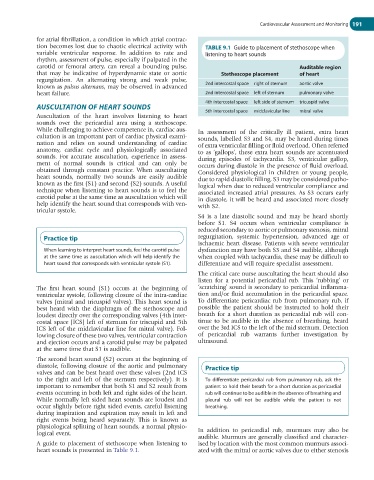
             A guide to placement of stethoscope when listening to   ised by location with the most common murmurs associ-
             heart sounds is presented in Table 9.1.              ated with the mitral or aortic valves due to either stenosis

