


Page 215 - ACCCN's Critical Care Nursing
P. 215
192  P R I N C I P L E S   A N D   P R A C T I C E   O F   C R I T I C A L   C A R E


            TABLE 9.2  Classification of heart murmurs using
            the Levine scale 12

            Grade 1        low intensity and difficult to hear
            Grade 2        low intensity, but audible with a                RA        I
                            stethoscope but no palpable thrill                                  LA

            Grade 3        medium intensity and easily heard with a
                            stethoscope                                           aV R  aV L
            Grade 4        loud and audible and with palpable thrill
            Grade 5        very loud but cannot be heard outside the           II           III
                            praecordium and with palpable thrill
                                                                                     aV F
            Grade 6        audible with the stethoscope away from
                            the chest


                                                                                     LL
         or  regurgitation  at  these  locations.  Murmurs  are  best
         thought of as turbulent flow or vibrations associated with
         the  corresponding  valve  and  can  be  of  variable  pitch.
                                                                                                            17
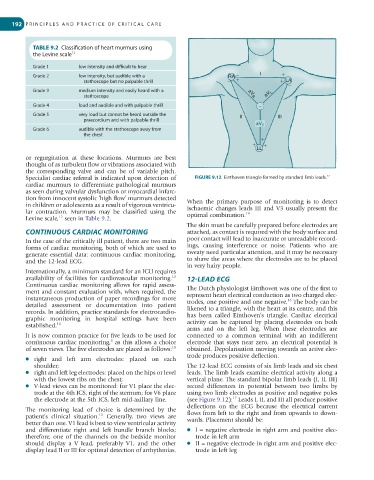
         Specialist cardiac referral is indicated upon detection of   FIGURE 9.12  Einthoven triangle formed by standard limb leads.
         cardiac murmurs to differentiate pathological murmurs
         as seen during valvular dysfunction or myocardial infarc-
         tion from innocent systolic ‘high flow’ murmurs detected   When  the  primary  purpose  of  monitoring  is  to  detect
         in children or adolescents as a result of vigorous ventricu-  ischaemic  changes  leads  III  and  V3  usually  present  the
         lar  contraction.  Murmurs  may  be  classified  using  the   optimal combination. 14
                    12
         Levine scale,  seen in Table 9.2.
                                                              The skin must be carefully prepared before electrodes are
         CONTINUOUS CARDIAC MONITORING                        attached, as contact is required with the body surface and
         In the case of the critically ill patient, there are two main   poor contact will lead to inaccurate or unreadable record-
         forms of cardiac monitoring, both of which are used to   ings,  causing  interference  or  noise.  Patients  who  are
         generate essential data: continuous cardiac monitoring,   sweaty need particular attention, and it may be necessary
         and the 12-lead ECG.                                 to shave the areas where the electrodes are to be placed
                                                              in very hairy people.
         Internationally, a minimum standard for an ICU requires
         availability  of  facilities  for  cardiovascular  monitoring.    12-LEAD ECG
                                                         13
         Continuous cardiac monitoring allows for rapid assess-  The Dutch physiologist Einthoven was one of the first to
         ment and constant evaluation with, when required, the
         instantaneous production of paper recordings for more   represent heart electrical conduction as two charged elec-
                                                                                               16
                                                              trodes, one positive and one negative.  The body can be
         detailed  assessment  or  documentation  into  patient
         records. In addition, practice standards for electrocardio-  likened to a triangle, with the heart at its centre, and this
                                                              has  been  called  Einthoven’s  triangle.  Cardiac  electrical
         graphic  monitoring  in  hospital  settings  have  been
         established. 14                                      activity  can  be  captured  by  placing  electrodes  on  both
                                                              arms  and  on  the  left  leg.  When  these  electrodes  are
         It is now common practice for five leads to be used for   connected  to  a  common  terminal  with  an  indifferent
                                     5
         continuous cardiac monitoring,  as this allows a choice   electrode  that  stays  near  zero,  an  electrical  potential  is
         of seven views. The five electrodes are placed as follows: 15  obtained. Depolarisation moving towards an active elec-
                                                              trode produces positive deflection.
         ●  right  and  left  arm  electrodes:  placed  on  each
            shoulder;                                         The 12-lead ECG consists of six limb leads and six chest
         ●  right and left leg electrodes: placed on the hips or level   leads. The limb leads examine electrical activity along a
            with the lowest ribs on the chest;                vertical plane. The standard bipolar limb leads (I, II, III)
         ●  V-lead views can be monitored: for V1 place the elec-  record  differences  in  potential  between  two  limbs  by
            trode at the 4th ICS, right of the sternum; for V6 place   using two limb electrodes as positive and negative poles
            the electrode at the 5th ICS, left mid-axillary line.  (see Figure 9.12):  Leads I, II, and III all produce positive
                                                                             17
                                                              deflections  on  the  ECG  because  the  electrical  current
         The  monitoring  lead  of  choice  is  determined  by  the   flows from left to the right and from upwards to down-
                                 15
         patient’s  clinical  situation.   Generally,  two  views  are   wards. Placement should be:
         better than one. V1 lead is best to view ventricular activity
         and  differentiate  right  and  left  bundle  branch  blocks;   ●  I = negative electrode in right arm and positive elec-
         therefore,  one  of  the  channels  on  the  bedside  monitor   trode in left arm
         should  display  a  V  lead,  preferably  V1,  and  the  other   ●  II = negative electrode in right arm and positive elec-
         display lead II or III for optimal detection of arrhythmias.   trode in left leg

