


Page 284 - ACCCN's Critical Care Nursing
P. 284
Cardiac Rhythm Assessment and Management  261


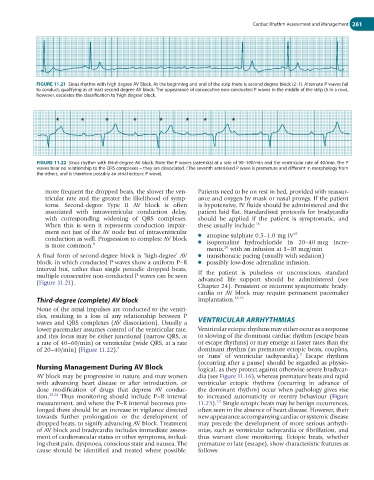
             FIGURE 11.21  Sinus rhythm with high degree AV Block. At the beginning and end of the strip there is second degree block (2 : 1). Alternate P waves fail
             to conduct, qualifying as at least second degree AV block. The appearance of consecutive non-conducted P waves in the middle of the strip (5 in a row),
             however, escalates the classification to ‘high degree’ block.


                   *       *       *         *       *        *     *        *


             FIGURE 11.22  Sinus rhythm with third-degree AV block. Note the P waves (asterisks) at a rate of 90–100/min and the ventricular rate of 40/min. The P
             waves bear no relationship to the QRS complexes – they are dissociated. (The seventh asterisked P wave is premature and different in morphology from
             the others, and is therefore possibly an atrial ectopic P wave).

                more frequent the dropped beats, the slower the ven-  Patients need to be on rest in bed, provided with reassur-
                tricular rate and the greater the likelihood of symp-  ance and oxygen by mask or nasal prongs. If the patient
                toms.  Second-degree  Type  II  AV  block  is  often   is hypotensive, IV fluids should be administered and the
                asso ciated  with  intraventricular  conduction  delay,   patient laid flat. Standardised protocols for bradycardia
                with  corresponding  widening  of  QRS  complexes.   should  be  applied  if  the  patient  is  symptomatic,  and
                When  this  is  seen  it  represents  conduction  impair-  these usually include: 18
                ment not just of the AV node but of intraventricular   ●  atropine sulphate 0.5–1.0 mg IV 25
                conduction as well. Progression to complete AV block   ●  isoprenaline  hydrochloride  in  20–40 mcg  incre-
                is more common. 9
                                                                          26
                                                                     ments,  with an infusion at 1–10 mcg/min
             A final form of second-degree block is ‘high-degree’ AV   ●  transthoracic pacing (usually with sedation)
             block, in which conducted P waves show a uniform P–R   ●  possibly low-dose adrenaline infusion.
             interval  but,  rather  than  single  periodic  dropped beats,
             multiple consecutive non-conducted P waves can be seen   If  the  patient  is  pulseless  or  unconscious,  standard
             (Figure 11.21).                                      advanced  life  support  should  be  administered  (see
                                                                  Chapter 24). Persistent or recurrent symptomatic brady-
                                                                  cardia  or  AV  block  may  require  permanent  pacemaker
             Third-degree (complete) AV block                     implantation. 18,19
             None of the atrial impulses are conducted to the ventri-
             cles,  resulting  in  a  loss  of  any  relationship  between  P
             waves and QRS complexes (AV dissociation). Usually a   VENTRICULAR ARRHYTHMIAS
             lower pacemaker assumes control of the ventricular rate,   Ventricular ectopic rhythms may either occur as a response
             and this focus may be either junctional (narrow QRS, at   to slowing of the dominant cardiac rhythm (escape beats
             a rate of 40–60/min) or ventricular (wide QRS, at a rate   or escape rhythms) or may emerge at faster rates than the
             of 20–40/min) (Figure 11.22). 9                      dominant rhythm (as premature ectopic beats, couplets,
                                                                                                   9
                                                                  or  ‘runs’  of  ventricular  tachycardia).   Escape  rhythms
                                                                  (occurring after a pause) should be regarded as physio-
             Nursing Management During AV Block                   logical, as they protect against otherwise severe bradycar-
             AV block may be progressive in nature, and may worsen   dia (see Figure 11.16), whereas premature beats and rapid
             with  advancing  heart  disease  or  after  introduction,  or   ventricular  ectopic  rhythms  (occurring  in  advance  of
             dose  modification  of  drugs  that  depress  AV  conduc-  the dominant rhythm) occur when pathology gives rise
             tion. 23,24   Thus  monitoring  should  include  P–R  interval   to  increased  automaticity  or  reentry  behaviour  (Figure
                                                                        7,9
             measurement, and where the P–R interval becomes pro-  11.23).  Single ectopic beats may be benign occurrences,
             longed there should be an increase in vigilance directed   often seen in the absence of heart disease. However, their
             towards  further  prolongation  or  the  development  of   new appearance accompanying cardiac or systemic disease
             dropped beats, to signify advancing AV block. Treatment   may precede the development of more serious arrhyth-
             of AV block and bradycardia includes immediate assess-  mias, such as ventricular tachycardia or fibrillation, and
             ment of cardiovascular status or other symptoms, includ-  thus  warrant  close  monitoring.  Ectopic  beats,  whether
             ing chest pain, dyspnoea, conscious state and nausea. The   premature or late (escape), show characteristic features as
             cause  should  be  identified  and  treated  where  possible.   follows:

