


Page 328 - ACCCN's Critical Care Nursing
P. 328
Cardiac Surgery and Transplantation  305

                                                                  usually undertaken if indicated and according to specific
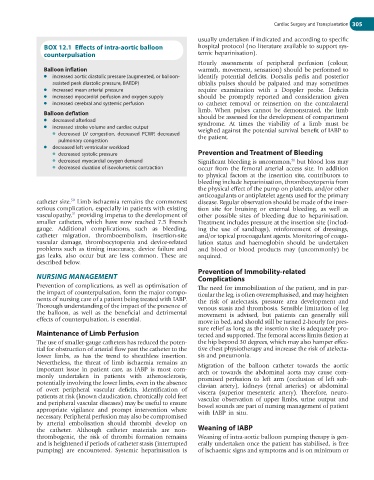
               BOX 12.1  Effects of intra-aortic balloon          hospital protocol (no literature available to support sys-
               counterpulsation                                   temic heparinisation).
                                                                  Hourly  assessments  of  peripheral  perfusion  (colour,
               Balloon inflation                                  warmth, movement, sensation) should be performed to
               ●  increased aortic diastolic pressure (augmented, or balloon-  identify  potential  deficits.  Dorsalis  pedis  and  posterior
                  assisted peak diastolic pressure, BAEDP)        tibialis  pulses  should  be  palpated  and  may  sometimes
               ●  increased mean arterial pressure                require  examination  with  a  Doppler  probe.  Deficits
               ●  increased myocardial perfusion and oxygen supply  should  be  promptly  reported  and  consideration  given
               ●  increased cerebral and systemic perfusion       to  catheter  removal  or  reinsertion  on  the  contralateral
                                                                  limb.  When  pulses  cannot  be  demonstrated,  the  limb
               Balloon deflation                                  should be assessed for the development of compartment
               ●  decreased afterload                             syndrome.  At  times  the  viability  of  a  limb  must  be
               ●  increased stroke volume and cardiac output      weighed against the potential survival benefit of IABP to
                  ●  decreased  LV  congestion,  decreased  PCWP,  decreased   the patient.
                    pulmonary congestion
               ●  decreased left ventricular workload
                  ●  decreased systolic pressure                  Prevention and Treatment of Bleeding
                  ●  decreased myocardial oxygen demand           Significant bleeding is uncommon,  but blood loss may
                                                                                                51
                  ●  decreased duration of isovolumetric contraction  occur  from  the  femoral  arterial  access  site.  In  addition
                                                                  to  physical  factors  at  the  insertion  site,  contributors  to
                                                                  bleeding include heparinisation, thrombocytopenia from
                                                                  the physical effect of the pump on platelets, and/or other
                                                                  anticoagulants or antiplatelet agents used for the primary
                        50
             catheter size.  Limb ischaemia remains the commonest   disease. Regular observation should be made of the inser-
             serious complication, especially in patients with existing   tion  site  for  bruising  or  external  bleeding,  as  well  as
                         51
             vasculopathy,  providing impetus to the development of   other  possible  sites  of  bleeding  due  to  heparinisation.
             smaller  catheters,  which  have  now  reached  7.5  French   Treatment includes pressure at the insertion site (includ-
             gauge.  Additional  complications,  such  as  bleeding,     ing  the  use  of  sandbags),  reinforcement  of  dressings,
             catheter  migration,  thromboembolism,  insertion-site     and/or topical procoagulant agents. Monitoring of coagu-
             vascular  damage,  thrombocytopenia  and  device-related   lation  status  and  haemoglobin  should  be  undertaken
             problems  such  as  timing  inaccuracy,  device  failure  and   and  blood  or  blood  products  may  (uncommonly)  be
             gas  leaks,  also  occur  but  are  less  common.  These  are   required.
             described below.
                                                                  Prevention of Immobility-related
             NURSING MANAGEMENT                                   Complications

             Prevention of complications, as well as optimisation of   The need for immobilisation of the patient, and in par-
             the impact of counterpulsation, form the major compo-  ticular the leg, is often overemphasised, and may heighten
             nents of nursing care of a patient being treated with IABP.   the  risk  of  atelectasis,  pressure  area  development  and
             Thorough understanding of the impact of the presence of   venous stasis and thrombosis. Sensible limitation of leg
             the  balloon,  as  well  as  the  beneficial  and  detrimental   movement  is  advised,  but  patients  can  generally  still
             effects of counterpulsation, is essential.           move in bed, and should still be turned 2-hourly for pres-
                                                                  sure relief as long as the insertion site is adequately pro-
             Maintenance of Limb Perfusion                        tected and supported. The femoral access limits flexion at
             The use of smaller-gauge catheters has reduced the poten-  the hip beyond 30 degrees, which may also hamper effec-
             tial for obstruction of arterial flow past the catheter to the   tive chest physiotherapy and increase the risk of atelecta-
             lower  limbs,  as  has  the  trend  to  sheathless  insertion.   sis and pneumonia.
             Nevertheless,  the  threat  of  limb  ischaemia  remains  an   Migration  of  the  balloon  catheter  towards  the  aortic
             important  issue  in  patient  care,  as  IABP  is  most  com-  arch  or  towards  the  abdominal  aorta  may  cause  com-
             monly  undertaken  in  patients  with  atherosclerosis,   promised  perfusion  to  left  arm  (occlusion  of  left  sub-
             potentially involving the lower limbs, even in the absence   clavian  artery),  kidneys  (renal  arteries)  or  abdominal
             of  overt  peripheral  vascular  deficits.  Identification  of   viscera  (superior  mesenteric  artery).  Therefore,  neuro-
             patients at risk (known claudication, chronically cold feet   vascular  observation  of  upper  limbs,  urine  output  and
             and peripheral vascular diseases) may be useful to ensure   bowel sounds are part of nursing management of patient
             appropriate  vigilance  and  prompt  intervention  where   with  IABP  in  situ.
             necessary. Peripheral perfusion may also be compromised
             by  arterial  embolisation  should  thrombi  develop  on
             the  catheter.  Although  catheter  materials  are  non-  Weaning of IABP
             thrombogenic,  the  risk  of  thrombi  formation  remains   Weaning of intra-aortic balloon pumping therapy is gen-
             and is heightened if periods of catheter stasis (interrupted   erally undertaken once the patient has stabilised, is free
             pumping)  are  encountered.  Systemic  heparinisation  is   of ischaemic signs and symptoms and is on minimum or

