


Page 329 - ACCCN's Critical Care Nursing
P. 329
306  P R I N C I P L E S   A N D   P R A C T I C E   O F   C R I T I C A L   C A R E

         no inotropic support. Algorithms have been offered for   should  be  set  to  ‘earlier’  until  the  inflation  upstroke
                                      52
         approaches  to  weaning  therapy,   but  their  impact  on   emerges smoothly out of the dicrotic notch.
         weaning  duration  or  success  has  not  been  studied.
         Weaning  is  carried  out  by  either  gradual  reductions  in   Early deflation
         balloon inflation volume (volume weaning) or gradual   Deflating the balloon earlier than necessary shortens the
         reductions in assist frequency from 1 : 1 through 1 : 2 and   duration  for  which  the  balloon  remains  inflated  and
         1 : 4 (ratio weaning). Hybrids of the two approaches are   therefore  limits  the  benefit  of  IABP.  When  deflation  is
         sometimes used. Support is reduced at intervals while the   very early, it may cause harm. Deflation sees the aortic
         patient is observed for haemodynamic deterioration, pul-  pressure drop markedly but there is now time for blood
         monary congestion, or the return of ischaemic signs and   to fill the space left by the balloon before systole com-
         symptoms.                                            mences. Aortic end-diastolic pressure increases and may
         Assessment of Timing and Timing Errors               even exceed the normal end-diastolic pressure, increasing
         Accurate timing of inflation and deflation in relation to   the  duration  of  isovolumetric  phase,  worsening  left
                                                              ventricular  afterload  and  increasing  myocardial  oxygen
         the  cardiac  cycle  is  required  to  maximise  IABP  benefit.   demand (Figure 12.9). Correction is achieved by setting
         Errors in timing may lessen the potential benefit, or in   deflation  to  later  until  the  pressure  drop  of  deflation
         some cases may worsen cardiac performance and increase   occurs just in advance of the succeeding systole.
         demands  on  the  myocardium.  Nurses  are  required  to
         continually assess the haemodynamic impact of balloon   Late deflation
         pumping,  the  accuracy  of  timing  via  inspection  of  the
         arterial pressure waveform, and to adjust timing to opti-  When deflation begins too late, systole commences before
         mise the impact of balloon pumping.                  complete emptying of the intra-aortic balloon. The typical
                                                              reduction  of  aortic  end-diastolic  pressure  is  not  seen.
         Early inflation                                      When  significantly  late,  the  end-diastolic  pressure  may
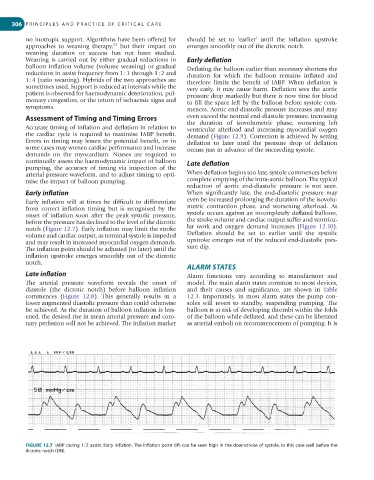
         Early  inflation  will  at  times  be  difficult  to  differentiate   even be increased prolonging the duration of the isovolu-
         from  correct  inflation  timing  but  is  recognised  by  the   metric  contraction  phase,  and  worsening  afterload.  As
         onset  of  inflation  soon  after  the  peak  systolic  pressure,   systole occurs against an incompletely deflated balloon,
         before the pressure has declined to the level of the dicrotic   the stroke volume and cardiac output suffer and ventricu-
         notch (Figure 12.7). Early inflation may limit the stroke   lar  work  and  oxygen  demand  increases  (Figure  12.10).
         volume and cardiac output, as terminal systole is impeded   Deflation  should  be  set  to  earlier  until  the  systolic
         and may result in increased myocardial oxygen demands.   upstroke emerges out of the reduced end-diastolic pres-
         The inflation point should be adjusted (to later) until the   sure dip.
         inflation upstroke emerges smoothly out of the dicrotic
         notch.
                                                              ALARM STATES
         Late inflation                                       Alarm  functions  vary  according  to  manufacturer  and
         The  arterial  pressure  waveform  reveals  the  onset  of    model. The main alarm states common to most devices,
         diastole  (the  dicrotic  notch)  before  balloon  inflation   and  their  causes  and  significance,  are  shown  in  Table
         commences  (Figure  12.8).  This  generally  results  in  a   12.3. Importantly, in most alarm states the pump con-
         lower augmented diastolic pressure than could otherwise   soles  will  revert  to  standby,  suspending  pumping.  The
         be achieved. As the duration of balloon inflation is less-  balloon is at risk of developing thrombi within the folds
         ened, the desired rise in mean arterial pressure and coro-  of the balloon while deflated, and these can be liberated
         nary perfusion will not be achieved. The inflation marker   as arterial emboli on recommencement of pumping. It is


         FIGURE 12.7  IABP during 1 : 2 assist. Early inflation. The inflation point (IP) can be seen high in the downstroke of systole, in this case well before the
         dicrotic notch (DN).

