


Page 45 - Concise Pathology for Exam Preparation ( PDFDrive )
P. 45
30    SECTION I  General Pathology

                     Morphologic Alterations due to Cell Ageing

                     •  Irregular and abnormal location of nuclei
                     •  Pleomorphic and vacuolated mitochondria
                     •  Dilated and distorted endoplasmic reticulum
                     •  Distorted Golgi apparatus

                     Theories of Cell Ageing
                     Cell ageing is considered to be multifactorial in origin. Factors influencing cell ageing
                     include:
                       1.  Endogenous molecular programme of cellular senescence:
                         (a)  Normally, DNA damage is repaired by DNA repair enzymes.
                         (b)  Accumulation of DNA damage due to defective DNA repair mechanisms induces
                           ageing.
                         (c)  Also,  contribution  from  activation  of  senescence-inducing  apoptotic  genes  (on
                           chromosomes 1 and 4) and induction of growth inhibitors.
                          (d)  Telomeres  are  critical  for  stabilization  of  terminal  portion  of  chromosomes  and
                           anchoring them to the nuclear matrix. De novo synthesis of telomeres is regulated
                           by an enzyme called telomerase. During somatic cell replication, a small segment of
                           the telomere is not duplicated leading to telomere shortening and loss of DNA, in-
                           ducing cellular ageing.
                         (e)  Telomerase repairs the shortened tips of chromosomes and maintains their length.
                         (f)  Repetitive mitoses (60–70 times)    telomeres lost    cell ageing.
                         (g)  Telomerase activity upregulated    telomere length maintained
                           avoids cell ageing.
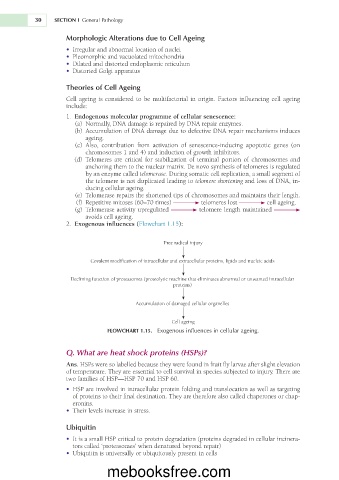
                       2.  Exogenous influences (Flowchart 1.15):


                                                   Free radical injury


                             Covalent modification of intracellular and extracellular proteins, lipids and nucleic acids

                       Declining function of proteasomes (proteolytic machine that eliminates abnormal or unwanted intracellular
                                                      proteins)


                                           Accumulation of damaged cellular organelles

                                                      Cell ageing
                                  FLOWCHART 1.15.  Exogenous influences in cellular ageing.


                     Q. What are heat shock proteins (HSPs)?
                     Ans. HSPs were so labelled because they were found in fruit fly larvae after slight elevation
                     of temperature. They are essential to cell survival in species subjected to injury. There are
                     two families of HSP—HSP 70 and HSP 60.
                     •  HSP are involved in intracellular protein folding and translocation as well as targeting
                       of proteins to their final destination. They are therefore also called chaperones or chap-
                       eronins.
                     •  Their levels increase in stress.

                     Ubiquitin

                     •  It is a small HSP critical to protein degradation (proteins degraded in cellular incinera-
                       tors called ‘proteasomes’ when denatured beyond repair)
                     •  Ubiquitin is universally or ubiquitously present in cells


                                  mebooksfree.com

