


Page 47 - Concise Pathology for Exam Preparation ( PDFDrive )
P. 47
32    SECTION I  General Pathology


           TABLE 2.1.    Comparison between acute and chronic inflammation

           Feature            Acute                     Chronic
           Causative agents   Physical  (heat,  radiation  and    Persistent acute inflammation due to nondegradable
                               mechanical trauma)         pathogens
                              Chemical  agents  (organic  and   Persistent foreign bodies
                               inorganic poisons)
                              Infectious  agents  (bacteria,  vi-  Autoimmune reactions
                               ruses and parasites)
                              Immunological  agents  (hyper-
                               sensitivity reactions)
           Major cells        Mainly neutrophils; also eosino-  Mononuclear cells (monocytes, macrophages, lym-
             involved          phils and basophils        phocytes, plasma cells) and fibroblasts
           Primary            Vasoactive amines, eicosanoids  Interferon  gamma  (IFN-g)  and  other  cytokines,
             mediators                                    growth factors, reactive oxygen species, and hy-
                                                          drolytic enzymes
           Onset              Immediate/rapid           Insidious/delayed
           Duration           Few days                  Up to many months or years
           Outcomes           Resolution, fibrosis and chronic   Tissue destruction and scarring
                               inflammation
           Cardinal signs and     1.  Pain (dolour)     Absence of any cardinal signs
             systemic mani-
             festations
                                2.  Heat (calor)        Patient is asymptomatic or presents with low-grade
                                                          fever, lethargy, loss of appetite and weight loss
                                3.  Redness (rubor)     Patient may also present with high-grade fever
                                4.  Swelling (tumour)
                               5.  Loss of function (functio leasa)
           Oedema             Present                   Absent
           Angiogenesis       Absent                    Present
           Tissue destruction  Absent                   Present
           Attempts at repair  Absent                   Present
           Fibrosis           Absent                    Present


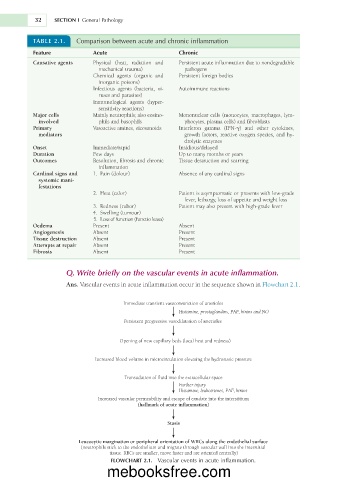
                     Q. Write briefly on the vascular events in acute inflammation.
                     Ans. Vascular events in acute inflammation occur in the sequence shown in Flowchart 2.1.


                                       Immediate transient vasoconstriction of arterioles
                                                        Histamine, prostaglandins, PAF, kinins and NO
                                       Persistent progressive vasodilatation of arterioles


                                      Opening of new capillary beds (local heat and redness)

                               Increased blood volume in microcirculation elevating the hydrostatic pressure


                                       Transudation of fluid into the extracellular space
                                                        Further injury
                                                        Histamine, leukotrienes, PAF, kinins
                                Increased vascular permeability and escape of exudate into the interstitium
                                           (hallmark of acute inflammation)


                                                     Stasis

                         Leucocytic margination or peripheral orientation of WBCs along the endothelial surface
                          (neutrophils stick to the endothelium and migrate through vascular wall into the interstitial
                                   tissue. RBCs are smaller, move faster and are oriented centrally)
                                   FLOWCHART 2.1.  Vascular events in acute inflammation.
                                  mebooksfree.com

