


Page 48 - Concise Pathology for Exam Preparation ( PDFDrive )
P. 48
2  Acute and Chronic Inflammation  33

             Q. Enumerate the causes of leaky endothelium.

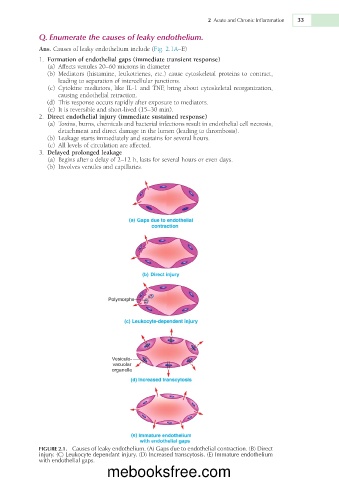
             Ans. Causes of leaky endothelium include (Fig. 2.1A–E)
               1.  Formation of endothelial gaps (immediate transient response)
                 (a)  Affects venules 20–60 microns in diameter
                 (b)  Mediators (histamine, leukotrienes, etc.) cause cytoskeletal proteins to contract,
                   leading to separation of intercellular junctions.
                 (c)  Cytokine mediators, like IL-1 and TNF, bring about cytoskeletal reorganization,
                   causing endothelial retraction.
                  (d)  This response occurs rapidly after exposure to mediators.
                 (e)  It is reversible and short-lived (15–30 min).
               2.  Direct endothelial injury (immediate sustained response)
                 (a)  Toxins, burns, chemicals and bacterial infections result in endothelial cell necrosis,
                   detachment and direct damage in the lumen (leading to thrombosis).
                 (b)  Leakage starts immediately and sustains for several hours.
                 (c)  All levels of circulation are affected.
               3.  Delayed prolonged leakage
                 (a)  Begins after a delay of 2–12 h, lasts for several hours or even days.
                 (b)  Involves venules and capillaries.


                                   Vesiculo-
                                    vacuolar
                                   organelle


             FIGURE 2.1.  Causes of leaky endothelium. (A) Gaps due to endothelial contraction. (B) Direct
             injury. (C) Leukocyte dependant injury. (D) Increased transcytosis. (E) Immature endothelium
             with endothelial gaps.
                                  mebooksfree.com

