


Page 49 - Concise Pathology for Exam Preparation ( PDFDrive )
P. 49
34    SECTION I  General Pathology


                         (c)  Caused by thermal injury, X-rays, UV radiation and bacterial toxins, which lead to
                           delayed endothelial damage by apoptosis or cause endothelial retraction by releasing
                           cytokines.
                      4.  Leukocyte-mediated endothelial injury
                         (a)  Leukocytes adhere to endothelium, release toxic oxygen species and proteolytic
                           enzymes, which cause endothelial injury and increased permeability.
                         (b)  Largely restricted to venules, pulmonary and glomerular capillaries where leukocytes
                           adhere for prolonged periods.
                       5.  Increased transcytosis across the endothelial cytoplasm
                         (a)  Occurs  across  interconnected  channels  made  of  vesicles  and  vacuoles  called
                           vesiculovacuolar organelles.
                         (b)  Certain  factors,  eg,  vascular  endothelial  growth  factor  (VEGF),  appear  to  cause
                           vascular leakage by increasing the number and size of the vascular channels.
                       6.  Leakage from new blood vessels
                        New vessels formed during angiogenesis remain leaky until endothelial cells mature
                          and form intracellular junctions.

                     Q. Write briefly on the cellular events involved in acute inflammation.
                     Ans. The two main cellular events involved in acute inflammation are
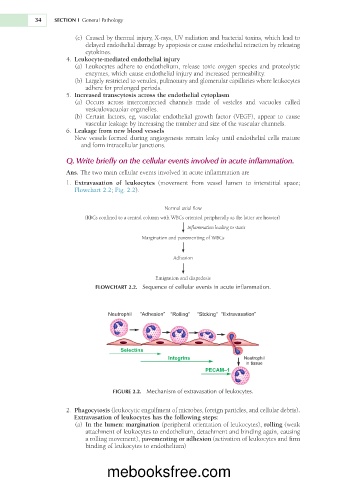
                       1.  Extravasation  of  leukocytes  (movement  from  vessel  lumen  to  interstitial  space;
                        Flowchart 2.2; Fig. 2.2).


                                                    Normal axial flow
                           (RBCs confined to a central column with WBCs oriented peripherally as the latter are heavier)
                                                           Inflammation leading to stasis
                                             Margination and pavementing of WBCs


                                                      Adhesion


                                                 Emigration and diapedesis
                              FLOWCHART 2.2.  Sequence of cellular events in acute inflammation.


                                  Neutrophil  “Adhesion ”  “Rolling”  “Stcking” “Extravasation ”


                                      Selectins
                                                     Integrins              Neutrophil
                                                                             in tissue
                                                                PECAM–1

                                    FIGURE 2.2.  Mechanism of extravasation of leukocytes.


                      2.  Phagocytosis (leukocytic engulfment of microbes, foreign particles, and cellular debris).
                        Extravasation of leukocytes has the following steps:
                         (a)  In the lumen: margination (peripheral orientation of leukocytes), rolling (weak
                           attachment of leukocytes to endothelium, detachment and binding again, causing
                           a rolling movement), pavementing or adhesion (activation of leukocytes and firm
                           binding of leukocytes to endothelium)


                                  mebooksfree.com

