


Page 595 - Concise Pathology for Exam Preparation ( PDFDrive )
P. 595
580    SECTION II  Diseases of Organ Systems


                                                                                  Mature
                                                                                  trabecular
                                                                                  bone


                                                                                  Cap of
                                                                                  Hyaline
                                                                                  Cartilage


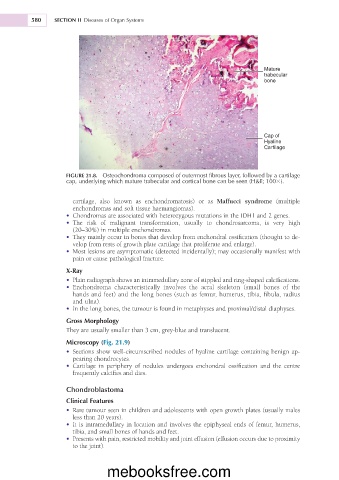
                     FIGURE 21.8.  Osteochondroma composed of outermost fibrous layer, followed by a cartilage
                     cap, underlying which mature trabecular and cortical bone can be seen (H&E; 1003).


                       cartilage,  also  known  as  enchondromatosis)  or  as  Maffucci	 syndrome  (multiple
                       enchondromas and soft tissue haemangiomas).
                     •	 Chondromas are associated with heterozygous mutations in the IDH1 and 2 genes.
                     •	 The  risk  of  malignant  transformation,  usually  to  chondrosarcoma,  is  very  high
                       (20–30%) in multiple enchondromas.
                     •	 They mainly occur in bones that develop from enchondral ossification (thought to de-
                       velop from rests of growth plate cartilage that proliferate and enlarge).
                     •	 Most lesions are asymptomatic (detected incidentally); may occasionally manifest with
                       pain or cause pathological fracture.
                     X-Ray
                     •	 Plain radiograph shows an intramedullary zone of stippled and ring-shaped calcifications.
                     •	 Enchondroma  characteristically  involves  the  acral  skeleton  (small  bones  of  the
                       hands and feet) and the long bones (such as femur, humerus, tibia, fibula, radius
                       and ulna).
                     •	 In the long bones, the tumour is found in metaphyses and proximal/distal diaphyses.
                     Gross Morphology
                     They are usually smaller than 3 cm, grey-blue and translucent.
                     Microscopy (Fig. 21.9)
                     •	 Sections show well-circumscribed nodules of hyaline cartilage containing benign ap-
                       pearing chondrocytes.
                     •	 Cartilage  in  periphery  of  nodules  undergoes  enchondral  ossification  and  the  centre
                       frequently calcifies and dies.

                     Chondroblastoma
                     Clinical Features
                     •	 Rare tumour seen in children and adolescents with open growth plates (usually males
                       less than 20 years).
                     •	 It is intramedullary in location and involves the epiphyseal ends of femur, humerus,
                       tibia, and small bones of hands and feet.
                     •	 Presents with pain, restricted mobility and joint effusion (effusion occurs due to proximity
                       to the joint).


                                  mebooksfree.com

