


Page 1348 - Hematology_ Basic Principles and Practice ( PDFDrive )
P. 1348
1194   Part VII  Hematologic Malignancies


                                CD20       CD3


                       A A                       B B                       CC

                                                                                               ALK


                       D D                       E E                       F F
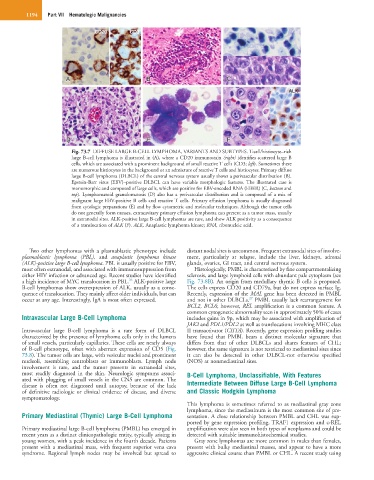
                        Fig. 73.7  DIFFUSE LARGE B-CELL LYMPHOMA, VARIANTS AND SUBTYPES. T-cell/histiocyte–rich
                        large B-cell lymphoma is illustrated in (A), where a CD20 immunostain (right) identifies scattered large B
                        cells, which are associated with a prominent background of small reactive T cells (CD3; left). Sometimes there
                        are numerous histiocytes in the background or an admixture of reactive T cells and histiocytes. Primary diffuse
                        large B-cell lymphoma (DLBCL) of the central nervous system usually shows a perivascular distribution (B).
                        Epstein-Barr  virus  (EBV)–positive  DLBCL  can  have  variable  morphologic  features. The  illustrated  case  is
                        monomorphic and composed of large cells, which are positive for EBV-encoded RNA (EBER) (C, bottom and
                        top). Lymphomatoid granulomatosis (D) also has a perivascular distribution and is composed of a mix of
                        malignant large EBV-positive B cells and reactive T cells. Primary effusion lymphoma is usually diagnosed
                        from cytologic preparations (E) and by flow cytometric and molecular techniques. Although the tumor cells
                        do not generally form masses, extracavitary primary effusion lymphoma can present as a tumor mass, usually
                        in extranodal sites. ALK-positive large B-cell lymphomas are rare, and show ALK positivity as a consequence
                        of a translocation of ALK (F). ALK, Anaplastic lymphoma kinase; RNA, ribonucleic acid.


           Two  other  lymphomas  with  a  plasmablastic  phenotype  include   distant nodal sites is uncommon. Frequent extranodal sites of involve-
        plasmablastic  lymphoma  (PBL),  and  anaplastic  lymphoma  kinase   ment,  particularly  at  relapse,  include  the  liver,  kidneys,  adrenal
        (ALK)-positive large B-cell lymphoma. PBL is usually positive for EBV,   glands, ovaries, GI tract, and central nervous system.
        most often extranodal, and associated with immunosuppression from   Histologically, PMBL is characterized by fine compartmentalizing
        either HIV infection or advanced age. Recent studies have identified   sclerosis, and large lymphoid cells with abundant pale cytoplasm (see
                                           26
        a high incidence of MYC translocation in PBL.  ALK-positive large   Fig. 73.8B). An origin from medullary thymic B cells is proposed.
        B-cell lymphomas show overexpression of ALK, usually as a conse-  The cells express CD20 and CD79a, but do not express surface Ig.
        quence of translocation. They mainly affect older individuals, but can   Recently, expression of the MAL gene has been detected in PMBL
                                                                                   27
        occur at any age. Interestingly, IgA is most often expressed.  and not in other DLBCLs.  PMBL usually lack rearrangement for
                                                              BCL2, BCL6; however, REL amplification is a common feature. A
                                                              common cytogenetic abnormality seen in approximately 50% of cases
        Intravascular Large B-Cell Lymphoma                   includes gains in 9p, which may be associated with amplification of
                                                              JAK2 and PDL1/PDL2 as well as translocations involving MHC class
        Intravascular  large  B-cell  lymphoma  is  a  rare  form  of  DLBCL   II transactivator (CIITA). Recently, gene expression profiling studies
        characterized by the presence of lymphoma cells only in the lumens   have  found  that  PMBL  bears  a  distinct  molecular  signature  that
        of small vessels, particularly capillaries. These cells are nearly always   differs  from  that  of  other  DLBCLs  and  shares  features  of  CHL;
        of  B-cell  phenotype,  often  with  aberrant  expression  of  CD5  (Fig.   however, the same signature is not restricted to mediastinal sites since
        73.8). The tumor cells are large, with vesicular nuclei and prominent   it  can  also  be  detected  in  other  DLBCL-not  otherwise  specified
        nucleoli,  resembling  centroblasts  or  immunoblasts.  Lymph  node   (NOS) at nonmediastinal sites.
        involvement  is  rare,  and  the  tumor  presents  in  extranodal  sites,
        most  readily  diagnosed  in  the  skin.  Neurologic  symptoms  associ-  B-Cell Lymphoma, Unclassifiable, With Features
        ated with plugging of small vessels in the CNS are common. The
        disease  is  often  not  diagnosed  until  autopsy,  because  of  the  lack   Intermediate Between Diffuse Large B-Cell Lymphoma
        of  definitive  radiologic  or  clinical  evidence  of  disease,  and  diverse    and Classic Hodgkin Lymphoma
        symptomatology.
                                                              This  lymphoma  is  sometimes  referred  to  as  mediastinal  gray  zone
                                                              lymphoma, since the mediastinum is the most common site of pre-
        Primary Mediastinal (Thymic) Large B-Cell Lymphoma    sentation. A close relationship between PMBL and CHL was sup-
                                                              ported by gene expression profiling. TRAF1 expression and c-REL
        Primary mediastinal large B-cell lymphoma (PMBL) has emerged in   amplification were also seen in both types of neoplasms and could be
        recent years as a distinct clinicopathologic entity, typically arising in   detected with suitable immunohistochemical studies.
        young women, with a peak incidence in the fourth decade. Patients   Gray zone lymphomas are more common in males than females,
        present with a mediastinal mass, with frequent superior vena cava   present with bulky mediastinal masses, and appear to have a more
        syndrome.  Regional  lymph  nodes  may  be  involved  but  spread  to   aggressive clinical course than PMBL or CHL. A recent study using

