


Page 1353 - Hematology_ Basic Principles and Practice ( PDFDrive )
P. 1353
Chapter 73  The Pathologic Basis for the Classification of Non-Hodgkin and Hodgkin Lymphomas  1199


                          A A                          B                    C
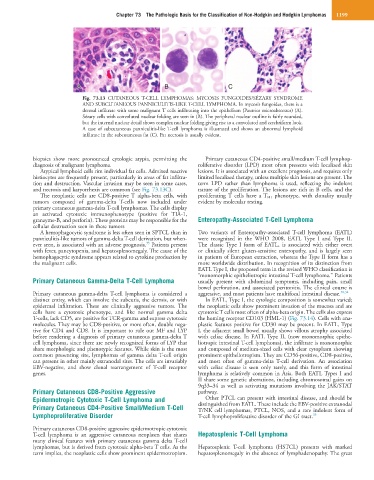
                            Fig.  73.13  CUTANEOUS  T-CELL  LYMPHOMAS:  MYCOSIS  FUNGOIDES/SÉZARY  SYNDROME
                            AND SUBCUTANEOUS PANNICULITIS-LIKE T-CELL LYMPHOMA. In mycosis fungoides, there is a
                            dermal infiltrate with some malignant T cells infiltrating into the epithelium (Pautrier microabscesses) (A).
                            Sézary cells with convoluted nuclear folding are seen in (B). The peripheral nuclear outline is fairly rounded,
                            but the internal nuclear detail shows complex nuclear folding giving rise to a convoluted and cerebriform look.
                            A  case  of  subcutaneous  panniculitis-like T-cell  lymphoma  is illustrated and shows  an abnormal  lymphoid
                            infiltrate in the subcutaneous fat (C). Fat necrosis is usually evident.


            biopsies  show  more  pronounced  cytologic  atypia,  permitting  the   Primary cutaneous CD4-positive small/medium T-cell lymphop-
            diagnosis of malignant lymphoma.                      roliferative disorder (LPD) most often presents with localized skin
              Atypical lymphoid cells rim individual fat cells. Admixed reactive   lesions. It is associated with an excellent prognosis, and requires only
            histiocytes are frequently present, particularly in areas of fat infiltra-  limited localized therapy, unless multiple skin lesions are present. The
            tion and destruction. Vascular invasion may be seen in some cases,   term  LPD  rather  than  lymphoma  is  used,  reflecting  the  indolent
            and necrosis and karyorrhexis are common (see Fig. 73.13C).  nature of the proliferation. The lesions are rich in B cells, and the
              The  neoplastic  cells  are  CD8-positive  T  alpha-beta  cells,  with   proliferating T  cells  have  a T FH   phenotype,  with  clonality  usually
            tumors  composed  of  gamma-delta  T-cells  now  included  under   evident by molecular testing.
            primary cutaneous gamma-delta T-cell lymphomas. The cells display
            an  activated  cytotoxic  immunophenotype  (positive  for  TIA-1,
            granzyme-B, and perforin). These proteins may be responsible for the   Enteropathy-Associated T-Cell Lymphoma
            cellular destruction seen in these tumors
              A hemophagocytic syndrome is less often seen in SPTCL than in   Two  variants  of  Enteropathy-associated  T-cell  lymphoma  (EATL)
            panniculitis-like tumors of gamma-delta T-cell derivation, but when-  were  recognized  in  the  WHO  2008,  EATL  Type  I  and  Type  II.
                                                 33
            ever seen, is associated with an adverse prognosis.  Patients present   The  classic Type  I  form  of  EATL,  is  associated  with  either  overt
            with fever, pancytopenia, and hepatosplenomegaly. The cause of the   or  clinically  silent  gluten-sensitive  enteropathy,  and  is  largely  seen
            hemophagocytic syndrome appears related to cytokine production by   in patients of European extraction, whereas the Type II form has a
            the malignant cells.                                  more worldwide distribution. In recognition of its distinction from
                                                                  EATL Type I, the proposed term in the revised WHO classification is
                                                                  “monomorphic epitheliotropic intestinal T-cell lymphoma.” Patients
            Primary Cutaneous Gamma-Delta T-Cell Lymphoma         usually  present  with  abdominal  symptoms,  including  pain,  small
                                                                  bowel perforation, and associated peritonitis. The clinical course is
            Primary  cutaneous  gamma-delta  T-cell  lymphoma  is  considered  a   aggressive, and most patients have multifocal intestinal disease. 30,34
            distinct entity, which can involve the subcutis, the dermis, or with   In EATL, Type I, the cytologic composition is somewhat varied;
            epidermal  infiltration.  These  are  clinically  aggressive  tumors.  The   the neoplastic cells show prominent invasion of the mucosa and are
            cells  have  a  cytotoxic  phenotype,  and  like  normal  gamma  delta   cytotoxic T cells most often of alpha-beta origin. The cells also express
            T-cells, lack CD5, are positive for TCR-gamma and express cytotoxic   the homing receptor CD103 (HML-1) (Fig. 73.14). Cells with ana-
            molecules. They may be CD8-positive, or more often, double nega-  plastic features positive for CD30 may be present. In EATL, Type
            tive for CD4 and CD8. It is important to rule out MF and LYP   I, the adjacent small bowel usually shows villous atrophy associated
            before rendering a diagnosis of primary cutaneous gamma-delta T   with  celiac  disease.  In  EATL Type  II,  (now  monomorphic  epithe-
            cell lymphoma, since there are newly recognized forms of LYP that   liotropic intestinal T-cell lymphoma), the infiltrate is monomorphic
            share morphologic and phenotypic features. While skin is the most   and composed of medium-sized cells with clear cytoplasm showing
            common presenting site, lymphomas of gamma delta T-cell origin   prominent epitheliotropism. They are CD56-positive, CD8-positive,
            can present in other mainly extranodal sites. The cells are invariably   and  most  often  of  gamma-delta  T-cell  derivation.  An  association
            EBV-negative,  and  show  clonal  rearrangement  of  T-cell  receptor   with  celiac  disease  is  seen  only  rarely,  and  this  form  of  intestinal
            genes.                                                lymphoma  is  relatively  common  in  Asia.  Both  EATL Types  I  and
                                                                  II share some genetic aberrations, including chromosomal gains on
                                                                  9q33–34  as  well  as  activating  mutations  involving  the  JAK/STAT
            Primary Cutaneous CD8-Positive Aggressive             pathway.
            Epidermotropic Cytotoxic T-Cell Lymphoma and            Other PTCL can present with intestinal disease, and should be
            Primary Cutaneous CD4-Positive Small/Medium T-Cell    distinguished from EATL. These include the EBV-positive extranodal
                                                                  T/NK cell lymphomas, PTCL, NOS, and a rare indolent form of
            Lymphoproliferative Disorder                          T-cell lymphoproliferative disorder of the GI tract. 35

            Primary cutaneous CD8-positive aggressive epidermotropic cytotoxic
            T-cell  lymphoma  is  an  aggressive  cutaneous  neoplasm  that  shares   Hepatosplenic T-Cell Lymphoma
            many clinical features with primary cutaneous gamma delta T-cell
            lymphomas, but is derived from cytotoxic alpha-beta T cells. As the   Hepatosplenic  T-cell  lymphoma  (HSTCL)  presents  with  marked
            term implies, the neoplastic cells show prominent epidermotropism.  hepatosplenomegaly in the absence of lymphadenopathy. The great

