


Page 1351 - Hematology_ Basic Principles and Practice ( PDFDrive )
P. 1351
Chapter 73  The Pathologic Basis for the Classification of Non-Hodgkin and Hodgkin Lymphomas  1197


                          A A                       B                          C C
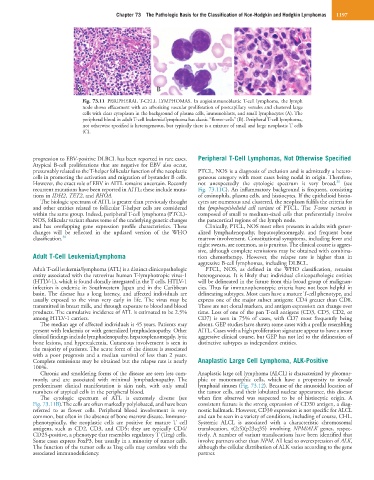
                            Fig. 73.11  PERIPHERAL T-CELL LYMPHOMAS. In angioimmunoblastic T-cell lymphoma, the lymph
                            node shows effacement with an arborizing vascular proliferation of postcapillary venules and clustered large
                            cells with clear cytoplasm in the background of plasma cells, immunoblasts, and small lymphocytes (A). The
                            peripheral blood in adult T-cell leukemia/lymphoma has classic “flower-cells” (B). Peripheral T-cell lymphoma,
                            not otherwise specified is heterogeneous, but typically there is a mixture of small and large neoplastic T cells
                            (C).


            progression to EBV-positive DLBCL has been reported in rare cases.   Peripheral T-Cell Lymphomas, Not Otherwise Specified
            Atypical B-cell proliferations that are negative for EBV also occur,
            presumably related to the T-helper follicular function of the neoplastic   PTCL, NOS is a diagnosis of exclusion and is admittedly a hetero-
            cells in promoting the activation and migration of bystander B cells.   geneous category with most cases being nodal in origin. Therefore,
                                                                                                               30
            However, the exact role of EBV in AITL remains uncertain. Recently   not  unexpectedly  the  cytologic  spectrum  is  very  broad.   (see
            recurrent mutations have been reported in AITL; these include muta-  Fig. 73.11C). An inflammatory background is frequent, consisting
            tions in IDH2, TET2, and RHOA.                        of eosinophils, plasma cells, and histiocytes. If the epithelioid histio-
              The biologic spectrum of AITL is greater than previously thought   cytes are numerous and clustered, the neoplasm fulfils the criteria for
            and other entities related to follicular T-helper cells are considered   the  lymphoepithelioid  cell  variant  of  PTCL.  The  T-zone  variant  is
            within the same group. Indeed, peripheral T-cell lymphoma (PTCL)-  composed of small to medium-sized cells that preferentially involve
            NOS, follicular variant shares some of the underlying genetic changes   the paracortical regions of the lymph node.
            and  has  overlapping  gene  expression  profile  characteristics.  These   Clinically, PTCL, NOS most often presents in adults with gener-
            changes  will  be  reflected  in  the  updated  version  of  the  WHO   alized  lymphadenopathy,  hepatosplenomegaly,  and  frequent  bone
            classification. 30                                    marrow involvement. Constitutional symptoms, including fever and
                                                                  night sweats, are common, as is pruritus. The clinical course is aggres-
                                                                  sive, although complete remissions may be obtained with combina-
            Adult T-Cell Leukemia/Lymphoma                        tion  chemotherapy.  However,  the  relapse  rate  is  higher  than  in
                                                                  aggressive B-cell lymphomas, including DLBCL.
            Adult T-cell leukemia/lymphoma (ATL) is a distinct clinicopathologic   PTCL,  NOS,  as  defined  in  the  WHO  classification,  remains
            entity associated with the retrovirus human T-lymphotropic virus-1   heterogeneous. It is likely that individual clinicopathologic entities
            (HTLV-1), which is found clonally integrated in the T cells. HTLV-1   will be delineated in the future from this broad group of malignan-
            infection  is  endemic  in  Southwestern  Japan  and  in  the  Caribbean   cies. Thus far immunophenotypic criteria have not been helpful in
            basin. The  disease  has  a  long  latency,  and  affected  individuals  are   delineating subtypes. Most cases have a mature T-cell phenotype, and
            usually  exposed  to  the  virus  very  early  in  life.  The  virus  may  be   express one of the major subset antigens: CD4 greater than CD8.
            transmitted in breast milk, and through exposure to blood and blood   These are not clonal markers, and antigen expression can change over
            products. The cumulative incidence of ATL is estimated to be 2.5%   time. Loss of one of the pan T-cell antigens (CD3, CD5, CD2, or
            among HTLV-1 carriers.                                CD7)  is  seen  in  75%  of  cases,  with  CD7  most  frequently  being
              The median age of affected individuals is 45 years. Patients may   absent. GEP studies have shown some cases with a profile resembling
            present with leukemia or with generalized lymphadenopathy. Other   AITL. Cases with a high proliferation signature appear to have a more
            clinical findings include lymphadenopathy, hepatosplenomegaly, lytic   aggressive clinical course, but GEP has not led to the delineation of
            bone lesions, and hypercalcemia. Cutaneous involvement is seen in   distinctive subtypes as independent entities.
            the majority of patients. The acute form of the disease is associated
            with a poor prognosis and a median survival of less than 2 years.
            Complete remissions may be obtained but the relapse rate is nearly   Anaplastic Large Cell Lymphoma, ALK-Positive
            100%.
              Chronic and smoldering forms of the disease are seen less com-  Anaplastic large cell lymphoma (ALCL) is characterized by pleomor-
            monly,  and  are  associated  with  minimal  lymphadenopathy.  The   phic  or  monomorphic  cells,  which  have  a  propensity  to  invade
            predominant  clinical  manifestation  is  skin  rash,  with  only  small   lymphoid sinuses (Fig. 73.12). Because of the sinusoidal location of
            numbers of atypical cells in the peripheral blood.    the tumor cells, and their lobulated nuclear appearance, this disease
              The  cytologic  spectrum  of  ATL  is  extremely  diverse  (see     when  first  observed  was  suspected  to  be  of  histiocytic  origin.  A
            Fig. 73.11B).The cells are often markedly polylobated, and have been   consistent feature is the strong expression of CD30 antigen, a diag-
            referred  to  as  flower  cells.  Peripheral  blood  involvement  is  very   nostic hallmark. However, CD30 expression is not specific for ALCL
            common, but often in the absence of bone marrow disease. Immuno-  and can be seen in a variety of conditions, including of course, CHL.
            phenotypically,  the  neoplastic  cells  are  positive  for  mature  T  cell   Systemic  ALCL  is  associated  with  a  characteristic  chromosomal
            antigens,  such  as  CD2,  CD3,  and  CD5;  they  are  typically  CD4/  translocation,  t(2;5)(p23;q35)  involving  NPM/ALK  genes,  respec-
            CD25-positive, a phenotype that resembles regulatory T (Treg) cells.   tively. A number of variant translocations have been identified that
            Some cases express FoxP3, but usually in a minority of tumor cells.   involve partners other than NPM. All lead to overexpression of ALK,
            The function of the tumor cells as Treg cells may correlate with the   although the cellular distribution of ALK varies according to the gene
            associated immunodeficiency.                          partner.

