


Page 1352 - Hematology_ Basic Principles and Practice ( PDFDrive )
P. 1352
1198   Part VII  Hematologic Malignancies


                       A A                      B             C                  D

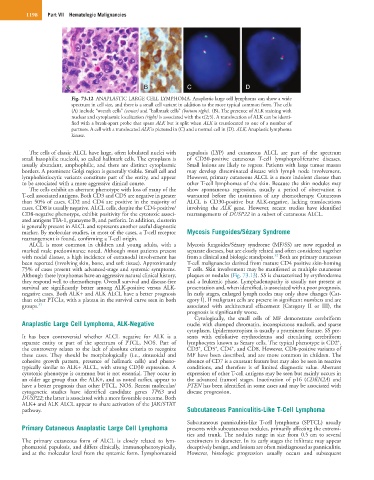
                        Fig. 73.12  ANAPLASTIC LARGE CELL LYMPHOMA. Anaplastic large cell lymphoma can show a wide
                        spectrum in cell size, and there is a small cell variant in addition to the more typical common form. The cells
                        (A) include “wreath cells” (center) and “hallmark cells” (bottom right). (B), The presence of ALK staining with
                        nuclear and cytoplasmic localization (right) is associated with the t(2;5). A translocation of ALK can be identi-
                        fied with a break-apart probe that spans ALK but is split when ALK is translocated to one of a number of
                        partners. A cell with a translocated ALK is pictured in (C) and a normal cell in (D). ALK, Anaplastic lymphoma
                        kinase.

           The cells of classic ALCL have large, often lobulated nuclei with   papulosis  (LYP)  and  cutaneous  ALCL  are  part  of  the  spectrum
        small basophilic nucleoli, so called hallmark cells. The cytoplasm is   of  CD30-positive  cutaneous  T-cell  lymphoproliferative  diseases.
        usually  abundant,  amphophilic,  and  there  are  distinct  cytoplasmic   Small lesions are likely to regress. Patients with large tumor masses
        borders. A prominent Golgi region is generally visible. Small cell and   may  develop  disseminated  disease  with  lymph  node  involvement.
        lymphohistiocytic variants constitute part of the entity, and appear   However, primary cutaneous ALCL is a more indolent disease than
        to be associated with a more aggressive clinical course.  other T-cell lymphomas of the skin. Because the skin nodules may
           The cells exhibit an aberrant phenotype with loss of many of the   show  spontaneous  regression,  usually  a  period  of  observation  is
        T-cell associated antigens. Both CD3 and CD5 are negative in greater   warranted  before  the  institution  of  any  chemotherapy.  Cutaneous
        than 50% of cases. CD2 and CD4 are positive in the majority of   ALCL  is  CD30-positive  but  ALK-negative,  lacking  translocations
        cases. CD8 is usually negative. ALCL cells, despite the CD4-positive/  involving  the  ALK  gene.  However,  recent  studies  have  identified
        CD8-negative phenotype, exhibit positivity for the cytotoxic associ-  rearrangements of DUSP22 in a subset of cutaneous ALCL.
        ated antigens TIA-1, granzyme B, and perforin. In addition, clusterin
        is generally present in ALCL and represents another useful diagnostic
        marker. By molecular studies, in most of the cases, a T-cell receptor   Mycosis Fungoides/Sézary Syndrome
        rearrangement is found, confirming a T-cell origin.
           ALCL  is  most  common  in  children  and  young  adults,  with  a   Mycosis  fungoides/Sézary  syndrome  (MF/SS)  are  now  regarded  as
        marked male predominance noted. Although most patients present   separate diseases, but are closely related and often considered together
                                                                                           32
        with nodal disease, a high incidence of extranodal involvement has   from a clinical and biologic standpoint.  Both are primary cutaneous
        been reported (involving skin, bone, and soft tissue). Approximately   T-cell malignancies derived from mature CD4 positive skin-homing
        75% of cases present with advanced-stage and systemic symptoms.   T cells. Skin involvement may be manifested as multiple cutaneous
        Although these lymphomas have an aggressive natural clinical history,   plaques or nodules (Fig. 73.13). SS is characterized by erythroderma
        they respond well to chemotherapy. Overall survival and disease-free   and a leukemic phase. Lymphadenopathy is usually not present at
        survival  are  significantly  better  among  ALK-positive  versus  ALK-  presentation and, when identified, is associated with a poor prognosis.
        negative cases. Both ALK+ and ALK ALCL have a better prognosis   In early stages, enlarged lymph nodes may only show changes (Cat-
        than other PTCLs, with a plateau in the survival curve seen in both   egory I). If malignant cells are present in significant numbers and are
        groups. 31                                            associated  with  architectural  effacement  (Category  II  or  III),  the
                                                              prognosis is significantly worse.
                                                                 Cytologically,  the  small  cells  of  MF  demonstrate  cerebriform
        Anaplastic Large Cell Lymphoma, ALK-Negative          nuclei with clumped chromatin, inconspicuous nucleoli, and sparse
                                                              cytoplasm. Epidermotropism is usually a prominent feature. SS pre-
        It  has  been  controversial  whether  ALCL  negative  for  ALK  is  a   sents  with  exfoliative  erythroderma  and  circulating  cerebriform
                                                                                                               +
        separate  entity  or  part  of  the  spectrum  of  PTCL,  NOS.  Part  of   lymphocytes known as Sezary cells. The typical phenotype is CD2 ,
                                                                  +
                                                                             +
                                                                       +
        the controversy relates to the lack of absolute criteria to recognize   CD3 , CD5 , CD4 , and CD8. However, CD8-positive variants of
        these  cases.  They  should  be  morphologically  (i.e.,  sinusoidal  and   MF have been described, and are more common in children. The
        cohesive  growth  pattern,  presence  of  hallmark  cells)  and  pheno-  absence of CD7 is a constant feature but may also be seen in reactive
        typically similar to ALK+ ALCL, with strong CD30 expression. A   conditions,  and  therefore  is  of  limited  diagnostic  value.  Aberrant
        cytotoxic phenotype is common but is not essential. They occur in   expression of other T-cell antigens may be seen but mainly occurs in
        an older age group than the ALK+, and as noted earlier, appear to   the  advanced  (tumor)  stages.  Inactivation  of  p16  (CDKN2A)  and
        have a better prognosis than other PTCL, NOS. Recent molecular/  PTEN has been identified in some cases and may be associated with
        cytogenetic  studies  have  identified  candidate  genes  TP63  and   disease progression.
        DUSP22; the latter is associated with a more favorable outcome. Both
        ALK+ and ALK ALCL appear to share activation of the JAK/STAT
        pathway.                                              Subcutaneous Panniculitis-Like T-Cell Lymphoma
                                                              Subcutaneous  panniculitis-like  T-cell  lymphoma  (SPTCL)  usually
        Primary Cutaneous Anaplastic Large Cell Lymphoma      presents with subcutaneous nodules, primarily affecting the extremi-
                                                              ties  and  trunk. The  nodules  range  in  size  from  0.5 cm  to  several
        The  primary  cutaneous  form  of  ALCL  is  closely  related  to  lym-  centimeters in diameter. In its early stages the infiltrate may appear
        phomatoid papulosis, and differs clinically, immunophenotypically,   deceptively benign, and lesions are often misdiagnosed as panniculitis.
        and at the molecular level from the systemic form. Lymphomatoid   However,  histologic  progression  usually  occurs  and  subsequent

