


Page 1574 - Hematology_ Basic Principles and Practice ( PDFDrive )
P. 1574
Chapter 86  Plasma Cell Neoplasms  1401


                           100                        100           No t(4;14)/  100
                                                                    del(17p)                  No t(4;14)/
                            75            No t(4;14)/  75                        75           del(17p)
                          Patients (%)  50  t(4;14)/  Patients (%)  50  del(17p)/  Patients (%)  50
                                          del(17p)


                            25
                                P <.001  del(17p)     25   P <.001  t(4;14)      25  P = .001  del(17p)/
                                                                                              t(4;14)
                                    20   40   60              20    40   60              20   40   60
                                     ISS 1 (mo)                ISS 2 (mo)                 ISS 3 (mo)
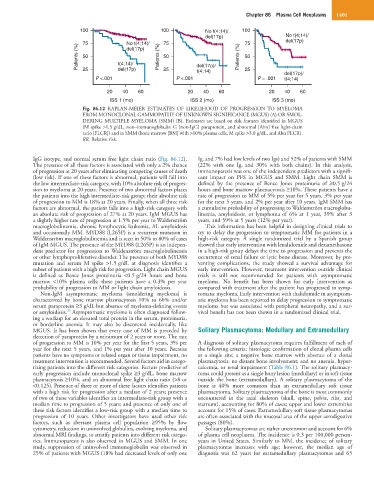
                            Fig.  86.12  KAPLAN-MEIER  ESTIMATES  OF  LIKELIHOOD  OF  PROGRESSION TO  MYELOMA
                            FROM MONOCLONAL GAMMOPATHY OF UNKNOWN SIGNIFICANCE (MGUS) (A) OR SMOL-
                            DERING MULTIPLE MYELOMA (SMM) (B). Estimates are based on risk features identified in MGUS
                            (M spike >1.5 g/dL, non–immunoglobulin G [non-IgG] paraprotein, and abnormal [Abn] free light-chain
                            ratio [FLCR]) and in SMM (bone marrow [BM] with >10% plasma cells, M spike >3.0 g/dL, and Abn FLCR).
                            RR, Relative risk.


            IgG isotype, and normal serum free light chain ratio (Fig. 86.12).   Ig, and 7% had low levels of two Igs) and 52% of patients with SMM
            The presence of all these factors is associated with only a 2% chance   (22%  with  one  Ig,  and  30%  with  both  chains).  In  this  analysis,
            of progression at 20 years after eliminating competing causes of death   immunoparesis was one of the independent predictors with a signifi-
            (low risk). If one of these factors is abnormal, patients will fall into   cant  impact  on  PFS  in  MGUS  and  SMM.  Light  chain  SMM  is
            the low intermediate-risk category, with 10% absolute risk of progres-  defined  by  the  presence  of  Bence  Jones  proteinuria  of  ≥0.5 g/24
            sion to myeloma at 20 years. Presence of two abnormal factors places   hours and bone marrow plasmacytosis ≥10%. These patients have a
            the patients into the high intermediate-risk group; their absolute risk   rate of progression to MM of 5% per year for 5 years, 3% per year
            of progression to MM is 18% at 20 years. Finally, when all three risk   for the next 5 years, and 2% per year after 10 years. IgM SMM has
            factors are abnormal, the patient falls into a high-risk category with   a cumulative probability of progressing to Waldenström macroglobu-
            an absolute risk of progression of 27% at 20 years. IgM MGUS has   linemia,  amyloidosis,  or  lymphoma  of  6%  at  1  year,  39%  after  3
            a slightly higher rate of progression at 1.5% per year to Waldenström   years, and 59% at 5 years (12% per year).
            macroglobulinemia, chronic lymphocytic leukemia, AL amyloidosis   This information has been helpful in designing clinical trials to
            and occasionally MM. MYD88 (L265P) is a recurrent mutation in   try to delay the progression to symptomatic MM for patients in a
            Waldenström macroglobulinemia and is seen in 50% to 80% of cases   high-risk  category.  A  single  randomized  trial  by  a  Spanish  group
            of IgM MGUS. The presence of the MYD88 (L265P) is an indepen-  showed that early intervention with lenalidomide and dexamethasone
            dent predictor for progression to Waldenström macroglobulinemia   in a high-risk group delays the time to progression and prevents the
            or other lymphoproliferative disorder. The presence of both MYD88   occurrence of renal failure or lytic bone disease. Moreover, by pre-
            mutation  and  serum  M  spike  >1.5 g/dL  at  diagnosis  identifies  a   venting  complications,  the  study  showed  a  survival  advantage  for
            subset of patients with a high risk for progression. Light chain MGUS   early intervention. However, treatment intervention outside clinical
            is  defined  as  Bence  Jones  proteinuria  <0.5 g/24  hours  and  bone   trials  is  still  not  recommended  for  patients  with  asymptomatic
            marrow  <10%  plasma  cells;  these  patients  have  a  0.3%  per  year   myeloma.  No  benefit  has  been  shown  for  early  intervention  as
            probability of progression to MM or light chain amyloidosis.  compared with treatment after the patient has progressed to symp-
              Non-IgM  asymptomatic  myeloma  (smoldering  myeloma)  is   tomatic myeloma. Early intervention with thalidomide in asymptom-
            characterized  by  bone  marrow  plasmacytosis  10%  to  60%  and/or   atic myeloma has been reported to delay progression to symptomatic
            serum paraprotein ≥3 g/dL but absence of myeloma-defining events   myeloma but was associated with peripheral neuropathy, and a sur-
                       25
            or amyloidosis.  Asymptomatic myeloma is often diagnosed follow-  vival benefit has not been shown in a randomized clinical trial.
            ing a workup for an elevated total protein in the serum, proteinuria,
            or  borderline  anemia.  It  may  also  be  discovered  incidentally,  like
            MGUS. It has been shown that every case of MM is preceded by   Solitary Plasmacytoma: Medullary and Extramedullary
            detection of paraprotein by a minimum of 2 years or more. The rate
            of progression to MM is 10% per year for the first 5 years, 3% per   A diagnosis of solitary plasmacytoma requires fulfillment of each of
            year for the next 5 years, and 1% per year after 10 years. Because   the following criteria: histologic confirmation of clonal plasma cells
            patients have no symptoms or related organ or tissue impairment, no   at  a  single  site;  a  negative  bone  marrow  with  absence  of  a  clonal
            treatment intervention is recommended. Several factors aid in catego-  plasmacytosis; no distant bone involvement; and no anemia, hyper-
            rizing patients into the different risk categories. Factors predictive of   calcemia, or renal impairment (Table 86.1). The solitary plasmacy-
            early progression include monoclonal spike ≥3 g/dL, bone marrow   toma could present as a single bony lesion (medullary) or in soft tissue
            plasmacytosis ≥10%, and an abnormal free light chain ratio (>8 or   outside the bone (extramedullary). A solitary plasmacytoma of the
            <0.125). Presence of three or more of these factors identifies patients   bone  is  40%  more  common  than  an  extramedullary  soft  tissue
            with a high risk for progression after a median of 2 years; presence   plasmacytoma. Solitary plasmacytoma of the bone is most commonly
            of two of these variables identifies an intermediate-risk group with a   encountered  in  the  axial  skeleton  (skull,  spine,  pelvis,  ribs,  and
            median time to progression of 5 years; and presence of only one of   sternum), accounting for 80% of cases; upper and lower extremities
            these risk factors identifies a low-risk group with a median time to   account for 15% of cases. Extramedullary soft tissue plasmacytomas
            progression  of  10  years.  Other  investigators  have  used  other  risk   are often associated with the mucosal area of the upper aerodigestive
            factors,  such  as  aberrant  plasma  cell  population  ≥95%  by  flow   passages (80%).
            cytometry, reduction in uninvolved globulins, evolving myeloma, and   Solitary plasmacytomas are rather uncommon and account for 6%
            abnormal MRI findings, to stratify patients into different risk catego-  of plasma cell neoplasms. The incidence is 0.3 per 100,000 person-
            ries. Immunoparesis is also observed in MGUS and SMM. In one   years in United States. Similarly to MM, the incidence of solitary
            study, suppression of uninvolved immunoglobulin was observed in   plasmacytomas  increases  with  age;  however,  the  median  age  of
            25% of patients with MGUS (18% had decreased levels of only one   diagnosis  was  62  years  for  extramedullary  plasmacytomas  and  65

