


Page 1578 - Hematology_ Basic Principles and Practice ( PDFDrive )
P. 1578
Chapter 86  Plasma Cell Neoplasms  1405


            in the United Kingdom (MRC Myeloma IX Trial). The CTD regimen   of  improving  the  outcome  of  patients  with  unfavorable  genetic
            consisted of cyclophosphamide 500 mg weekly, thalidomide 100 mg   markers.
            daily, and dexamethasone 40 mg for 4 days every other week. The
            induction chemotherapy was given for a minimum of six cycles and
            up  to  nine  cycles  or  until  maximum  response. The  postinduction   Lenalidomide
            ORR was significantly higher with CTD versus CVAD (82.5% vs.
            71.2%; p < .0001); likewise, CR rates were also higher with CTD   Lenalidomide  and  dexamethasone  are  an  effective  combination
            (13% vs. 8.1%; p = .0083). This differential response was maintained   therapy  for  the  treatment  of  previously  untreated  symptomatic
            following autologous stem cell transplant with regard to posttrans-  myeloma  patients.  A  large,  open-label,  phase  III  randomized  trial
            plant CR (50% vs. 37.2%; p = .00052). With a median follow-up   comparing lenalidomide plus high-dose dexamethasone or lenalido-
            of 47 months, there was no difference in PFS or OS between the two   mide plus weekly dexamethasone conducted by the Eastern Coopera-
            groups. This  establishes  CTD  as  an  acceptable  induction  therapy   tive Oncology Group established lenalidomide and dexamethasone
            before transplant.                                    as a simple oral regimen that could be used as an induction therapy
              For elderly patients and patients otherwise ineligible for HDT,   before transplant or as a first-line therapy without a stem cell trans-
            CTD was compared with MP. The dose of cyclophosphamide was   plant. Administration of lenalidomide 25 mg daily for 3 weeks on
            500 mg weekly, thalidomide 50 mg daily, and dexamethasone 20 mg   and 1 week off, along with dexamethasone 40 mg in a pulsed fashion
            for 4 days every other week. Both arms were oral regimens. CTD   (days 1–4, 9–12, and 17–20) for the first four cycles only (high-dose
            therapy  was  associated  with  a  superior  ORR  (63.8%  vs.  32.6%;   dexamethasone arm), gave a higher response rate of 79% compared
            p  <  .0001)  and  CR  rate  (13.1%  vs.  2.4%)  and  VGPR  (16.9%   with weekly dexamethasone 40 mg (low-dose dexamethasone arm;
            vs.  1.7%).  After  a  median  follow-up  of  44  months,  PFS  and  OS   60%);  however,  the  high-dose  dexamethasone  arm  was  associated
            were similar between the groups. CTD was associated with higher   with a higher incidence of infections and venous thromboembolism
            rates  of  thromboembolic  events,  constipation,  infection,  and  neu-  and an inferior 1-year survival rate (87%) compared with the low-
            ropathy. This study also illustrated that thalidomide was incapable   dose  dexamethasone  arm  (1-year  survival  rate  of  96%).  However,
                                                                  with longer follow-up, there was no survival difference between the
                                                                  two arms.
                                                                    In  a  large,  open-label,  international  randomized  clinical  trial,
                                                                  1623 patients who were transplant ineligible were randomly assigned
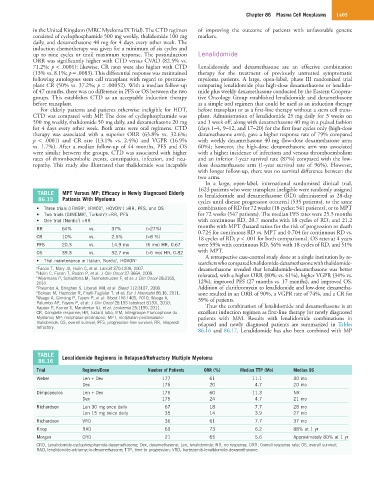
             TABLE   MPT Versus MP: Efficacy in Newly Diagnosed Elderly   to  lenalidomide  and  dexamethasone  (RD)  administered  as  28-day
              86.15  Patients With Myeloma                        cycles until disease progression occurred (535 patients), to the same
                                  b
                                         c
                            a
             •  Three trials (IFM99 , IFM01 , HOVON ) >RR, PFS, and OS  combination of RD for 72 weeks (18 cycles; 541 patients), or to MPT
             •  Two trials (GIMEMA , Turkish ) >RR, PFS           for 72 weeks (547 patients). The median PFS rates were 25.5 months
                             d
                                   e
             •  One trial (Nordic ) >RR                           with continuous RD, 20.7 months with 18 cycles of RD, and 21.2
                          f
             RR      64%      vs.    37%         (>27%)           months with MPT (hazard ratios for the risk of progression or death
                                                                  0.724 for continuous RD vs. MPT and 0.704 for continuous RD vs.
             CR      10%      vs.    2.5%        (>8 %)           18 cycles of RD; p < .001 for both comparisons). OS rates at 4 years
             PFS     20.3     vs.    14.9 mo     (6 mo) HR, 0.67  were 59% with continuous RD, 56% with 18 cycles of RD, and 51%
             OS      39.3     vs.    32.7 mo     (>6 mo) HR, 0.82  with MPT.
                                                                    A retrospective case-control study done at a single institution by re-
             •  Thal maintenance in Italian, Nordic , HOVON c     searchers who compared lenalidomide-dexamethasone with thalidomide-
                                       f
             a Facon T, Mary JY, Hulin C, et al: Lancet 370:1209, 2007.  dexamethasone  revealed  that  lenalidomide-dexamethasone  was  better
             b Hulin C, Facon T, Rodon P, et al: J Clin Oncol 27:3664, 2009.  tolerated, with a higher ORR (80% vs. 61%), higher VGPR (34% vs.
             c Wijermans P, Schaafsma M, Termorshuizen F, et al: J Clin Oncol 28:3160,
             2010.                                                12%), improved PFS (27 months vs. 17 months), and improved OS.
             d Palumbo A, Bringhen S, Liberati AM, et al: Blood 112:3107, 2008.  Addition of clarithromycin to lenalidomide and low-dose dexametha-
             e Beksac M, Haznedar R, Firatli-Tuglular T, et al: Eur J Haematol 86:16, 2011.  sone resulted in an ORR of 90%, a VGPR rate of 74%, and a CR for
             f Waage A, Gimsing P, Fayers P, et al: Blood 116:1405, 2010; Waage A,   39% of patients.
             Palumbo AP, Fayers P, et al: J Clin Oncol 28:15S [abstract 8130], 2010;
             Kapoor P, Kumar S, Mandrekar SJ, et al: Leukemia 25:1195, 2011.  Thus the combination of lenalidomide and dexamethasone is an
             CR, Complete response; HR, hazard ratio; IFM, Intergroupe Francophone du   excellent induction regimen as first-line therapy for newly diagnosed
             Myélome; MP, melphalan-prednisone; MPT, melphalan-prednisolone-  patients  with  MM.  Results  with  lenalidomide  combinations  in
             thalidomide; OS, overall survival; PFS, progression-free survival; RR, relapsed/  relapsed  and  newly  diagnosed  patients  are  summarized  in  Tables
             refractory.
                                                                  86.16 and 86.17. Lenalidomide has also been combined with MP
             TABLE   Lenalidomide Regimens in Relapsed/Refractory Multiple Myeloma
              86.16
             Trial          Regimen/Dose         Number of Patients  ORR (%)    Median TTP (Mo)  Median OS
             Weber          Len + Dex                 177             61            11.1         30 mo
                            Dex                       176             20            4.7          20 mo
             Dimpopoulos    Len + Dex                 176             60            11.3         NR
                            Dex                       175             24            4.7          21 mo
             Richardson     Len 30 mg once daily       67             18            7.7          28 mo
                            Len 15 mg twice daily      35             14            3.9          27 mo
             Richardson     VRD                        36             61            7.7          37 mo
             Knop           RAD                        69             73            6.2          88% at 1 yr
             Morgan         CRD                        21             65            5.6          Approximately 80% at 1 yr
             CRD, Lenalidomide-cyclophosphamide-dexamethasone; Dex, dexamethasone; Len, lenalidomide; NR, no response; ORR, Overall response rate; OS, overall survival;
             RAD, lenalidomide-adriamycin-dexamethasone; TTP, time to progression; VRD, bortezomib-lenalidomide-dexamethasone.

