


Page 1580 - Hematology_ Basic Principles and Practice ( PDFDrive )
P. 1580
Chapter 86  Plasma Cell Neoplasms  1407


                                100                                      1.00
                                                                                    P = .03 by Wilcoxon test
                                                                                    P = .04 by log-rank test
                              Overall survival (%)  50  Conventional    Survival  0.50   Intensive therapy
                                                 High-dose
                                                                         0.75
                                75
                                           dose
                                25
                                     7 yr  SDT   HD   P                  0.25   Standard therapy
                                     OS   25%   43%   .03
                                 0                                       0.00
                                   0     15   30    45    60                  0    20    40   60    80
                             A               Months                    B                Months

                          Proportion alive  30 mo  45 mo  60 mo     No. at risk
                          Conventional (%) 63 (53-73) 35 (22-50) 12 (1-40)  High-dose  201  148  79  38  8
                          High-dose (%)  69 (58-78) 61 (50-71) 52 (36-67)  Standard  200  129  70  30  8
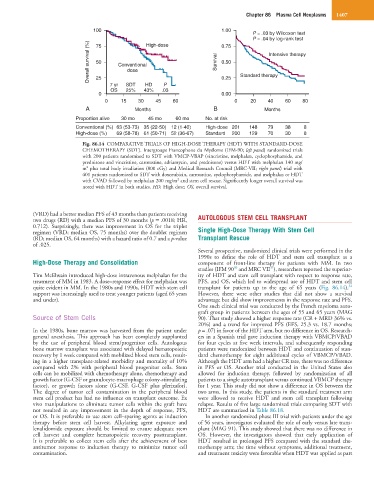
                            Fig. 86.14  COMPARATIVE TRIALS OF HIGH-DOSE THERAPY (HDT) WITH STANDARD-DOSE
                            CHEMOTHERAPY (SDT). Intergroupe Francophone du Myélome (IFM-90; left panel) randomized trials
                            with 200 patients randomized to SDT with VMCP-VBAP (vincristine, melphalan, cyclophosphamide, and
                            prednisone and vincristine, carmustine, adriamycin, and prednisone) versus HDT with melphalan 140 mg/
                             2
                            m  plus total body irradiation (800 cGy) and Medical Research Council (MRC-VII; right panel) trial with
                            401 patients randomized to SDT with doxorubicin, carmustine, cyclophosphamide, and melphalan or HDT
                                                           2
                            with CVAD followed by melphalan 200 mg/m  and stem cell rescue. Significantly longer overall survival was
                            noted with HDT in both studies. HD, High dose; OS, overall survival.


            (VRD) had a better median PFS of 43 months than patients receiving
            two drugs (RD) with a median PFS of 30 months (p = .0018; HR,   AUTOLOGOUS STEM CELL TRANSPLANT
            0.712).  Surprisingly,  there  was  improvement  in  OS  for  the  triplet
            regimen (VRD; median OS, 75 months) over the doublet regimen   Single High-Dose Therapy With Stem Cell
            (RD; median OS, 64 months) with a hazard ratio of 0.7 and a p-value   Transplant Rescue
            of .025.
                                                                  Several prospective, randomized clinical trials were performed in the
                                                                  1990s  to  define  the  role  of  HDT  and  stem  cell  transplant  as  a
            High-Dose Therapy and Consolidation                   component  of  front-line  therapy  for  patients  with  MM.  In  two
                                                                              30
                                                                                         31
                                                                  studies (IFM 90  and MRC VII ), researchers reported the superior-
            Tim McElwain introduced high-dose intravenous melphalan for the   ity of HDT and stem cell transplant with respect to response rate,
            treatment of MM in 1983. A dose–response effect for melphalan was   PFS, and OS, which led to widespread use of HDT and stem cell
                                                                                                                   32
            quite evident in MM. In the 1980s and 1990s, HDT with stem cell   transplant  for  patients  up  to  the  age  of  65  years  (Fig.  86.14).
            support was increasingly used to treat younger patients (aged 65 years   However,  there  were  other  studies  that  did  not  show  a  survival
            and under).                                           advantage but did show improvements in the response rate and PFS.
                                                                  One such clinical trial was conducted by the French myeloma auto-
                                                                  graft group in patients between the ages of 55 and 65 years (MAG
            Source of Stem Cells                                  90). That study showed a higher response rate (CR + MRD 36% vs.
                                                                  20%) and a trend for improved PFS (EFS, 25.3 vs. 18.7 months;
            In the 1980s, bone marrow was harvested from the patient under   p = .07) in favor of the HDT arm, but no difference in OS. Research-
            general  anesthesia. This  approach  has  been  completely  supplanted   ers in a Spanish trial gave induction therapy with VBMCP/VBAD
            by  the  use  of  peripheral  blood  stem/progenitor  cells.  Autologous   for four cycles at five week intervals, and subsequently responding
            bone marrow transplant was associated with delayed hematopoietic   patients were randomized between HDT and continuation of stan-
            recovery by 1 week compared with mobilized blood stem cells, result-  dard chemotherapy for eight additional cycles of VBMCP/VBAD.
            ing in a higher transplant-related morbidity and mortality of 10%   Although the HDT arm had a higher CR rate, there was no difference
            compared  with  2%  with  peripheral  blood  progenitor  cells.  Stem   in  PFS  or  OS.  Another  trial  conducted  in  the  United  States  also
            cells can be mobilized with chemotherapy alone, chemotherapy and   allowed  for  induction  therapy,  followed  by  randomization  of  all
            growth factor (G-CSF or granulocyte-macrophage colony-stimulating   patients to a single autotransplant versus continued VBMCP therapy
            factor),  or  growth  factors  alone  (G-CSF,  G-CSF  plus  plerixafor).   for 1 year. This study did not show a difference in OS between the
            The  degree  of  tumor  cell  contamination  in  the  peripheral  blood   two arms. In this study, the patients in the standard treatment arm
            stem cell product has had no influence on transplant outcome. Ex   were  allowed  to  receive  HDT  and  stem  cell  transplant  following
            vivo  manipulations  to  eliminate  tumor  cells  within  the  graft  have   relapse. Results of five large randomized trials comparing SDT with
            not  resulted  in  any  improvement  in  the  depth  of  response,  PFS,   HDT are summarized in Table 86.18.
            or OS. It is preferable to use stem cell–sparing agents as induction   In another randomized phase III trial with patients under the age
            therapy  before  stem  cell  harvest.  Alkylating  agent  exposure  and   of 56 years, investigatos evaluated the role of early versus late trans-
            lenalidomide  exposure  should  be  limited  to  ensure  adequate  stem   plant (MAG 91). This study showed that there was no difference in
            cell  harvest  and  complete  hematopoietic  recovery  posttransplant.   OS.  However,  the  investigators  showed  that  early  application  of
            It  is  preferable  to  collect  stem  cells  after  the  achievement  of  best   HDT resulted in prolonged PFS compared with the standard che-
            antitumor  response  to  induction  therapy  to  minimize  tumor  cell     motherapy arm; the time without symptoms, additional treatment,
            contamination.                                        and treatment toxicity were favorable when HDT was applied as part

