


Page 901 - Hematology_ Basic Principles and Practice ( PDFDrive )
P. 901
784    Part VII  Hematologic Malignancies


        in UK, suggests that peripheral blood of normal individuals showed   demonstrates not only the presence of the Ph chromosome but also
        clonal mutations in 9.5% of individuals between 70 and 79 years of   the presence of other chromosomal rearrangements (clonal evolution)
        age, 11.7% in individuals between 80 and 89 years of age and in   of clinical significance.
        18.4% of individuals between 90 and 103 years of age. As in previous   The reciprocal nature of the Ph-positive translocation was con-
        studies of healthy individuals, the majority of the mutations were in   firmed when studies showed that its molecular consequence is the
        three  genes,  DNMT3,  TET2  and  ASXL1,  all  known  to  occur  in   translocation of the ABL1 gene from chromosome 9, band region
        myeloid malignancies. The presence of mutations in these three genes   q34, and subsequent fusion to the breakpoint cluster region (BCR)
                                                          3
        is associated with an increase in the risk of hematologic malignancy.    gene  on  chromosome  22,  band  q11.2  (Fig.  56.9).  This  creates  a
        However, individuals with clonal hematopoiesis may live for many   hybrid  BCR-ABL1  gene  that  is  transcribed  into  a  chimeric  BCR-
        years and decades without hematologic malignancies though they are   ABL1 messenger RNA (mRNA) and translated into a specific chimeric
        at increased risk as compared with those without mutations. These   protein.
        studies may explain the higher frequency of myeloid malignancies in   Three major breakpoint locations along the BCR gene on chromo-
        the elderly population.                               some 22 result in three chimeric proteins. They include P210 BCR-ABL1 ,
                                                              P190 BCR-ABL1 , and P230 BCR-ABL1  and are associated with three distinct
                                                              types of leukemia. P210 BCR-ABL  is found in the majority of patients
        CHRONIC MYELOPROLIFERATIVE NEOPLASMS                  with  classic  Ph-positive,  BCR-ABL1-fusion–positive  CML  and
                                                              approximately 30% of patients with Ph-positive ALL. Expression of
        The  World  Health  Organization  (WHO)  characterizes  MPNs  as   P190 BCR-ABL1  is seen in 20% to 30% of adults and 80% of children
        clonal stem cell disorders. CML has a unique place among hemato-  with Ph-positive ALL. Expression of P230 BCR-ABL1  is associated with
        logic  malignancies  and  is  described  separately  from  the  other   a rare indolent chronic neutrophilic leukemia variant and up to 1.6%
        Ph-negative MPNs.                                     of CML (approximately 50 patients in the worldwide literature have
                                                              been  described).  Approximately 1%  to 2%  of  Ph-positive patients
                                                              with  CML  express  both  P21 BCR-ABL1   and  P190 BCR-ABL1   and  their
        Chronic Myelogenous Leukemia (see Chapter 67)         response to TKI therapy is inferior to patients showing only P210 BCR-
                                                              ABL1 . The BCR-ABL1 fusion is present in both standard and variant
        Knowledge of the origins of CML has accumulated over the last 56   forms, in cases where chromosome 9 involvement is cytogenetically
        years and serves as a classic example of molecular medicine at its best   not detectable, and when a masked Ph is present. In the majority of
        (Table 56.2). The Ph chromosome is the first example of a specific   patients, the fusion of ABL1 and BCR takes place on chromosome
                                                         4–5
        chromosomal  abnormality  associated  with  a  malignant  disease.    22 (Fig. 56.10 A–B). However, in a small group of patients the BCR
        ABL1 and BCR genes are the first oncogenes localized at the site of   gene is translocated to chromosome 9, and the fusion of the two genes
        a  chromosomal  breakpoint  in  t(9;22)(q34;q11.2). The  BCR-ABL1   is localized to 9q34. The prognosis of these patients may be inferior,
        fusion  leads  to  a  “hybrid”  gene,  resulting  in  the  production  of  a   but the number of reports is too small for a definitive conclusion.
        dysregulated  tyrosine  kinase  protein.  Finally,  imatinib  mesylate,  a   The BCR-ABL1 fusion transcript is present in neutrophils, mono-
        specific  tyrosine  kinase  inhibitor  (TKI),  was  the  first  rationally   cytes,  eosinophils,  erythrocytes,  B  cells,  rarely  in  T  cells,  and  in
                                                                   +
                                                                                                                +
        designed targeted form of cancer therapy.             CD34  cells and is associated with increased proliferation of CD34
           The Ph chromosome, named in honor of Philadelphia, the city   myeloid  progenitor  cells  but  not  of  other  more  mature  myeloid
        of its discovery, was described for the first time in 1960. It represents   precursors.  These  observations  confirm  the  hypothesis  that  CML
        a signature genomic rearrangement occurring in more than 95% of   originates in a multipotent stem cell capable of differentiating to all
        patients with CML. Approximately 3% of all pediatric leukemias are   hematopoietic cell lineages with the exception of T cells. These and
        Ph-positive CML. The incidence in children increases with age and   other studies provide also evidence for the existence of clonal BCR-
        it is exceptionally rare in infants. The Ph chromosome results from   ABL1 fusion-negative stage. The formation of BCR-ABL1 and the Ph
        a balanced translocation t(9;22)(q34;q11.2) (Fig. 56.8A–B). The Ph   chromosome occurs in an already abnormal and genetically unstable
        chromosome arises postzygotically, being found only in hematopoi-  clone of pluripotent hematopoietic cells. Thus it is the preexisting
        etic  tissue. The  findings  of  the  Ph  chromosome  in  myeloid  cells,   genetic instability that predisposes to formation of BCR-ABL1 and
                                                                   6
        erythroid cells, eosinophils, monocytes/macrophages, basophils, and   in  Ph   chromosome.  Once  Ph  chromosome  formation  occurs,  it
        B lymphocytes, along with the absence of the Ph chromosome in   confers a further selective growth advantage over normal cells, result-
        cultured marrow fibroblasts, support the concept that the Ph chromo-  ing in overwhelming BCR-ABL1–positive, Ph-positive marrow cells
        some results from a specific rearrangement in a multipotent hemato-  at the time of diagnosis of CML.
        poietic stem cell and that it is an acquired rather than an inherited   In the 5% of patients with CML who are Ph-negative by cytoge-
        abnormality. Of interest, the Ph chromosome is rarely identified in   netic  studies,  clonal  and  stem  cell  origin  of  these  hematologic
        T  cells. T  lymphocytes  are  long-lived  cells  and  may  antedate  the   malignancies can still be demonstrated, and molecular analysis reveals
        development  of  CML. These  observations  combined  with  studies   the BCR-ABL1 fusion in approximately 2% to 3% of these patients
        exploiting  G6PD  heterozygosity  provide  further  evidence  for  the   (Fig. 56.11). In the majority of Ph-negative patients, an ABL1 inser-
        concept that CML is a clonal disease arising in a stem cell capable of   tion from chromosome 9 to 22q11.2 results in a BCR-ABL1–fusion
        differentiation into all hematopoietic cell lineages.  product without reciprocal translocation of sequences from chromo-
           In a review of 1129 Ph-positive patients, the 9;22 translocation   some 22 to chromosome 9. Approximately 2% of patients truly are
        was identified in 1036 (92%) cases. Karyotypic analysis of marrow   Ph-negative and BCR-ABL fusion-negative. These patients may not
        cells in patients with CML is a time-consuming task. However, it   have  CML  but  rather  another  MPN. The  concept  that  the  BCR-
                                                              ABL1  fusion  plays  a  central  role  in  the  pathogenesis  of  CML  is
                                                              strongly supported by two lines of evidence: (a) retroviral transduc-
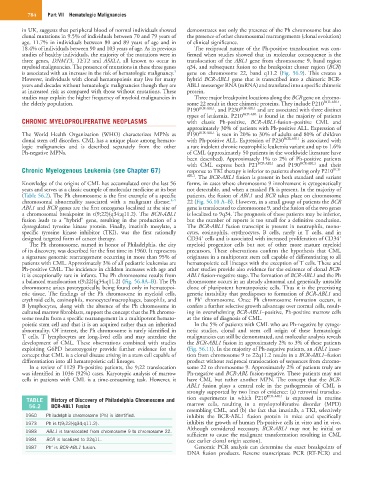
          TABLE   History of Discovery of Philadelphia Chromosome and   tion  experiments  in  which  P210 BCR-ABL1   is  expressed  in  murine
          56.2    BCR-ABL1 Fusion                             marrow  cells,  resulting  in  a  myeloproliferative  disorder  (MPD)
                                                              resembling CML, and (b) the fact that imatinib, a TKI, selectively
         1960   Philadelphia chromosome (Ph) is identified.   inhibits  the  BCR-ABL1  fusion  protein  in  mice  and  specifically
         1973   Ph is t(9;22)(q34;q11.2).                     inhibits the growth of human Ph-positive cells in vitro and in vivo.
                                                              Although  considered  necessary,  BCR-ABL1  may  not  be  initial  or
         1983   ABL1 is translocated from chromosome 9 to chromosome 22.
                                                              sufficient to cause the malignant transformation resulting in CML
         1984   BCR is localized to 22q11.                    (see earlier clonal origin section).
         1987   Ph′ is BCR-ABL1 fusion.                          Genomic PCR analysis can determine the exact breakpoints of
                                                              DNA  fusion  products.  Reverse  transcriptase  PCR  (RT-PCR)  and

