


Page 915 - Hematology_ Basic Principles and Practice ( PDFDrive )
P. 915
798    Part VII  Hematologic Malignancies


              1                2              3               4                 5


                                                                                              5' JAK2 (RP11-3H3)
                                                                                              3' JAK2 (RP11-28A9)


            6           7          8            9           10          11         12


             13           14            15            16            17            18


                                                                                                  CDKN2A
                                                                                                Centromere 9
            19           20              21             22            X           Y

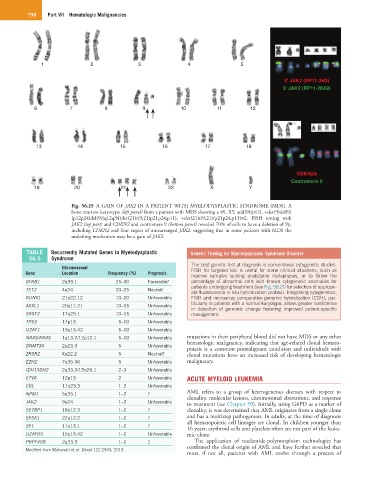
                        Fig. 56.25  A GAIN OF JAK2 IN A PATIENT WITH MYELODYSPLASTIC SYNDROME (MDS). A
                        bone marrow karyotype (left panel) from a patient with MDS showing a 49, XY, add(9)(p12), +der(9)del(9)
                        (p12p24)del(9)(q12q34)der(21)t(9;21)p21p24;p11),  +der(21)t(9;21)(p21p24;p11)×2.  FISH  testing  with
                        JAK2 (top part) and CDKN2 and centromere 9 (bottom panel) revealed 70% of cells to have a deletion of 9p,
                        including CDKN2 and four copies of unrearranged JAK2, suggesting that in some patients with MDS the
                        underling mechanism may be a gain of JAK2.

          TABLE   Recurrently Mutated Genes in Myelodysplastic   Genetic Testing for Myelodysplastic Syndrome Disorder
          56.5    Syndrome
                                                                The best genetic test at diagnosis is conventional cytogenetic studies.
                     Chromosomal                                FISH  for  targeted  loci  is  useful  for  some  clinical  situations,  such  as
         Gene        Location       Frequency (%)  Prognosis
                                                                marrow  samples  lacking  analyzable  metaphases,  or  to  follow  the
         SFRB1       2q33.1            25–30     Favorable?     percentage  of  abnormal  cells  with  known  cytogenetic  anomalies  for
                                                                patients undergoing treatment (see Fig. 56.20 for selection of appropri-
         TET2        4q24              20–25     Neutral
                                                                ate fluorescence in situ hybridization probes). Integrating cytogenetics,
         RUNX1       21q22.12          10–20     Unfavorable    FISH and microarray comparative genomic hybridization (CGH), par-
         ASXL1       20q11.21          10–15     Unfavorable    ticularly in patients with a normal karyotype, allows greater confidence
                                                                in  detection  of  genomic  change  fostering  improved  patient-specific
         SRSF2       17q25.1           10–15     Unfavorable    management.
         TP53        17p13              5–10     Unfavorable
         U2AF1       19q13.42           5–10     Unfavorable
         NRAS/KRAS   1p13.2/12p12.1     5–10     Unfavorable  mutations in their peripheral blood did not have MDS or any other
         DNMT3A      2p23.3             5        Unfavorable  hematologic malignancy, indicating that age-related clonal hemato-
                                                              poiesis  is  a  common  premalignant  condition  and  individuals  with
         ZRSR2       Xp22.2             5        Neutral?     clonal mutations have an increased risk of developing hematologic
         EZH2        7q35-36            5        Unfavorable  malignancy.
         IDH1/IDH2   2q33.3/15q26.1     2–3      Unfavorable
         ETV6        12p13              2        Unfavorable  ACUTE MYELOID LEUKEMIA
         CBL         11q23.3            1–2      Unfavorable
         NPM1        5q35.1             1–2      ?            AML  refers  to  a  group  of  heterogeneous  diseases  with  respect  to
                                                              clonality, molecular lesions, chromosomal aberrations, and response
         JAK2        9p24               1–2      Unfavorable  to treatment (see Chapter 59). Initially, using G6PD as a marker of
         SETBP1      18q12.3            1–2      ?            clonality, it was determined that AML originates from a single clone
         SF3A1       22q12.2            1–2      ?            and has a multistep pathogenesis. In adults, at the time of diagnosis
                                                              all hematopoietic cell lineages are clonal. In children younger than
         SF1         11q13.1            1–2      ?
                                                              16 years, erythroid cells and platelets often are not part of the leuke-
         U2AF65      19q13.42           1–2      Unfavorable  mic clone.
         PRPF40B     2q23.3             1–2      ?               The  application  of  nucleotide-polymorphism  technologies  has
         Modified from Malcovati et al: Blood 122:2943, 2013.  confirmed the clonal origin of AML and have further revealed that
                                                              most,  if  not  all,  patients  with  AML  evolve  through  a  process  of

