


Page 942 - Hematology_ Basic Principles and Practice ( PDFDrive )
P. 942
Chapter 56  Conventional and Molecular Cytogenomic Basis of Hematologic Malignancies  825


            targets for amplification or deletion in cases of B-CLL. Most of the   TABLE   Most Frequent Somatic Mutations in Chronic
            patients with del(11q) are relatively young. The appearance of this   56.13  Lymphocytic Leukemia
            deletion is clinically associated with lymphadenopathy, rapid disease
            progression, poor response to treatment and a shorter OS.  Chromosomal
              Structural aberrations of chromosome 17 are observed in 4% of   Location  Gene  Pathway  Co-Segregation  Frequency
            cytogenetically  evaluable  B-cell  CLL  cases.  This  abnormality  fre-  Alterations Associated With M-IGHV
            quently affects the short arm of chromosome 17, the site of the TP53   15q26  CDH2  Chromatin    5
            tumor suppressor gene. Monoallelic deletions of TP53, detected by           modification
            FISH,  are  present  in  7%  to  20%  of  patients  and  represent  the
            strongest predictor of inferior survival. The median survival of these   3p22  MYD88  Inflammatory   del(13q)  3–5
            patients is only 32 months. P53 mutations are associated with aggres-       pathway
            sive disease and a lack of response to conventional therapy. A novel   Alterations Associated With U-IGHV
            recurrent dic(8;17)(p11;p11) abnormality also results in loss of TP53,   11q22.3  ATM  DNA damage   del(11q)  9–14
            and low copy repeats in 17p12 and 8p11 may represent the origin of          response
            the translocation by nonallelic homologous recombination on a single   11q22  BIRC3  Cell cycle   del(11q)  1–5
            chromosome 17. B-CLL in patients with deletion of the TP53 gene             control
            is  associated  with  progressive  disease,  resistance  to  treatment,  and   7q31.33  POT1  Cell cycle   SF3B1  5
            shortened survival. Patients with 17p deletions or TP53 mutations           control
            are resistant to purine analogs.
              Deletion 6q is a relatively rare chromosomal change occurring in   17p13.1  TP53  Cell cycle   del(17p)  5–27
            approximately 6% of CLL cases and is associated with marked lym-            control
            phocytosis, abnormal morphology, splenomegaly, overexpression of   2q33.1  SF3B1  mRNA   del(11q)  10–19
            CD38, and unmutated IGH heavy chain variable region.                        processing
              Because the leukemic phase of certain lymphomas can clinically   9q34.3  NOTCH  NOTCH   Trisomy 12,   12–24
            mimic  B-CLL,  FISH  for  translocations  using  an  IGH  probe  is         signaling  XPO1,
            important.  Fewer  than  7%  of  patients  with  CLL/prolymphocytic                    TP53
            leukemia  patients  have  t(11;14)(q13;q32),  and  these  conditions
            usually  transform  into  prolymphocytic  leukemia.  Moreover,  IGH   4q31.3  FBXW7  NOTCH   Trisomy 12  4
            testing  in  CLL  is  important  for  detecting  patients  with  recurrent   signaling
            del(14)(q24.1)  associated  with  unmutated  IgV H   status  (66%)  and   Other Recurrent Mutations
            trisomy  12  (47%).  Other  rare  chromosomal  aberrations  in  CLL   NFKB1E                     10
            include trisomy 3q27 (3%), trisomy 8q24 (5%), gains of 15q15-qter,   FAT1                        10
            trisomy 18 and trisomy 19. Other recurrent rearrangements involving   EGR2                       1–8
            loss  of  8p21-pter  and  del(9)(q11)  have  been  reported.  A  complex
            karyotype  remains  a  poor  prognostic  indicator  associated  with  a   LRP1B                  5
            significantly shorter OS.                                        ZMYM3                           4
              Based on the recent CGH results, CLL may be classified into three   DDX3X                      3
            groups: those with poor outcome (20.6%) exhibit at least one aber-
            ration: gain of 2p, 3q, 8q, 17q, and loss of 7q, 8p, 11q, 17p, and   MAPK1                       3
            18p; good outcome (32.5%) includes 13q14 loss without any of the   HIST1H1E                      3
            other 10 aberrations (gain: 1p, 7p, 12, 18p, 18q 19, loss: 4p, 5p,   BCOR                        3
            6q,7p) and the third, intermediate outcome are all other abnormali-
            ties. The three groups are significantly separated with respect to time   RIPK1                  3
            to first treatment and OS (p < .001). Gain of 3q and 8q and 17p loss   SAMHDI                    3
            are independent unfavorable prognostic biomarkers.               SI                              3
              Cumulative evidence over the last 20 years of over 20,000 patients
            with  CLL  suggests  that  FISH  and  Ig  heavy  chain  variable  region   XPO1                  2.5
            (IGHV) mutation status are standard clinical tests for all patients with   KLHL6                 2
            newly diagnosed CLL for initial risk stratification.             BRAF                            2
                                                                             KRAS                            2
            Gene Mutations as Diagnostic and                                 MED12                           2
            Prognostic Biomarkers                                            NRAS                            1–3
                                                                             IRF4                            1.5
            Approximately  60%  to  65%  of  patients  with  CLL  have  somatic
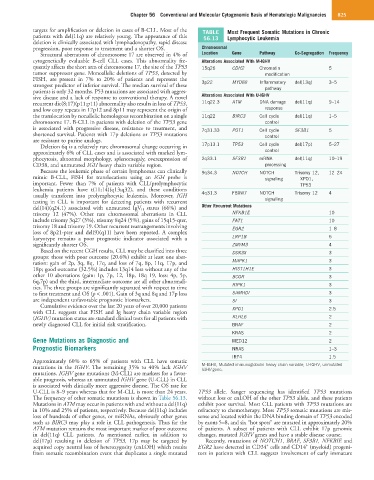
            mutations  in  the  IGHV. The  remaining  35%  to  40%  lack  IGHV   M-IGHV, Mutated immunoglobulin heavy chain variable; U-IGHV, unmutated
                                                                   IGHV gene.
            mutations. IGHV gene mutations (M-CLL) are markers for a favor-
            able prognosis, whereas an unmutated IGHV gene (U-CLL) in CLL
            is associated with clinically more aggressive disease. The OS rate for
            U-CLL is 8–9 years whereas that for M-CLL is more than 24 years.   TP53  allele.  Sanger  sequencing  has  identified  TP53  mutations
            The frequency of other somatic mutations is shown in Table 56.13.   without loss or cnLOH of the other TP53 allele, and these patients
            Mutations in ATM may occur in patients with and without a del(11q)   exhibit poor survival. Most CLL patients with TP53 mutations are
            in 10% and 25% of patients, respectively. Because del(11q) includes   refractory to chemotherapy. Most TP53 somatic mutations are mis-
            loss of hundreds of other genes, or miRNAs, obviously other genes   sense and located within the DNA binding domain of TP53 encoded
            such as BIRC3 may play a role in CLL pathogenesis. Thus far the   by exons 5–8, and six “hot spots” are mutated in approximately 20%
            ATM mutation remains the most important marker of poor outcome   of  patients.  A  subset  of  patients  with  CLL  exhibit  17p  genomic
            in  del(11q)  CLL  patients.  As  mentioned  earlier,  in  addition  to   changes, mutated IGHV genes and have a stable disease course.
            del(17p)  resulting  in  deletion  of  TP53,  17p  may  be  targeted  by   Recently, mutations of NOTCH1, BRAF, SF3B1, NFKBIE and
                                                                                                     +
                                                                                        +
            acquired copy neutral loss of heterozygosity (cnLOH) which results   EGR2 have detected in CD34  cells and CD14  (myeloid) progeni-
            from somatic recombination event that duplicates a single mutated   tors in patients with CLL suggests involvement of early immature

