


Page 943 - Hematology_ Basic Principles and Practice ( PDFDrive )
P. 943
826    Part VII  Hematologic Malignancies

                                           21
        hematopoietic cells before B-cell differentiation.  These observations
        may  indicate  that  CLL  develops  from  preleukemic  multipotent
        hematopoietic progenitors as a result of deregulation of B-cell recep-  chr.5
        tor intracellular signaling and that CLL develops from a preleukemic
        phase.                                                 chr.7

                                                              chr.18
        Genome Complexity in Chronic Lymphocytic Leukemia
                                                               chr.5
        Most patients with CLL have two chromosomal abnormalities sug-
        gesting genomic stability at the microscope level. Solid evidence exists
        that chromosomal translocations detected by conventional cytogenet-  chr.7
        ics independently predict treatment failure, treatment-free survival,
        and OS in untreated and treated patients with B-cell CLL. When   chr.22
        CLL-derived  metaphase  cells  were  obtained  following  systematic
        stimulation using B-cell mitogens and activators, balanced and unbal-  A  B
        anced  translocations  were  observed  in  34%  to  42%  of  patients,
        respectively.  Following  multivariate  analysis,  unbalanced  transloca-
        tions  have  independently  been  associated  with  risk  for  treatment
        failure. Because del(13q) usually is cryptic by conventional cytogenet-
        ics but easily detected with FISH, both conventional cytogenetics and
        interphase FISH should be performed at baseline in patients with
        advanced CLL.
           Array CGH and NGS studies have effectively clarified the level
        of genomic complexity in CLL and revealed that the average number
        of mutations in CLL cells at diagnosis of CLL lies between 10 and
        20, which is one of the lowest among the adult cancers, confirming
        previous  cytogenetic  observations. The  recent  studies  also  revealed
        that no single unifying mutation is responsible for CLL. Array-based
        genomic  profiling  has  extended  previous  cytogenetic  data  demon-
        strating that a subset of patients with CLL have complex genomic
        profiles pointing to the interplay between chromosomal abnormali-
        ties  and  somatic  mutations  that  are  associated  with  reduced  OS.
        Moreover, telomere dysfunction in CLL and acute telomere attrition
        results in fusion events that contribute to genomic complexity such
        as chromothripsis, which is a high level of DNA damage that may
        occur during a single mitotic division. In 2011, using NGS technique,
        a new phenomenon called chromothripsis (from the Greek chromos,
        meaning  “chromosomes,”  and  thripsis,  meaning  “shattering  into
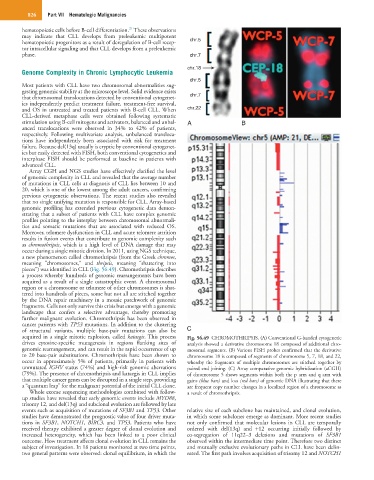
        pieces”) was identified in CLL (Fig. 56.49). Chromothripsis describes
        a process whereby hundreds of genomic rearrangements have been
        acquired as a result of a single catastrophic event. A chromosomal
        region or a chromosome or telomere of other chromosomes is shat-
        tered into hundreds of pieces, some but not all are stitched together
        by the DNA repair machinery in a mosaic patchwork of genomic
        fragments. Cells not only survive this crisis but emerge with a genomic
        landscape  that  confers  a  selective  advantage,  thereby  promoting
        further malignant evolution. Chromothripsis has been observed in
        cancer patients with TP53 mutations. In addition to the clustering
        of  structural  variants,  multiple  base-pair  mutations  can  also  be   C
        acquired in a single mitotic explosion, called kataegis. This process   Fig. 56.49  CHROMOTHRIPSIS. (A) Conventional G-banded cytogenetic
        drives  cytosine-specific  mutagenesis  in  regions  flanking  sites  of   analysis showed a derivative chromosome 18 composed of additional chro-
        genomic rearrangement, and can result in the rapid occurrence of up   mosomal segments. (B) Various FISH probes confirmed that the derivative
        to 20 base-pair substitutions. Chromothripsis have been shown to   chromosome 18 is composed of segments of chromosome 5, 7, 18, and 22,
        occur  in  approximately  5%  of  patients,  primarily  in  patients  with   whereby  the  fragments  of  multiple  chromosomes  are  stitched  together  by
        unmutated IGHV status (74%) and high-risk genomic aberrations   paired end joining. (C) Array comparative genomic hybridization (aCGH)
        (79%). The presence of chromothripsis and kataegis in CLL implies   of chromosome 5 shows segments within both the p arm and q arm with
        that multiple cancer genes can be disrupted in a single step, providing   gains (blue bars) and loss (red bars) of genomic DNA illustrating that there
        a “quantum leap” for the malignant potential of the initial CLL clone.  are frequent copy number changes in a localized region of a chromosome as
           Whole exome sequencing methodologies combined with follow-   a result of chromothripsis.
        up studies have revealed that early genomic events include MYD88,
        trisomy 12, and del(13q) and subclonal evolution are followed by late
        events such as acquisition of mutations of SF3B1 and TP53. Other   relative size of each subclone has maintained, and clonal evolution,
        studies have demonstrated the prognostic value of four driver muta-  in which some subclones emerge as dominant. More recent studies
        tions  in  SF3B1,  NOTCH1,  BIRC3,  and  TP53.  Patients  who  have   not  only  confirmed  that  molecular  lesions  in  CLL  are  temporally
        received therapy exhibited a greater degree of clonal evolution and   ordered  with  del(13q)  and  +12  occurring  initially  followed  by
        increased  heterogeneity,  which  has  been  linked  to  a  poor  clinical   co-segregation  of  11q22–3  deletions  and  mutations  of  SF3B1
        outcome. How treatment affects clonal evolution in CLL remains the   observed within the intermediate time point. Therefore two distinct
        subject of investigation. In 18 patients monitored at two time points,   and mutually exclusive evolutionary paths in CLL have been delin-
        two general patterns were observed: clonal equilibrium, in which the   eated. The first path involves acquisition of trisomy 12 and NOTCH1

